Science questions, chapter 4
Reproduction
47 marks. Use Practice to check each answer as you go, or Exam to answer everything against the clock first.
Section A: objective questions
12 marksChoose the best answer for each question.
1
Which statement describes asexual reproduction?
Show answerHide answer
C
Asexual reproduction involves one parent and no reproductive cells, so fertilisation does not occur and the offspring are identical to the parent. The other three describe sexual reproduction.
2
A swelling grows on the body of a Hydra, develops, and then breaks off as a new individual. What is this type of reproduction?
Show answerHide answer
A
Budding: a bud starts as a swelling, develops and breaks off as a new young. Hydra and yeast reproduce by budding.
3
A potato can grow into new potato plants. Which part of the plant is used in this vegetative reproduction?
Show answerHide answer
D
A potato is an underground stem. Carrot and sweet potato use roots; Bryophyllum uses leaves. Vegetative reproduction never uses the flower.
4
Where does fertilisation take place in the female reproductive system?
Show answerHide answer
B
The sperm fuses with the ovum in the Fallopian tube. The embryo later grows in the uterus.
5
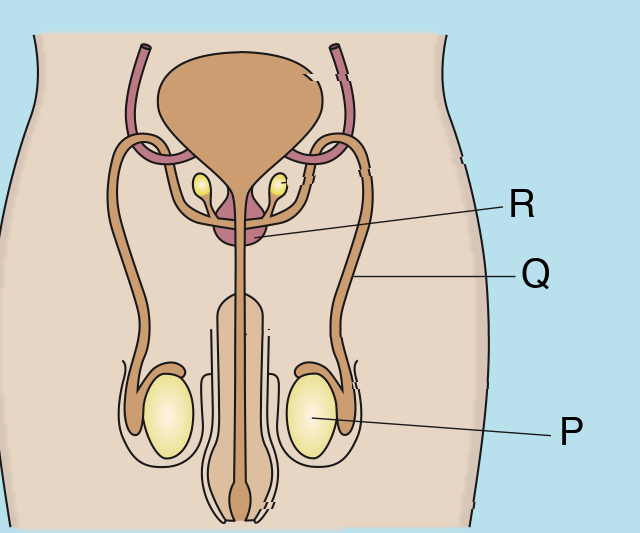
Diagram 1 shows the front view of the male reproductive system. What is the function of Q?
Show answerHide answer
A
Q is the sperm duct. P (testis) produces sperm; R (prostate gland) secretes a nutritious, protective fluid.
6
Which statement about the sperm and the ovum is correct?
Show answerHide answer
D
Both gametes have a nucleus carrying genetic information. The sperm is the smallest male cell and can swim; the ovum cannot move and usually only one is released each month.
7
Puan Lina has a regular 28-day menstrual cycle. Her menstruation starts on 8 April. On which date does ovulation most likely occur?
Show answerHide answer
B
8 April is day 1, so day 14 is 8 + 13 = 21 April. (22 April forgets that 8 April is already day 1; 12 April is day 5, the end of menstruation; 6 May is day 29, the start of the next menstruation.)
8
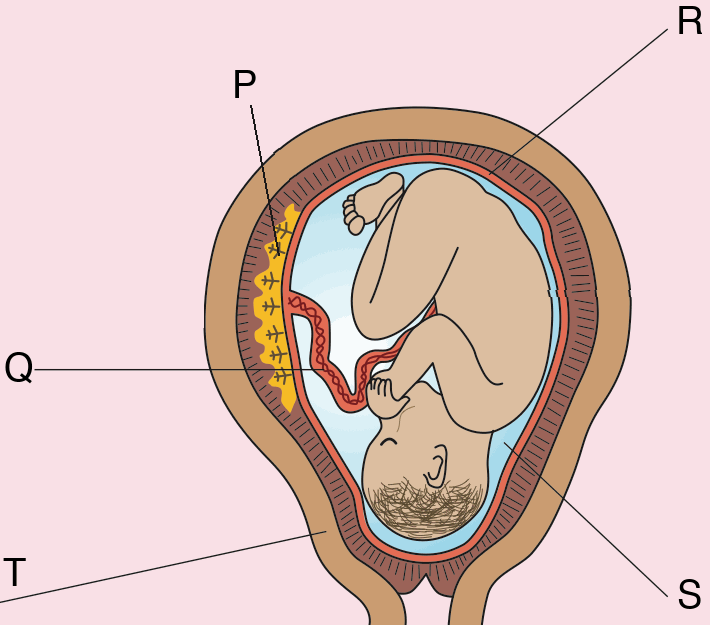
Diagram 2 shows a foetus in the uterus. What is the function of S?
Show answerHide answer
C
S is the amniotic fluid, which absorbs shocks and protects the foetus. The other options are the functions of the placenta, the umbilical cord and the uterine wall.
9
A baby is born with a small head, facial abnormalities and low birth weight (Foetal Alcohol Syndrome). What did the mother most likely take during pregnancy?
Show answerHide answer
D
Foetal Alcohol Syndrome is caused by drinking alcohol during pregnancy. The other three are healthy foods for a pregnant woman.
10
How does an intrauterine contraceptive device (IUCD) prevent pregnancy?
Show answerHide answer
A
The IUCD is placed in the uterus to prevent implantation. Pills prevent ovulation, a condom blocks sperm, and ligation cuts and ties the Fallopian tubes.
11
A flower has small pale petals, no smell, a long furry stigma, and produces a lot of small, smooth and light pollen grains. Which statement about this flower is correct?
Show answerHide answer
B
These are features of wind-pollinated flowers: light pollen is blown by the wind and the long furry stigma traps it. Insect-pollinated flowers are big, colourful, scented and have nectar.
12
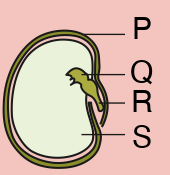
Diagram 3 shows a longitudinal section of a green bean seed. What does part R develop into during germination?
Show answerHide answer
C
R is the radicle, which grows into the root. Q (plumule) becomes the shoot, P is the testa, and S (cotyledon) stores food.
Section B: structured questions
35 marksAnswer all questions. Write your answers in the spaces provided.
13
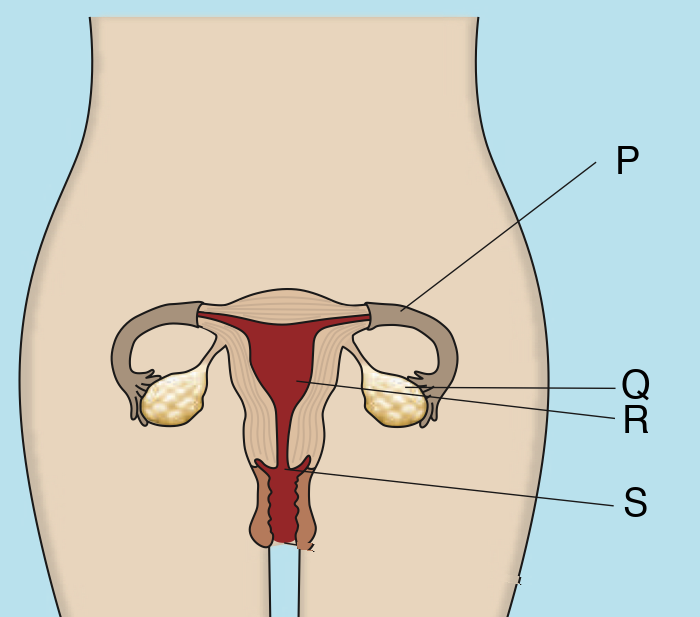
Diagram 4 shows the front view of the female reproductive system.
[2 marks]
(a)Name parts P and Q.
Show answerHide answer
- P: Fallopian tube1
- Q: ovary1
Tick each point you got.
[1 mark]
(b)What is the function of R?
Show answerHide answer
Place where the embryo grows and develops
R is the uterus (womb). The ovary produces ova; the cervix (S) produces mucus.
14
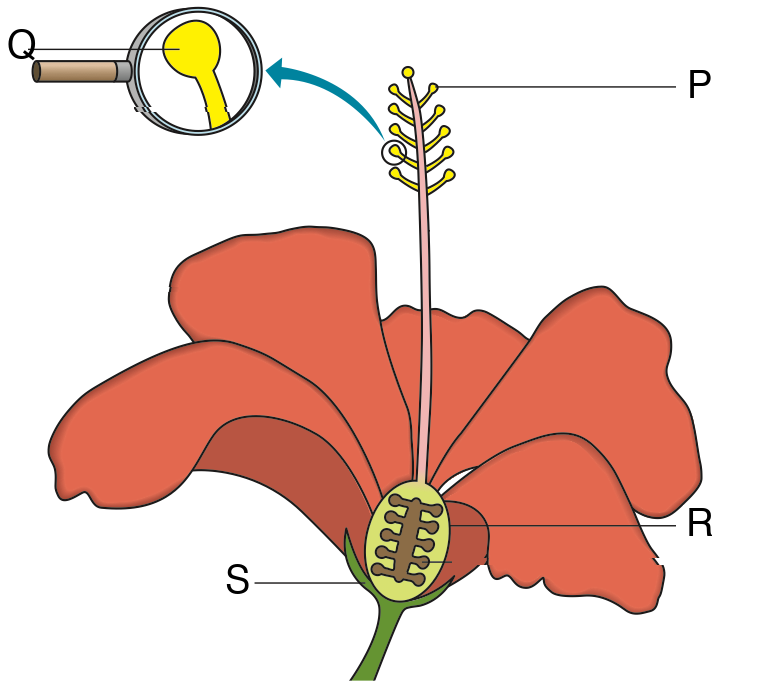
Diagram 5 shows a longitudinal section of a flower.
[1 mark]
(a)Which labelled part is part of the male reproductive organ (stamen)?
Show answerHide answer
Q
Q is the anther, which produces pollen grains. P (stigma) and R (ovary) belong to the pistil; S is the sepal.
[2 marks]
(b)Name part R and state what it becomes after fertilisation.
Show answerHide answer
- R is the ovary1
- It becomes the fruit1
Tick each point you got.
[1 mark]
(c)State the function of P.
Show answerHide answer
- P (stigma) receives / traps pollen grains (it is sticky)1
Tick each point you got.
15
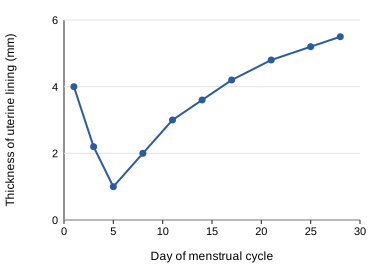
Diagram 6 shows the thickness of a woman's uterine lining during one 28-day menstrual cycle.
[1 mark]
(a)On which day is the uterine lining thinnest?
Show answerHide answer
- Day 51
Tick each point you got.
[2 marks]
(b)Name the phase from day 1 to day 5 and explain why the lining becomes thinner.
Show answerHide answer
- Menstruation phase1
- The uterine lining breaks down and flows out with blood (and the unfertilised ovum and mucus)1
Tick each point you got.
[1 mark]
(c)On which day does ovulation usually occur?
Show answerHide answer
Day 14
[2 marks]
(d)The woman has sexual intercourse with her husband on day 13. Is it possible for her to become pregnant? Explain.
Show answerHide answer
- Yes, because day 13 is in the fertile phase (day 12–17)1
- Ovulation is on day 14 and sperm can live 3–4 days, so live sperm are present to fertilise the ovum when it is released1
Tick each point you got.
16
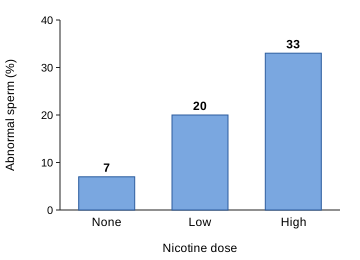
Researchers divided 60 rats into three groups of 20. For 30 days, one group was given no nicotine, one a low dose and one a high dose every day. Diagram 7 shows the percentage of abnormal sperm produced.
[1 mark]
(a)State the manipulated variable.
Show answerHide answer
- Dose of nicotine1
Tick each point you got.
[1 mark]
(b)State one variable that must be kept constant.
Show answerHide answer
Any 1 points
- Number of rats in each group (20)1
- Duration of the experiment (30 days)1
- Type / age of rats1
Tick each point you got.
[1 mark]
(c)How many percentage points higher is the abnormal sperm in the high-dose group than in the group given no nicotine?
Show answerHide answer
- 33 − 7 = 26 (percentage points)1
Tick each point you got.
[1 mark]
(d)State the conclusion of this experiment.
Show answerHide answer
- The higher the dose of nicotine, the higher the percentage of abnormal sperm1
Tick each point you got.
[1 mark]
(e)Why was one group of rats not given any nicotine?
Show answerHide answer
- As a control, to compare with the groups given nicotine1
Tick each point you got.
17
Diagram 8 shows a foetus developing in the uterus.
[2 marks]
(a)Name P and Q.
Show answerHide answer
- P: placenta1
- Q: umbilical cord1
Tick each point you got.
[2 marks]
(b)Explain how the foetus obtains oxygen and food.
Show answerHide answer
- Oxygen and nutrients pass from the mother's blood to the foetus's blood through the placenta (P)1
- They are carried to the foetus by blood vessels in the umbilical cord (Q)1
Tick each point you got.
[1 mark]
(c)Which substance passes from the foetus to the mother's blood?
Show answerHide answer
Carbon dioxide
Waste such as carbon dioxide passes from the foetus to the mother's blood to be removed.
18
Encik Ahmad and his wife have been married for 12 years but still have no child. Tests show that Encik Ahmad's sperm are normal, but both of his wife's Fallopian tubes are blocked.
[1 mark]
(a)Explain why the wife cannot become pregnant.
Show answerHide answer
- The sperm cannot reach / meet the ovum in the Fallopian tube, so fertilisation cannot occur1
Tick each point you got.
[2 marks]
(b)A friend suggests hormone treatment. Another suggests in vitro fertilisation (IVF). Which method is more suitable for this couple? Justify your choice.
Show answerHide answer
Any 2 points
- IVF is more suitable1
- The ovum is fertilised outside the body (in a glass dish), so the blocked tubes are bypassed; the embryo is placed in the uterus1
- Hormone treatment only helps a hormone imbalance, which is not the problem here1
Tick each point you got.
[2 marks]
(c)"Infertility only happens to women." Do you agree? Give a reason.
Show answerHide answer
- Disagree1
- Men can also be sterile, e.g. testes cannot produce sperm / low sperm count / low-quality sperm / blocked sperm duct / impotence1
Tick each point you got.
19
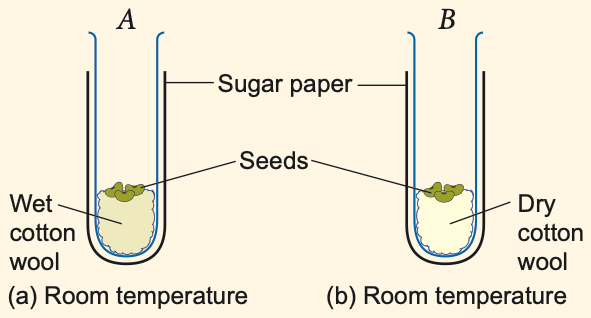
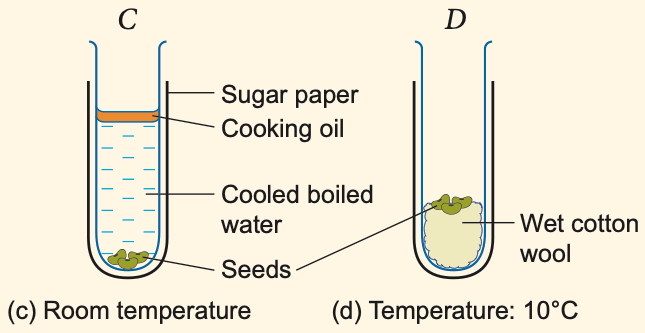
Diagram 9 shows Experiment 4.1 on the conditions needed for germination. The tubes were left for five days.
[1 mark]
(a)In which tube do the seeds germinate?
Show answerHide answer
A
Only tube A has water, air and a suitable temperature.
[1 mark]
(b)Explain why the water in tube C is boiled and covered with a layer of cooking oil.
Show answerHide answer
- Boiling removes dissolved air and the oil stops air dissolving back, so the seeds get no air (oxygen)1
Tick each point you got.
[2 marks]
(c)Pak Din's green bean seeds did not germinate after he sowed them in a waterlogged plot in a cold, shaded highland area. Plan two changes he should make so the seeds germinate, and explain each.
Show answerHide answer
Any 2 points
- Drain the plot / use loose, moist (not flooded) soil so the seeds get air (oxygen)1
- Sow in a warmer place / suitable season or cover the soil to keep it warm, so the temperature is suitable1
- Water the seeds regularly but not too much, so they have water without being waterlogged1
Tick each point you got.
20
Choose the type of asexual reproduction for each organism.
[1 mark]
(a)Amoeba divides into two daughter cells.
Show answerHide answer
Binary fission
[1 mark]
(b)A piece cut from a Planaria grows into a complete new worm.
Show answerHide answer
Regeneration
[1 mark]
(c)A fern releases tiny, light spores from its sporangia.
Show answerHide answer
Spore formation