Matter
By the end of this chapter you can
- Show that living and non-living things are matter, tell physical and chemical properties apart, and classify materials by density, melting point, boiling point and solubility (5.1)
- Use the kinetic theory to compare solids, liquids and gases, compare diffusion rates, and explain changes of state, constant temperature and constant mass (5.2)
5.1Matter in Nature
All living things (humans, animals, plants) and non-living things (water, soil, rocks, air) are matter. Things such as light, heat, sound and feelings have no mass and take up no space, so they are not matter.
Proving that things have mass and occupy space
- Soil, water and bean sprouts: put each one into a beaker. It fills part of the beaker (occupies space), and the lever balance reading goes up (has mass). So soil (non-living), water (non-living) and bean sprouts (living) are all matter.
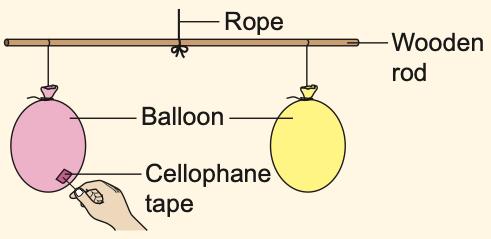
- Air: two blown-up balloons are balanced on a wooden rod. When one balloon is pricked through a piece of cellophane tape, its air escapes and the rod tilts down on the side of the balloon that is still full. The air had mass. The balloons grew bigger when blown up, so air also occupies space.
Physical and chemical properties
Chemical properties show up only when a substance changes into a new substance with a different composition. They depend on the reaction that happens.
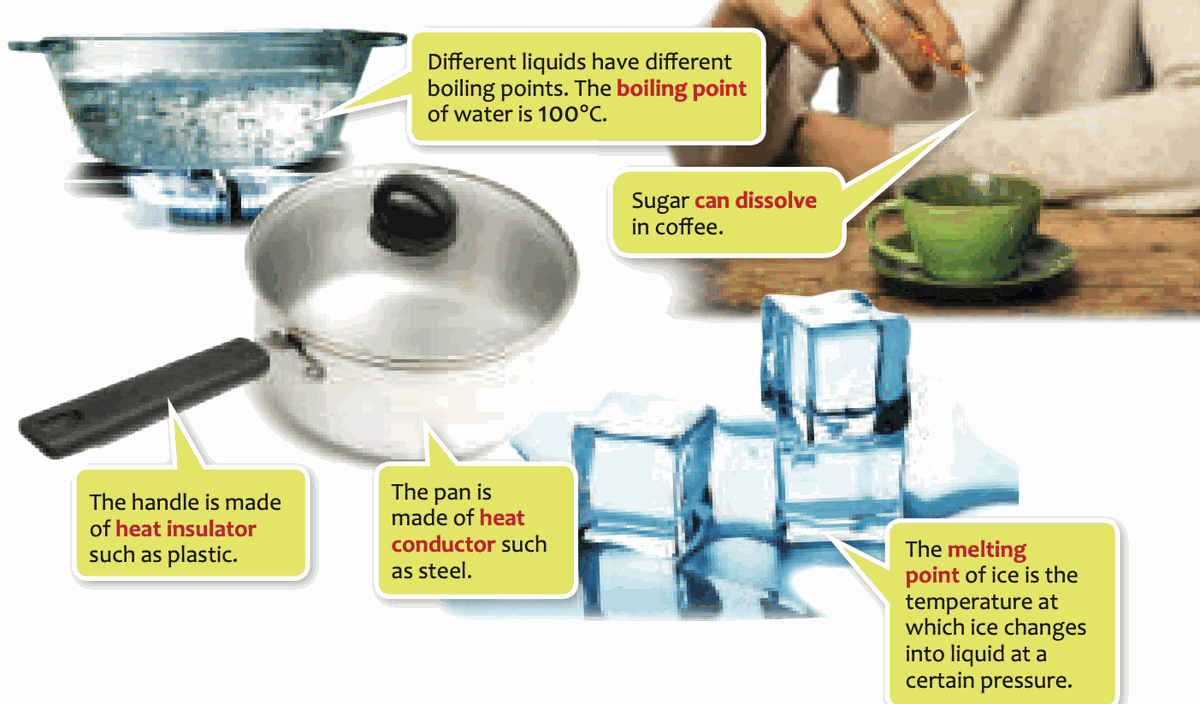
| Physical properties | Chemical properties |
|---|---|
| Boiling point — water boils at 100 °C | Rusting — iron rusts when exposed to water and air |
| Melting point — ice melts at 0 °C | Flammability — petrol catches fire easily; paper burns when lit |
| Solubility — sugar dissolves in coffee | |
| Heat conductivity — a steel pan is a heat conductor; its plastic handle is a heat insulator | |
| Density, colour, shape, hardness |
Show answerHide answer
Classifying materials by their characteristics
Materials can be classified by four characteristics: density, melting point, boiling point and solubility. For example, salt is obtained from seawater because water has a much lower boiling point than salt: the water evaporates and salt crystals are left behind.
Density
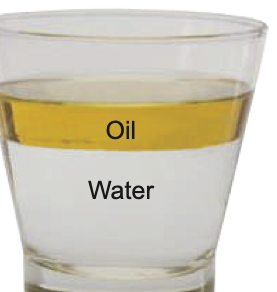
Density is the mass per unit volume of a material. A material with a lower density floats; a material with a higher density sinks. Oil floats on water because oil is less dense.
| Mixture | Higher density (sinks) | Lower density (floats) |
|---|---|---|
| Glycerol and water | Glycerol | Water |
| Petrol and mercury | Mercury | Petrol |
| Sand and water | Sand | Water |
| Oil and cork | Oil | Cork |
Melting point and boiling point
Boiling point — the temperature at which a substance changes from liquid to gas.
| Substance | Melting point (°C) | Boiling point (°C) | State at room temperature (about 30 °C) |
|---|---|---|---|
| Water | 0 | 100 | Liquid |
| Alcohol | −117 | 78 | Liquid |
| Copper | 1085 | 2562 | Solid |
| Oxygen | −218 | −183 | Gas |
Melting and boiling points: textbook Table 5.2, p. 143. Iron melts at 1536 °C.
Solubility
When you stir sugar into coffee, sugar is the solute, coffee is the solvent and sweet coffee is the solution. Salt and sugar are soluble in water; sand, cooking oil and a glass marble are not.
Show answerHide answer
5.2Three States of Matter
Matter is made up of tiny, discrete (separate) particles. They are too small to see with the naked eye or even a light microscope; they can only be seen with an electron microscope.
Conclusion: the crystal is made of many tiny separate particles that spread out between the water particles.
Solid, liquid and gas
Matter exists in three states: solid (a ceramic cup), liquid (honey) and gas (vapour from hot tea). Water is the only substance that exists naturally in all three states: ice (solid), water (liquid) and steam (gas).
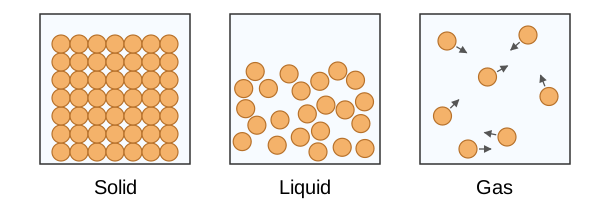
| Solid | Liquid | Gas | |
|---|---|---|---|
| Space between particles | Small | Moderate | Large |
| Arrangement | Very close, in an orderly pattern | Close, not orderly | Very loose, far apart |
| Movement | Vibrate in fixed positions | Move freely and collide with one another | Move randomly and quickly, colliding with one another |
| Shape | Fixed shape | Takes the shape of the container | Takes the shape of the container |
| Volume | Fixed volume | Fixed volume | Fills the whole container |
| Compressibility | Cannot be compressed | Difficult to compress | Easy to compress |
Based on textbook Table 5.3 and Figure 5.8, p. 147.
Wood and iron are used to build bridges because their particles are compactly arranged, giving a fixed shape. A gas can be squeezed into a gas cylinder because there are large spaces between its particles.
Did you know? The Sun is neither a solid nor a gas. It is in a fourth state called plasma.
Diffusion
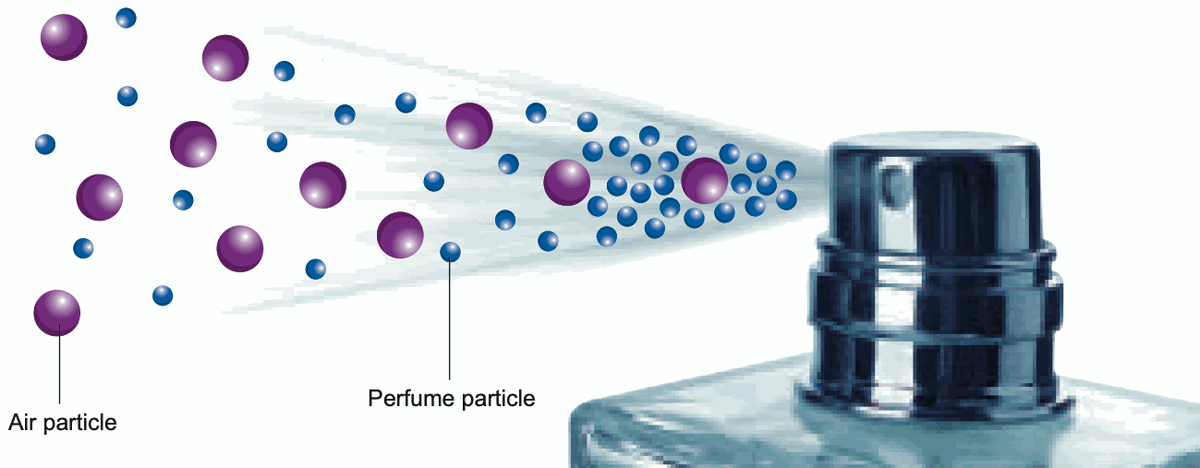
Bees use diffusion too: the first bee to attack releases a chemical whose smell diffuses through the air, alerting the swarm from all directions. The smell of cooking spreads through the house in the same way.
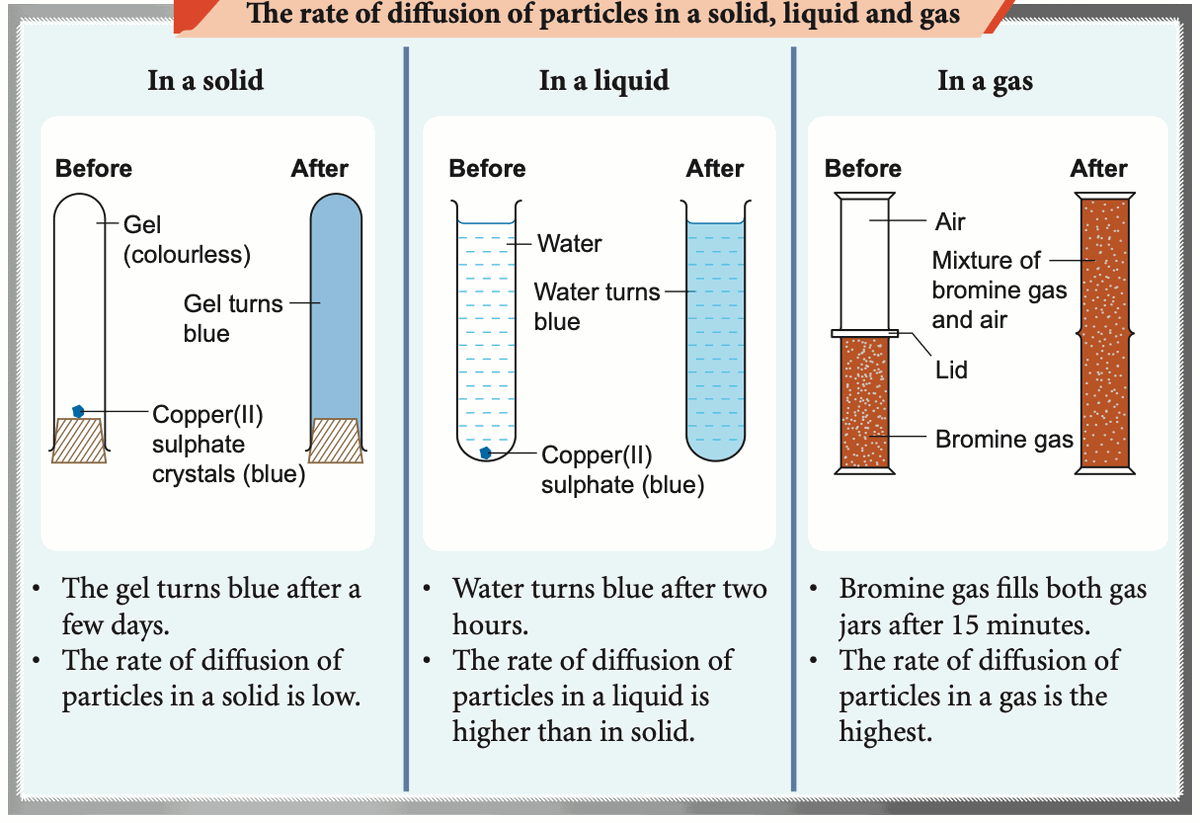
| Medium | Observation | Rate of diffusion |
|---|---|---|
| Solid (gel) | Gel turns blue after a few days | Lowest |
| Liquid (water) | Water turns blue after about two hours | Higher than in a solid |
| Gas (air) | Brown bromine gas fills both gas jars after 15 minutes | Highest |
The rate is highest in a gas because the particles are far apart and move fastest and most freely. In a solid the particles are packed closely and only vibrate.
Manipulated: diffusion medium (gel or water). Responding: rate of diffusion. Constant: temperature.
Changes in the state of matter
Matter changes state when it absorbs or releases heat. Heat changes the kinetic energy of the particles: absorbing heat makes them move faster, releasing heat makes them move slower.
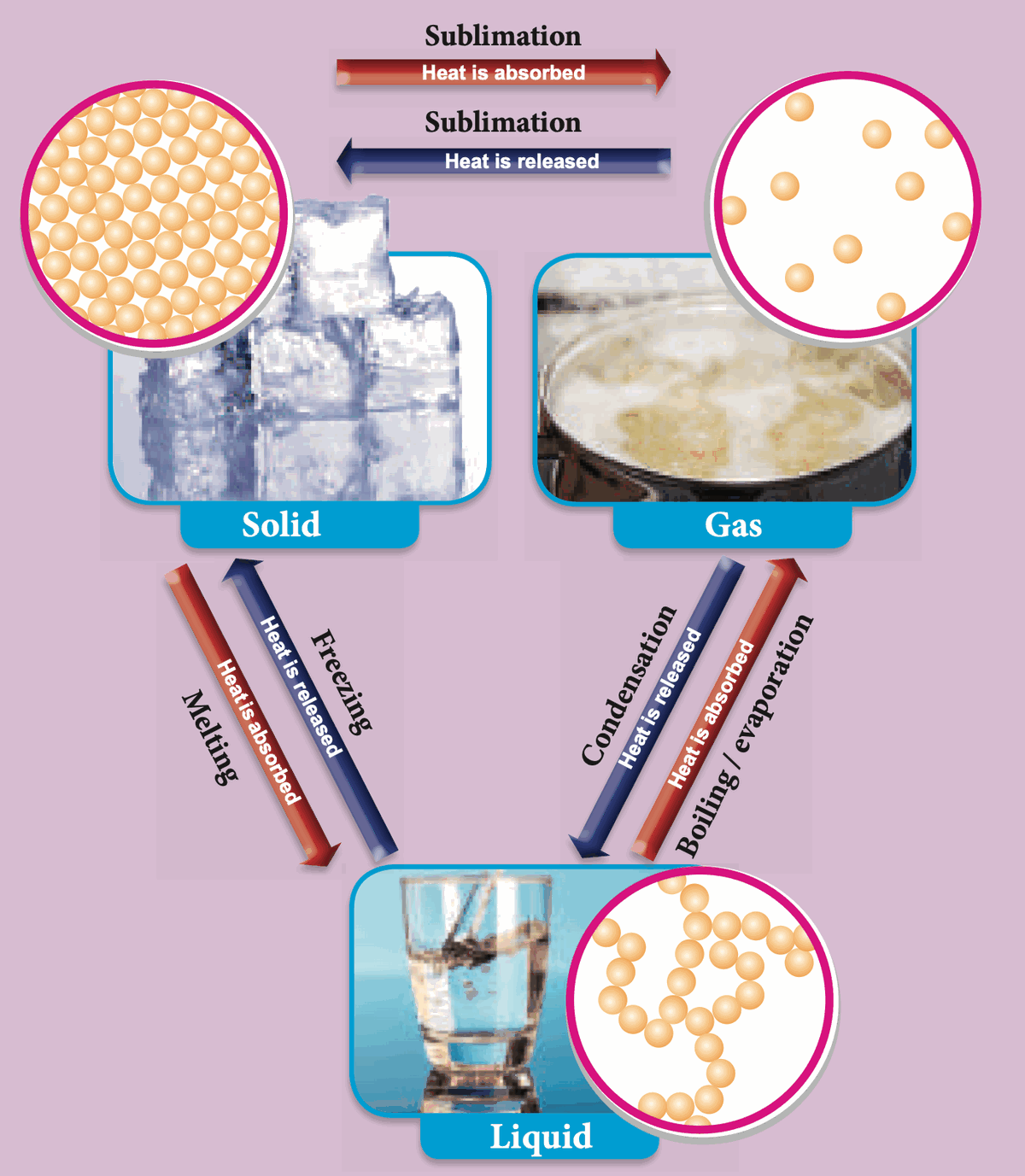
| Process | Change | Heat | What the particles do |
|---|---|---|---|
| Melting | Solid → liquid | Absorbed | Gain energy and vibrate faster, overcome the force of attraction and start to move freely at the melting point |
| Boiling | Liquid → gas | Absorbed | Gain energy and move faster; at the boiling point they break free and move randomly. Happens only at the boiling point, throughout the liquid |
| Evaporation | Liquid → gas | Absorbed (from surroundings) | Particles at the surface escape slowly. Happens at any temperature |
| Condensation | Gas → liquid | Released | Lose energy, move slower and closer together |
| Freezing | Liquid → solid | Released | Lose energy, move slower, and vibrate in fixed positions at the freezing point |
| Sublimation | Solid → gas, or gas → solid (directly) | Absorbed (solid → gas) / released (gas → solid) | Skip the liquid state |
Temperature and mass during a change of state
When water is heated, its temperature rises until it reaches 100 °C. Then it stays at 100 °C while the water boils, even though heating continues. The same happens at the melting point and the freezing point.
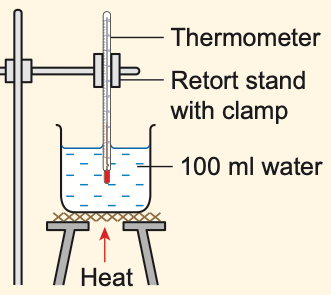
Why? The heat absorbed is used to overcome the force of attraction between the particles, not to raise the temperature. (When freezing, heat is released as the attractions form.)
Mass stays constant during physical changes. A beaker of ice has the same mass after the ice melts; a beaker of water has the same mass after salt dissolves in it; a metal ball has the same mass before and after it is heated and expands. The number of particles does not change — only their kinetic energy changes.
Mass of ice = 173 − 125 = 48 g = mass of water formed.
Changes of state in daily life
| Example | Process |
|---|---|
| Wet clothes dry on a clothes line | Evaporation |
| Sweet cream becomes ice cream in a freezer | Freezing |
| Dry ice keeps ice cream cold; it turns straight into gas | Sublimation |
| Moth balls in a cupboard become smaller | Sublimation |
| Dew forms on leaves in the early morning | Condensation |
| Ice cubes in a drink turn to water | Melting |
| The surface of a lake freezes in winter (below 0 °C) | Freezing |
Show answerHide answer
Summary
| Remember | Key fact |
|---|---|
| Matter | Has mass and occupies space; living and non-living things are matter |
| Physical vs chemical property | Physical: seen or measured, no new substance (melting point, boiling point, solubility, density, heat conductivity). Chemical: new substance forms (rusting, flammability) |
| Density | Lower density floats; higher density sinks |
| Kinetic theory | Matter is made of tiny discrete particles that are always moving and colliding |
| Particles | Solid: very close, vibrate. Liquid: close, move freely. Gas: far apart, move randomly |
| Diffusion rate | Gas > liquid > solid |
| Heat absorbed | Melting, boiling, evaporation, sublimation (solid → gas) |
| Heat released | Freezing, condensation, sublimation (gas → solid) |
| During melting, freezing and boiling | Temperature stays constant; mass stays constant during all physical changes |