Grammar: present perfect, past simple and the tense review
What this chapter covers
- I can form the present perfect (have / has + past participle) in positive, negative and question forms, and give short answers (2.1, 2.3)
- I can write the past participle of regular verbs and of the common irregular verbs on the textbook list (2.2)
- I can use ever, never, just, already and yet with the present perfect, and tell been from gone (2.3)
- I can choose for or since, and ask and answer How long ...? questions (2.4)
- I can choose between the present perfect and the past simple, and I know that a finished past time (yesterday, last year, in 2022) needs the past simple (2.5)
- I can use time expressions to choose the right tense in a text and correct underlined tense errors, as in UASA Paper 1 Part 2 (2.6)
You already know the present and past tenses. In Form 2 the key new tense is the present perfect, which joins the past to now. It is easy to confuse with the past simple, and the UASA tests this often. In the UASA Paper 1 Part 2, the underlined errors are often this pair ("She has visited Penang last year" should be visited; "I have live here since 2020" should be lived). This unit covers the present perfect, for and since, the choice between present perfect and past simple, and a review of all the tenses.
| Tense | Form | Use it for | Example |
|---|---|---|---|
| Present simple | walk / walks | habits, routines, facts | Hana walks to school. |
| Present continuous | am / is / are + -ing | happening now | Hana is walking now. |
| Past simple | walked; went | finished action at a past time | Hana walked to school yesterday. |
| Past continuous | was / were + -ing | action in progress in the past | Hana was walking when it rained. |
| Present perfect | have / has + past participle | past action linked to now, no exact time | Hana has walked 5 km today. |
2.1Present perfect: positive and negative
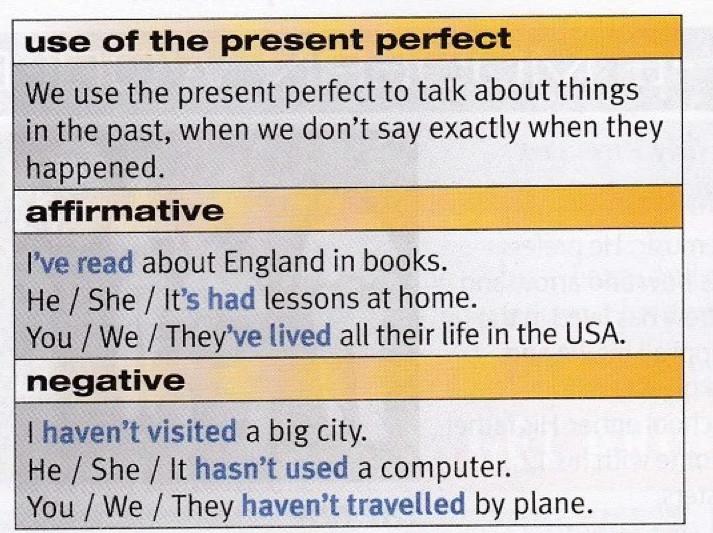
Textbook figure: Pulse 2 Student's Book, p.76.
Use the present perfect to talk about things in the past when we do not say exactly when they happened, or when the past action matters now.
| Subject | Positive | Negative |
|---|---|---|
| I, you, we, they | I have ('ve) read about England. | I have not (haven't) visited a big city. |
| he, she, it | He has ('s) had lessons at home. | He has not (hasn't) used a computer. |
"My parents
"He
"She
"I
Show answerHide answer
2.2Past participles: regular and irregular
For regular verbs, the past participle is the same as the past simple: add -ed. Spelling follows the same rules as the past simple.
| Rule | Examples |
|---|---|
| most verbs: add -ed | walk → walked, jump → jumped, visit → visited |
| ends in -e: add -d | live → lived, arrive → arrived |
| consonant + y: y becomes -ied | study → studied, carry → carried |
| short verb, one vowel + one consonant: double it | stop → stopped, plan → planned |
| British spelling: double l after one vowel | travel → travelled, cancel → cancelled |
Irregular verbs must be learned. The textbook list (p.111) is in alphabetical order, but verbs are easier to learn in groups. The Study guide (p.83) separates verbs whose past participle is the same as the past simple from verbs where it is different.
| Group | Pattern | Verbs (infinitive, past simple, past participle) |
|---|---|---|
| All three the same | all three forms match | put, put, put · read /ri:d/, read /red/, read /red/ (spelling the same, sound changes) |
| Past simple = past participle | past simple and past participle match | bring, brought, brought · buy, bought, bought · build, built, built · find, found, found · get, got, got · have, had, had · hear, heard, heard · leave, left, left · lose, lost, lost · make, made, made · meet, met, met · pay, paid, paid · say, said, said · sell, sold, sold · sit, sat, sat · teach, taught, taught · tell, told, told · think, thought, thought · win, won, won |
| All three different | all three forms differ | be, was / were, been · begin, began, begun · break, broke, broken · choose, chose, chosen · do, did, done · drink, drank, drunk · drive, drove, driven · eat, ate, eaten · fall, fell, fallen · fly, flew, flown · forget, forgot, forgotten · give, gave, given · go, went, gone · know, knew, known · ride, rode, ridden · see, saw, seen · sing, sang, sung · speak, spoke, spoken · take, took, taken · wear, wore, worn · write, wrote, written |
| Infinitive = past participle | The infinitive and the participle match; the past simple is different | come, came, come · run, ran, run |
Verb forms: Pulse 2 Student's Book, p.111 (Irregular verbs) and the Study guide spelling rules, p.83 (add -ed; irregular verbs). The doubling, -y and double l patterns are the same as for the past simple in Form 1.
"I have
"She has
"She has
Show answerHide answer
2.3Questions, short answers, and ever, never, just, already, yet
For a question, put Have / Has before the subject. The short answer repeats have / has; it does not repeat the main verb.
| Subject | Question | Short answers |
|---|---|---|
| I, you, we, they | Have you been to the USA? | Yes, I have. / No, I haven't. |
| he, she, it | Has Route 66 become famous? | Yes, it has. / No, it hasn't. |
Time words
| Word | Meaning | Where it goes | Example |
|---|---|---|---|
| ever | at any time in your life | questions, before the participle | Have you ever driven a car? |
| never | not at any time | before the participle (no "not") | I have never driven a car. |
| just | a very short time ago | between have / has and the participle | They have just left. |
| already | sooner than expected | between have / has and the participle | She has already finished. |
| yet | up to now (negatives and questions) | end of the sentence | He hasn't called yet. |
Other present perfect clues: so far, recently, before (= at any time before now), this week / this year (not finished yet).
Been or gone?
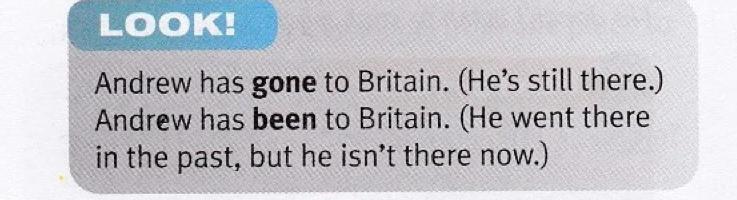
Textbook figure: Pulse 2 Student's Book, p.76 (LOOK! box).
I haven't been to Paris, but I'd love to go! (I have never visited)
Scott hasn't been to school yet. (he is still here; he has not gone to school)
Show answerHide answer
2.4For, since and How long ...?
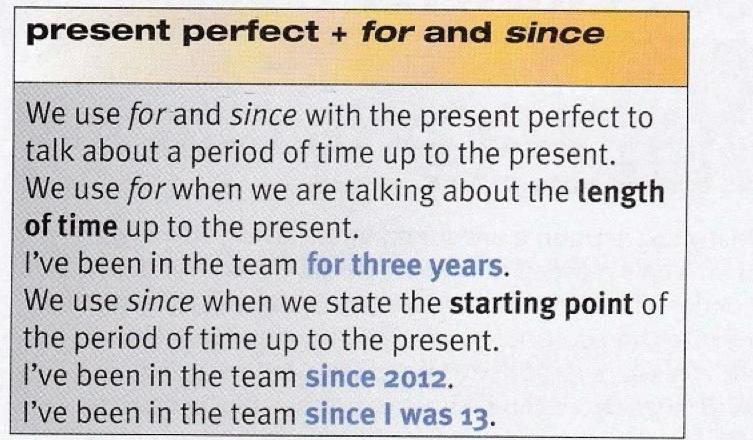
Textbook figure: Pulse 2 Student's Book, p.86.
Use for and since with the present perfect to talk about a period of time up to the present. The action began in the past and is still true now.
| for | since | |
|---|---|---|
| Tells you | the length of time | the starting point |
| Followed by | a period: two hours, five minutes, a few days, many years, a long time | a point: yesterday, last week, 10th June, 1995, my birthday, she was a student |
| Example | I've been in the team for three years. | I've been in the team since 2012. / since I was 13. |
How long ...?
Ask How long + have / has + subject + past participle. Answer with for or since.
She's been a swimming teacher for ten years. / since she was 18.
"I
"She has lived here
"How long
Show answerHide answer
2.5Present perfect or past simple?
| Present perfect | Past simple |
|---|---|
| an action in the past, but we do not say when it happened | a completed action at a finished past time |
| an action that began in the past and continues now | a state or repeated action in the past |
| a recent action (often with just) | — |
Rules summarised from Pulse 2 Student's Book, pp.89 and 93.
In the past, everyone believed in fairies. (finished past)
Look! I've found a four-leaf clover! (recent, no time)
Jo gave me this charm yesterday. (finished time: past simple)
We have been in Ireland since Saturday. (still there)
Yesterday morning we went to Blarney Castle. (finished time)
| If the sentence has ... | Use |
|---|---|
| yesterday, last night / week / year, in 2023, two days ago, when I was ten, a date | past simple |
| ever, never, just, already, yet, so far, recently, for / since (a period up to now) | present perfect |
| no time word, and the result matters now ("Somebody has broken the mirror!") | present perfect |
"I
"Have you
"Did you
"When
Show answerHide answer
2.6Tense review and correcting errors (UASA Paper 1 Part 2)
Time words are your best clue. Find them first.
| Time expressions | Tense |
|---|---|
| always, usually, often, sometimes, every day, on Fridays | present simple |
| now, at the moment, Look!, Listen! | present continuous |
| yesterday, last week, ... ago, in 2023, when I was nine | past simple |
| while, when (+ short action), at 8 p.m. yesterday | past continuous |
| ever, never, just, already, yet, so far, for, since | present perfect |
Method for an underlined error
- Read the whole text and decide its main time.
- Find the subject: one (he, she, it) or more than one (they)?
- Look for a time word in the same sentence: a finished time, or for / since / ever / yet?
- Choose the tense, then the form: -s, -ed, irregular past, have / has + past participle.
- Write one word, spelled correctly, and read the sentence again.
0 went (example)
| No. | Thinking | Answer |
|---|---|---|
| (1) | subject we; "since Form 1" means up to now: present perfect with have | have |
| (2) | "at 8 a.m." on a finished trip: past simple | left |
| (3) | the story is about last month: past simple of see | saw |
| (4) | has never + past participle | seen |
Show answerHide answer
Summary
- Present perfect = have / has + past participle. Negative: haven't / hasn't. Question: Have / Has + subject. Short answer: Yes, I have. / No, he hasn't.
- Regular past participle = past simple (-ed). Irregular verbs: learn them in groups (past simple = past participle, or all three different). Do not use the past simple after have / has.
- ever (questions), never (no "not"), just, already (before the participle), yet (end of negatives and questions).
- has gone = still there. has been = went and came back.
- for + length (three years). since + starting point (2012, last week, I was 13). How long ...? + have / has.
- Finished past time (yesterday, last year, in 2022, ... ago, when) = past simple. Never present perfect.
- In Part 2: main time, subject, time word, tense and form, write one word.