Grammar: nouns, pronouns, articles and quantifiers
What this chapter covers
- I can tell countable, uncountable and collective nouns apart and use units such as a litre of, a kilo of and a piece of (pp.67, 98)
- I can spell and use irregular plurals, and choose the right verb after a collective or uncountable noun
- I can choose a, an, the or no article, including with superlatives and the same-one-again rule (p.98)
- I can use subject and object pronouns, possessive adjectives and pronouns, reflexive pronouns and each other, and say what a pronoun refers to (p.70)
- I can use quantifiers (a lot of, several, enough, too much, too many, a few, a little, few, little) with the right noun (pp.67, 98)
- I can use relative pronouns who, which and that to join two sentences (p.99)
- I can find and correct noun, article, pronoun and quantifier errors in a UASA Paper 1 Part 2 text
Nouns, pronouns, articles and quantifiers are the small words that hold English sentences together. They make up most of the errors in Paper 1 Part 2, and the textbook practises them in context: the Unit 6 maths problems about money and kilos (p.67), the pronoun work in Paul's letter (p.70) and the Unit 9 Outback survival guide (p.98). This unit goes one step further than Tingkatan 1: collective nouns, the with superlatives, reflexive pronouns, relative pronouns and the quantifiers several, enough, too much and too many.
3.1Nouns: countable, uncountable and collective
The Outback guide says "take enough water with you" and "several litres of water a day". Water cannot be counted, so the unit (litre) is what becomes plural. The same pattern appears in the maths problems on p.67: half a kilo of bananas, a kilo of apples.
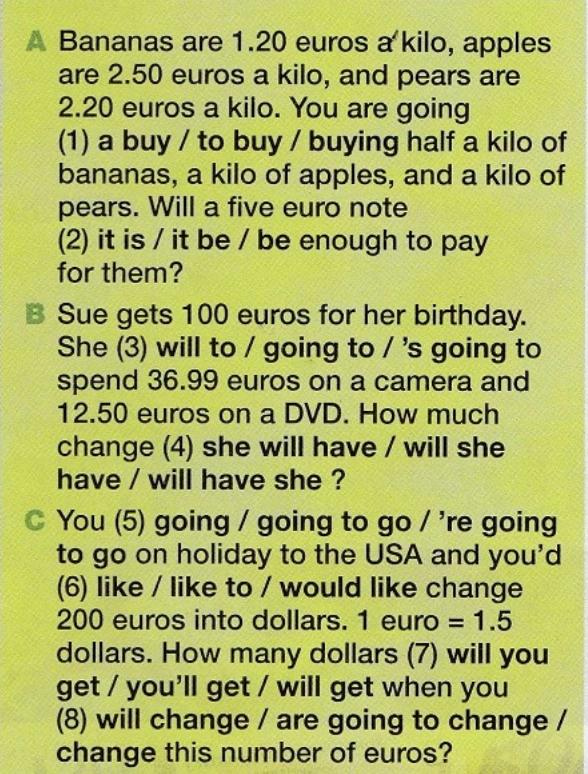
Pulse 2 Student's Book, p.67 (Grammar in context: Maths).
| Pattern | Examples | Verb |
|---|---|---|
| Uncountable | The water is warm. This advice is useful. The equipment was heavy. | singular |
| Unit + of + uncountable | two litres of water, a kilo of pears, a piece of advice, a loaf of bread | follows the unit: Two litres are enough. |
| Collective noun (one group) | My family is going on holiday. The team has won. | singular when it acts as one unit |
| Plural-only nouns | The police are here. My trousers are new. Scissors, glasses, people. | plural |
Subjects such as mathematics, physics and news take a singular verb: Mathematics is my favourite subject.
Irregular plurals
| Singular | Plural | Note |
|---|---|---|
| child, person, man, woman | children, people, men, women | already plural: no -s |
| foot, tooth, goose, mouse | feet, teeth, geese, mice | |
| crisis, analysis, bacterium, criterion | crises, analyses, bacteria, criteria | from Latin and Greek; common in science texts |
| sheep, fish, series, species | sheep, fish, series, species | same form |
Show answerHide answer
3.2Articles: a, an, the and no article
| Use | Rule | Examples |
|---|---|---|
| a / an | one of many, or the first mention; a before a consonant sound, an before a vowel sound | a detailed map, an up-to-date map, an hour, a university, an MRT station |
| the | both speaker and listener know which one; only one exists; with superlatives; with the + adjective for a group; rivers, oceans, deserts, mountain ranges and plural country names | the sun, the hottest part of the day, the biggest danger, the Outback, the poor, the Pacific, the Philippines |
| no article | plural or uncountable nouns in general; most countries and cities; languages; meals; sports; school subjects; by + transport | Crocodiles are dangerous. Water is vital. I study Science. We went by bus. |
You will need a hat and a GPS receiver. The hat protects you from sunburn. (first mention a, then the)
Compare: The school is near my house (the building) with She is at school (as a student).
Show answerHide answer
3.3Pronouns
Pronouns replace nouns so that we do not repeat them. In the Writing focus on p.70 the textbook gives the subject and object sets, with the example Molly hates shopping. She prefers playing computer games.
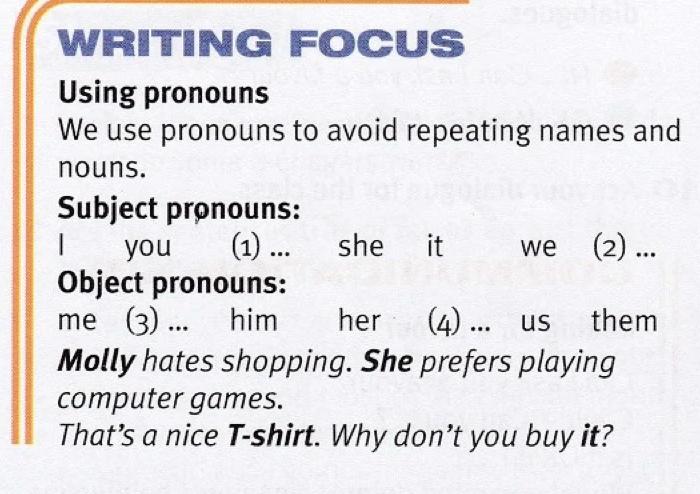
Pulse 2 Student's Book, p.70 (Writing focus). Missing words in the box: he, they, you, it.
| Subject | Object | Possessive adjective | Possessive pronoun | Reflexive |
|---|---|---|---|---|
| I | me | my | mine | myself |
| you | you | your | yours | yourself / yourselves |
| he / she / it | him / her / it | his / her / its | his / hers / – | himself / herself / itself |
| we | us | our | ours | ourselves |
| they | them | their | theirs | themselves |
Finding what a pronoun refers to
In Paul's letter, "I'm wearing them right now" refers back to my new trainers, and "he isn't very good at it" refers to bowling. To find a referent, look backwards for the nearest noun that matches in number (one or many), gender (he / she / it) and meaning.
Do not add a reflexive after verbs such as feel, relax, hurry, concentrate in English:
each other is for two or more people doing the same thing to one another: They helped each other. (not
Relative pronouns
| Word | Refers to | Example |
|---|---|---|
| who | people | The guide who helped us was very kind. |
| which | things and animals | Tarantulas are spiders which live in hot places. |
| that | people or things | The map that shows water is the best one. |
| whose | belonging to | That is the boy whose bag was lost. |
Show answerHide answer
3.4Quantifiers
A quantifier tells us how much or how many. Match it to the kind of noun.
| Quantifier | With countable (plural) | With uncountable | Meaning |
|---|---|---|---|
| many / much | many snakes | much water | a large number / amount, mostly in questions and negatives |
| a lot of / lots of | a lot of tourists | a lot of heat | a large number / amount in any sentence |
| several | several litres, several people | – | more than two, but not many |
| a few / few | a few friends | – | a few = some; few = hardly any |
| a little / little | – | a little time | a little = some; little = hardly any |
| enough | enough maps | enough water | as much as we need (before the noun) |
| too many / too much | too many people | too much sun | more than is good |
"There are many different kinds of poisonous snake, but only two or three people a year are killed." (many and two or three are about numbers)
"Several litres of water a day" (more than two, not a huge number)
enough goes before a noun (enough water) but after an adjective (strong enough).
few and little are negative: Few tourists go there = almost none. A few tourists = some.
Show answerHide answer
3.5Exam skill: Part 2 error correction
| Step | Ask yourself |
|---|---|
| 1 | What kind of word is underlined: noun, article, pronoun or quantifier? |
| 2 | Noun: is it countable? Is a plural needed (look for many, several, two, both)? |
| 3 | Article: first mention or known? Superlative? Vowel sound? Or does it need no article? |
| 4 | Pronoun: who is the doer, receiver or owner? Man or woman? One or many? |
| 5 | Quantifier: countable or uncountable? Positive or negative sentence? |
| 6 | Write one corrected word and read the sentence again. |
(1) a → the (superlative). (2) Him → He (subject). (3) he → him (object after gives). (4) advices → advice (uncountable).
Show answerHide answer
Summary
| Point | Remember |
|---|---|
| Nouns | No plural for advice, information, equipment, luggage, news. Use a unit word + of. Police and people are plural. |
| Articles | the + superlative; no article for general plurals, sports, meals, subjects and most countries. a / an by sound. |
| Pronouns | Subject, object, possessive adjective, possessive pronoun, reflexive. Find the referent: nearest matching noun. |
| Relative pronouns | who (people), which (things), that (both), whose (belonging). |
| Quantifiers | many / few / several + countable; much / little + uncountable; enough before nouns; too many / too much for more than is good. |