Grammar: adjectives, adverbs, comparison and intensifiers
What this chapter covers
- I can use adjectives before a noun and after be, look, feel and seem, and put two or three adjectives in the right order (4.1)
- I can choose between -ed and -ing adjectives to say how people feel and what causes the feeling (4.2)
- I can use intensifiers such as really, very, quite, a bit, extremely and too in the right place (4.3)
- I can make adverbs of manner and place adverbs of frequency correctly (4.4)
- I can make comparatives and superlatives, regular and irregular, and use much, far and slightly to say how big the difference is (4.5)
- I can use as ... as, not as ... as, too and enough (4.6)
- I can find and correct adjective, adverb and comparison errors in UASA Paper 1 Part 2 (4.7)
Adjectives, adverbs and the little words that make them stronger or weaker (really, a bit, too) turn plain sentences into good descriptions. In Pulse 2 you meet them in blog posts and emails (pages 82 and 92) and in fact files about Route 66 and Irish beliefs (pages 78 and 88). In the UASA they are tested in Paper 1 Part 2 (find and correct the error), and you need them to compare facts in Parts 1, 3 and 4 and to write well in Paper 2.
4.1Adjectives: position and order
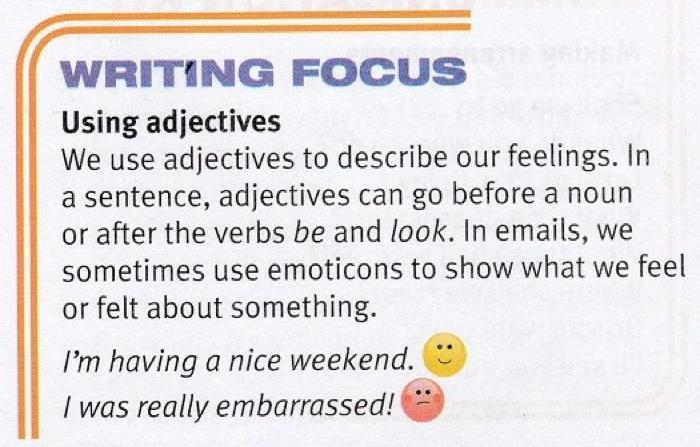
Pulse 2 Student's Book (Form 2), p. 92, Writing focus.
| Position | Pattern | Examples |
|---|---|---|
| Before the noun | a / the + adjective + noun | the biggest shop in the world; a new video game |
| After be and linking verbs | be / look / feel / seem / sound / taste + adjective | The London Underground is busy. They looked unhappy after the match. |
Opposites with un- and other prefixes
Page 82 gives friendly / unfriendly and page 92 uses happy / unhappy. Many adjectives take un- to make the opposite: tidy, untidy; fair, unfair; usual, unusual. Others use a different word: cheap, expensive; boring, interesting.
Two or three adjectives together
Opinion comes first, then size, age, shape, colour, origin, material, and then the noun: a lovely old wooden house; a small round Japanese bowl; a big black cat.
"a game exciting" ✗ → an exciting game ✓ (in English the adjective goes before the noun)
"two interestings books" ✗ → two interesting books ✓
"The weather lovely." ✗ → The weather is lovely. ✓
"a red big bag" ✗ → a big red bag ✓ (size before colour)
Show answerHide answer
4.2Adjectives for feelings: -ed and -ing
| -ed (how I feel) | -ing (what causes it) |
|---|---|
| I was really excited about the holiday. | The London Eye was exciting. |
| Natalie was annoyed when she lost. | Losing every time is annoying. |
| I was embarrassed when I fell. | Falling on stage is embarrassing. |
| We were bored. | The museum was boring. |
"I am very boring." ✗ (this says you make others bored) → I am very bored. ✓
"The match was excited." ✗ → The match was exciting. ✓
Show answerHide answer
4.3Intensifiers: really, very, a bit, quite, too
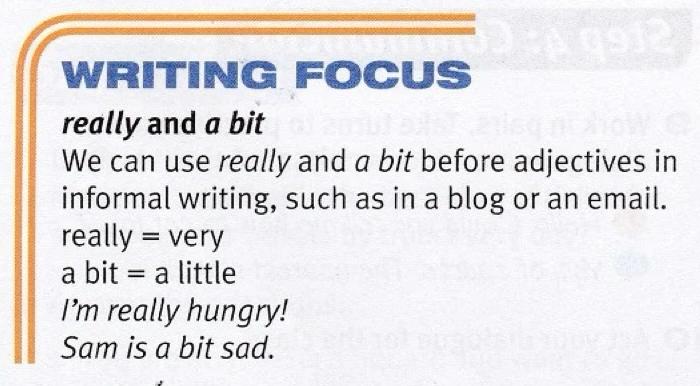
Pulse 2 Student's Book (Form 2), p. 82, Writing focus.
| Strength | Word | Example |
|---|---|---|
| Very strong | extremely, really, very | The London Underground is really busy. Leprechauns are very clever (p. 88). The game was extremely difficult. |
| Middle | quite, rather | The ride was quite long. |
| Weak | a bit, slightly, a little | Mum thought it was a bit scary. We got a bit lost. |
| More than is good | too | This tea is too hot to drink. |
Rewriting with a bit and really (page 82)
It was hot on the train. → It was really hot on the train.
"I am very agree." ✗ (agree is a verb) → I really agree. ✓
"The film was very much interesting." ✗ → The film was really interesting. ✓
"The soup is too delicious!" ✗ (too means a problem) → The soup is really delicious! ✓
"a really good a film" ✗ → a really good film ✓
Show answerHide answer
4.4Adverbs: manner and frequency
| Adjective | Rule | Adverb |
|---|---|---|
| slow, careful, clear | add -ly | slowly, carefully, clearly |
| happy, easy, noisy | -y becomes -ily | happily, easily, noisily |
| good | irregular | well |
| fast, hard, late | no change | fast, hard, late |
The adverb of manner goes after the verb or the object: She speaks clearly. He plays chess well. A frequency adverb (always, usually, often, sometimes, never) goes before the main verb and after be: Mina always helps her mother. She is always kind. The Irish fairies aren't always good (page 88).
"He plays very good." ✗ → He plays very well. ✓
"She sings beautiful." ✗ → She sings beautifully. ✓
"I play always football." ✗ → I always play football. ✓
"The food looks deliciously." ✗ → The food looks delicious. ✓ (after look, use an adjective)
Show answerHide answer
4.5Comparatives and superlatives
| Adjective | Rule | Comparative | Superlative |
|---|---|---|---|
| long, fast, cheap | -er / -est | longer, faster, cheaper | the longest, the fastest, the cheapest |
| big, hot, thin | double the letter | bigger, hotter, thinner | the biggest, the hottest, the thinnest |
| busy, easy, pretty | -y becomes -ier / -iest | busier, easier, prettier | the busiest, the easiest, the prettiest |
| famous, expensive, difficult, beautiful | more / the most | more famous, more expensive | the most famous, the most expensive |
| good / well, bad, far, much / many | irregular | better, worse, farther / further, more | the best, the worst, the farthest / furthest, the most |
The 1928 race was the longest race in history.
Harrods is the biggest shop in the world.
Pulse 2 Student's Book (Form 2), p. 78 (Route 66) and p. 82 (London blog).
How big is the difference?
Put much, far, a lot (big difference) or a bit, slightly (small difference) before a comparative: The race was much longer than Route 66. Route 66 is much shorter than the race route. My new ruler is slightly longer than my old one. Adverbs compare too: Zul rode faster than me. Please walk more slowly.
The ... the ...
For two things that change together: The more you practise, the better you play. The earlier we leave, the fewer cars we meet.
"more taller" ✗ → taller ✓ "the most easiest" ✗ → the easiest ✓
"gooder", "more better" ✗ → better ✓
"taller from me" ✗ → taller than me ✓
"the best student of Malaysia" ✗ → the best student in Malaysia ✓
Show answerHide answer
4.6As ... as, not as ... as, too and enough
| Pattern | Example | Meaning |
|---|---|---|
| as + adjective + as | Zul's new bike is as light as a feather. | the same |
| not as + adjective + as | The bus is not as fast as the train. | less; the train is faster |
| too + adjective (+ to + verb) | The tea is too hot to drink. | more than is good: a problem |
| adjective + enough | The room is big enough for ten people. | as much as needed |
"as taller as" ✗ → as tall as ✓
"enough big" ✗ → big enough ✓ (enough goes after the adjective)
"too much hot" ✗ → too hot ✓
Show answerHide answer
4.7Exam skill: correcting errors in Paper 1 Part 2
In Part 2 you read a text with underlined errors and write the correct word for each one. Use four steps.
| Step | What to do |
|---|---|
| 1. Read the whole sentence | Do not look at the underlined word alone. |
| 2. Find the job of the word | Describes a noun, or comes after be / look → adjective. Describes how → adverb. Before an adjective → intensifier. |
| 3. Look for signal words | than → comparative. the ... in / of → superlative. as ... as → plain form. A person feels → -ed. A thing causes → -ing. |
| 4. Write and check | Write only the correct word(s). Check the spelling (happier, biggest, carefully). |
(1) The match causes the feeling: exciting.
(2) It describes how they played: the adverb well.
(3) "than" needs a comparative; big doubles the g: bigger.
Summary
| Topic | Remember |
|---|---|
| Adjectives | Before the noun or after be / look; no plural -s; opinion, size, age, shape, colour, origin, material. |
| -ed / -ing | -ed = how I feel; -ing = what causes it. |
| Intensifiers | really = very; a bit = a little; quite; extremely; too = a problem. Before an adjective. |
| Adverbs | adjective + -ly; good, well. Manner after the verb or object; frequency before the main verb, after be. |
| Comparison | -er than / more ... than; the -est / the most ... in / of; better, worse. much / a bit + comparative. The more ... the better. |
| As ... as, too, enough | as tall as; not as tall as; too hot; hot enough. |