Prepositions, conjunctions, time expressions and spotting errors
What this chapter covers
- I can use for and since with the present perfect and choose the right time expression for each (6.1)
- I can ask and answer How long ...? questions with the present perfect (6.1)
- I can use prepositions of time, place and movement such as at, on, in, under, over, across, through and into (6.2)
- I can use verbs of movement with the right preposition, like walk under, throw over, put on and pick up (6.3)
- I can join ideas with because, so, but, although, however, while, when and in case (6.4)
- I can use the sound endings of verbs (-s, -es, -ed) and the weak form of was and were to check spelling and grammar (6.5)
- I can find and correct errors in a UASA Paper 1 Part 2 text, step by step (6.6)
In Form 1 you met the small words that give a sentence its meaning. In Form 2 the same words appear in longer texts and the errors are harder to spot. This unit builds on for and since with the present perfect, prepositions of time, place and movement, conjunctions and linking words, and then trains you to spot and correct errors in UASA Paper 1 Part 2. The examples come from the Pulse 2 pages on superstition and second-hand shopping.
6.1Time expressions: for and since
| Use | Time expressions | Example |
|---|---|---|
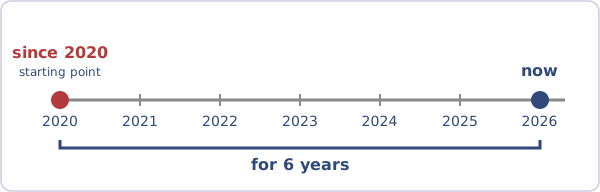
| for (how long) | two hours, five minutes, a few days, many years, a long time, three weeks | I have been in the team for three years. |
| since (when it began) | yesterday, last week, 10th June, 1995, my birthday, I was 13, she was a student | I have been in the team since 2023. |
Anna and Jack have been friends since they were four.
Anna and Jack have been friends for many years.
How long ...?
To ask about the length of a situation that is still true, use How long + have/has + subject + been ...?
| Question | Answer |
|---|---|
| How long has Jo been a swimming teacher? | She has been a swimming teacher for ten years. / ... since she was 18. |
| How long have you lived in your town? | I have lived here for six years. / ... since 2020. |
| How long have computers existed? | Computers have existed for many decades. / ... since the 1940s. |
(a) The modern Olympic Games have existed ____ 1896.
(b) Our town has had a sports stadium ____ last year.
(c) Juan has been a supporter ____ seven years.
(d) England has not won the World Cup ____ a long time.
Show answerHide answer
Other time expressions
| Tense | Time expressions | Example |
|---|---|---|
| past simple (finished) | yesterday, last week, in 2019, two days ago, when I was ten | Michael Jordan always wore his old college shorts. |
| present perfect (up to now) | for, since, so far, just, already, yet, ever, never | Superstitions have been part of sport since it began. |
| present simple (habit) | always, every day, usually, on Saturdays | Rafa Nadal always takes two identical bottles of water. |
| future | tomorrow, next week, in two days, soon | We will have the swap shop next Saturday. |
6.2Prepositions of time, place and movement
| Kind | Rule | Examples |
|---|---|---|
| time: at | clock times, meal times, night | at 7.00, at lunchtime, at night |
| time: on | days and dates | on Saturday, on 10th June, on my birthday |
| time: in | months, years, seasons, parts of the day | in June, in 1995, in the morning |
| place: at / on / in | a point / a surface / inside a space | at the door, on the table, in the box |
| movement | to, into, out of, across, along, through, up, down, over, under, past | walk across the road, go through a tunnel |
(a) A black cat walked (across / through) the road.
(b) Never walk (under / between) a ladder.
(c) She has lived (in / at) Kuching since 2022.
Show answerHide answer
6.3Verbs of movement and their prepositions
The vocabulary lesson on British superstitions uses twelve common verbs: touch, carry, break, drop, spill, walk, cross, open, pick, scratch, meet, put. Many of them take a preposition or a particle.
| Phrase | Meaning | Example |
|---|---|---|
| cross your fingers | hope for good luck | Cross your fingers before the exam. |
| touch wood | touch something made of wood so that your words do not bring bad luck | I will pass, touch wood. |
| walk under a ladder | pass beneath it | Never walk under a ladder. |
| put on / take off | wear / remove | Put on your cap. Take off your shoes at the door. |
| put ... on the table | place something on a surface (on is a preposition here) | Do not put your shoes on the table. |
| pick up | lift from a surface | Pick up the pen you dropped. |
| throw over your shoulder | throw behind you | Throw some spilt salt over your shoulder. |
| carry with you | keep with you | Carry a lucky charm with you. |
(a) ____ your fingers for good luck. (b) If you ____ some salt, throw some over your shoulder. (c) Do not ____ your nose, or you will have an argument. (d) Do not ____ your shoes on the table.
Show answerHide answer
6.4Conjunctions and linking words
| Word | Job | Example |
|---|---|---|
| and | adds an idea | Swap shops are popular and they are good for the environment. |
| but | contrast | It might take a while to find what you want, but it is fun looking. |
| because | reason | People like charity shops because the prices are low. |
| so | result | Athletes believe in luck, so they follow the same routine. |
| although / even though | contrast inside one sentence (do not add but) | Although the superstitions make no sense, many champions believe in them. |
| however | contrast between sentences | Routines help people relax. Some go too far, however. |
| while / when | time: long action / short action | While I was reading, my phone rang. |
| in case | to be ready for a problem | We do not change the routine in case things go wrong. |
(a) He wears red on the last day ____ he thinks it brings luck.
(b) ____ she was nervous, she won the match.
(c) Tara was ill, ____ she stayed at home.
Show answerHide answer
6.5Sounds that signal grammar
The pronunciation lab links sounds to grammar. Hearing the ending helps you check the form.
| Ending | Sound | Examples |
|---|---|---|
| third person singular -s / -es | /s/ after k, p, t | paints, cooks, works |
| /z/ after other sounds | tells, sings, wears | |
| /iz/ after s, sh, ch | practises, wishes, matches | |
| past simple -ed | /t/, /d/ or /id/ (/id/ after t and d) | watched /t/, played /d/, painted /id/ |
| was / were | weak forms /wəz/ and /wə/ in sentences | They were talking to him. |
| -er (a person) | /ə/ | teach - teacher, explore - explorer |
6.6Spotting errors in a text
In UASA Paper 1 Part 2 you see a text with underlined words. Some are wrong. You write the correct word. Follow these steps.
- Read the whole text first for the idea and the time (past, present or future).
- Look at the word before and after the underline.
- Decide the type of error: tense, agreement, preposition, conjunction, pronoun, spelling or plural.
- Write one word. Read the sentence again to check it.
| Clue | Likely error | Fix |
|---|---|---|
| yesterday, last year, ago | tense | past simple |
| for / since + now | tense | present perfect |
| subject he, she, it or one person | agreement | verb + s |
| a clock time, a day, a month | preposition | at / on / in |
| two ideas that are opposite | conjunction | but / although |
| before a noun (her book) | pronoun | possessive |
(a) Tom have lived in Melaka since he was born.
(b) The festival begins at Saturday.
(c) We stayed at home but it was raining.