Grammar: the future, modals and obligation (will, be going to, would like, should, must)
What this chapter covers
- I can use be going to for plans and intentions, and for predictions from evidence (5.1)
- I can choose between will and be going to, and use will for quick decisions, offers and predictions (5.2)
- I can use future time expressions and put the present simple after when, like "When I go shopping, I'll buy shoes" (5.3)
- I can use would like + to + base verb to say or ask what someone wants politely (5.4)
- I can give advice with should and shouldn't, and ask for advice with "Should I ...?" (5.5)
- I can use must and mustn't for obligation and prohibition, and tell must from should (5.6)
- I can choose the correct tense (present, past, perfect, will, be going to) using time expressions (5.7)
- I can find and correct future, modal and tense errors in a UASA Paper 1 Part 2 text (5.8)
5.1Be going to: plans and evidence
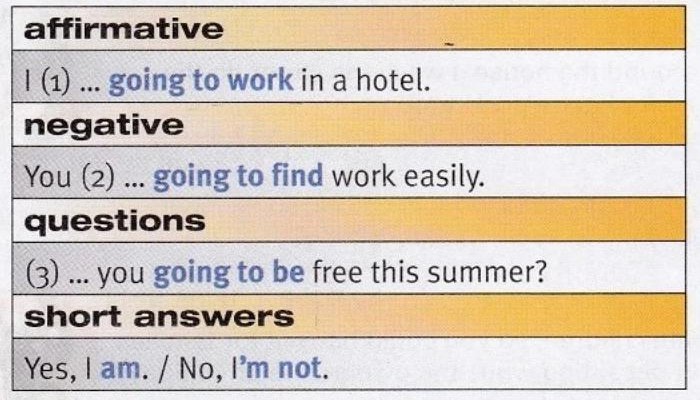
Source: Pulse 2 Student's Book, p. 64.
| Form | Example |
|---|---|
| Affirmative | I am going to work in a hotel. She is going to apply for the job. |
| Negative | You aren't going to find work easily. I 'm not going to buy it. |
| Question | Are you going to be free this summer? |
| Short answers | Yes, I am. / No, I 'm not. |
Only the be part changes (am, is, are). The going to part never changes, and the verb after it is always the base form.
(a) Adam ______ (not go) to university.
(b) ______ you ______ (save) your pocket money?
(c) They ______ (sell) the games to big companies.
Show answerHide answer
(b) Are ... going to save
(c) are going to sell
5.2Will or be going to?
| Use | Example |
|---|---|
| will: a decision made at the moment of speaking, an offer, a prediction | "The bags look heavy. I'll help you." / You 'll be rich one day! |
| be going to: a plan or intention made before speaking | I'm going to buy a new jacket. (I decided last week.) |
| be going to: a prediction from evidence we can see | Look at that dog near the money! It is going to take it. |
Negative: will not = won't ("You won't be able to use your phone in the Outback"). Question: Will a five euro note be enough? After will, the verb is the base form, with no "to".
(a) "The phone is ringing." "I ______ answer it."
(b) Dad has bought the tickets. We ______ visit Penang on Saturday.
Show answerHide answer
(b) are going to: a plan, the tickets are already bought
5.3Future time expressions and when
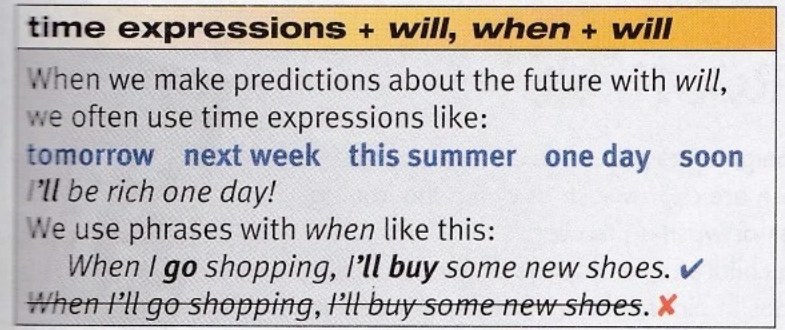
Future predictions with will often use time expressions: tomorrow, next week, this summer, one day, soon, later. (p. 67)
Source: Pulse 2 Student's Book, p. 67.
| Right | Wrong |
|---|---|
| When I go shopping, I'll buy some new shoes. | When I |
| When we feel tired, we will find a cafe. | When we |
Show answerHide answer
5.4Would like
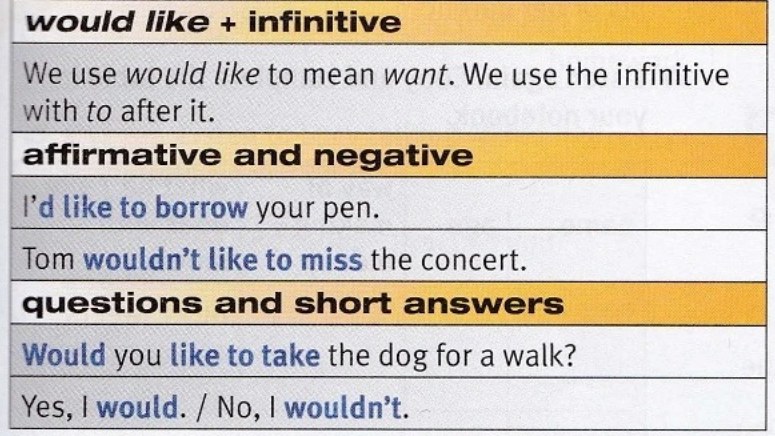
Source: Pulse 2 Student's Book, p. 67.
| Form | Example |
|---|---|
| Affirmative | I'd like to borrow your pen. |
| Negative | Tom wouldn't like to miss the concert. |
| Question | Would you like to take the dog for a walk? |
| Short answers | Yes, I would. / No, I wouldn't. |
5.5Should and shouldn't: advice
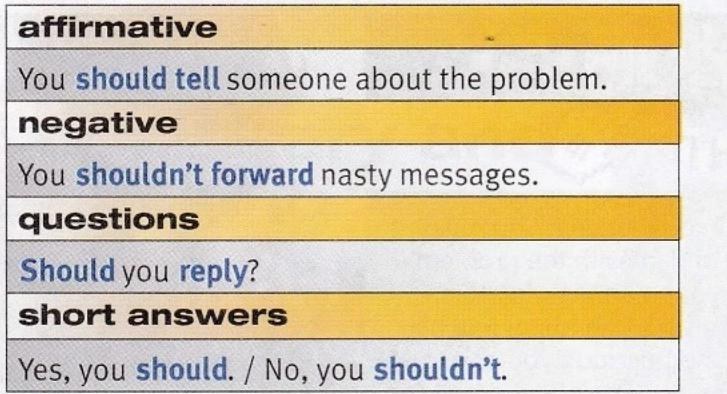
Source: Pulse 2 Student's Book, p. 96.
| Form | Example |
|---|---|
| Affirmative | You should tell someone about the problem. |
| Negative | You shouldn't forward nasty messages. |
| Question (asking for advice) | Should I get a new phone? |
| Short answers | Yes, you should. / No, you shouldn't. |
Useful ways to give advice: "I think you should ...", "Why don't you ...?" (p. 103).
5.6Must and mustn't: obligation and prohibition
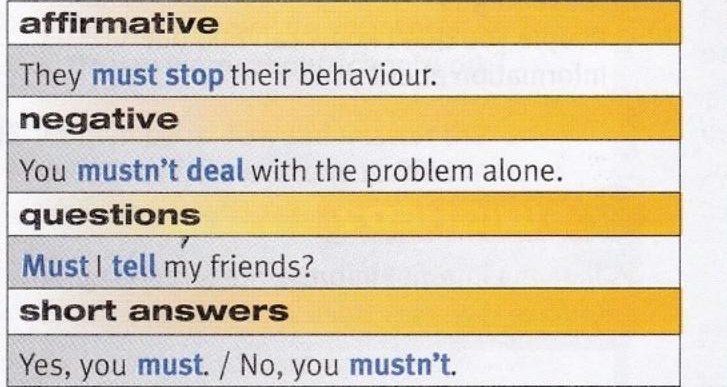
Source: Pulse 2 Student's Book, p. 96.
| Modal | Meaning | Example |
|---|---|---|
| must | obligation: you have to do it | They must stop their behaviour. You must act quickly and calmly. |
| mustn't | prohibition: it is not allowed or not safe | You mustn't deal with the problem alone. |
| should | advice: a good idea, but your choice | He should eat less fast food. |
Question: Must I tell my friends? Short answers: Yes, you must. / No, you mustn't. A rule such as "Don't enter before 11 a.m." can be said as "You mustn't enter before 11 a.m." (p. 96)
Show answerHide answer
(b) You mustn't move anything.
5.7Tense review: choose with the time expression
| Tense | Example | Time expressions |
|---|---|---|
| Present simple | Crocodiles attack people. / They don't attack people. | never, usually, often, sometimes |
| Present continuous | They're travelling around Australia. | now, at the moment |
| Past simple | Lucy left on Tuesday. / She didn't leave. | yesterday, two months ago, last weekend |
| Past continuous | Chris was watching a programme. | while |
| Present perfect | I've seen photos of the Outback. / I've never been to the zoo. | never, just |
| Will | You'll need to drink a lot of water. / You won't need a ticket. | later, tomorrow, soon |
| Be going to | We're going to fly to Sydney. | tomorrow, next week |
Source: study guide and grammar, Pulse 2 pp. 99 and 103. Remember for a length of time (for five minutes) and since a starting point (since Monday).
Show answerHide answer
5.8Spotting errors in a Part 2 text
- Find the time expression (tomorrow, yesterday, since, while, when).
- Look at the word before the verb: is it will, should, must, would, or am/is/are going to?
- Check the verb after it is the base form, with no -s, -ed, -ing or "to" (except going to and would like to).
- Check when clauses use the present simple.