Information transfer from a text
What this chapter covers
- I can say what Paper 1 Part 3 asks me to do and use the rule "no more than three words and/or a number" (7.1)
- I can read a pie chart and a short article about pocket money and give each amount as a percentage, a fraction or a number (7.2)
- I can copy details from a text or a conversation into a table, matching each label to the right words (7.3)
- I can read a timetable and its note, use am, pm and per, and find the day, time, price and equipment I need (7.4)
- I can move advice from a leaflet into a "problem and what to do" table (7.5)
- I can avoid the traps in information transfer, such as old plans, other people's choices, extra words and spelling mistakes (7.6)
- I can use the same moves on a new notice and fill a form with the right place, day, time and fee (7.7)
In information transfer you read a text and move the facts into a form, a table or notes. You do not write sentences. You find the right words and copy them. This unit uses the three Integrated skills pages in Pulse 2 (pocket money, the leisure centre timetable and holiday health) to practise it, the same skill as Paper 1 Part 3.
7.1What information transfer asks you to do
| Task in Pulse 2 | What you transfer | Page |
|---|---|---|
| Step 1: Read, true or false | Facts from an article and a chart into True / False with corrections | 68 |
| Step 2: Listen, complete a table | Name, age, way of making money and use of money | 68 |
| Step 1: Read, answer questions | Day, time, activity and equipment from a timetable and a note | 90 |
| Step 1: Read, answer questions | Problem and the item or action that goes with it | 100 |
In the UASA the rule is: write no more than three words and/or a number for each answer. One correct word is a full answer. Copy the spelling, the capital letters and the units (RM, p.m., %) exactly.
| Answer | Allowed? | Why |
|---|---|---|
| odd jobs | Yes | 2 words |
| 25 per cent | Yes | a number and 2 words |
| on Saturday morning | Yes | 3 words |
| by washing the neighbour's car | No | 5 words. Keep only the key words from the text, for example washing cars. |
Show answerHide answer
7.2Reading a chart and an article: percentages and fractions
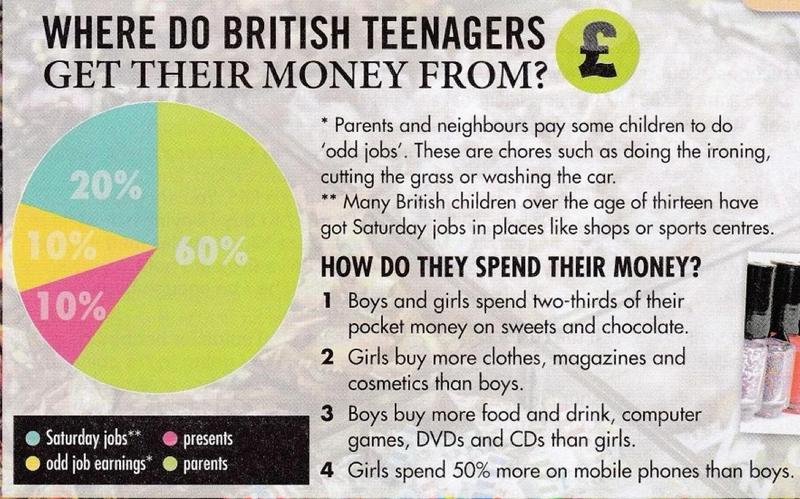
Textbook figure: Pulse 2 Student's Book, p.68.
A pie chart shows how a whole (100%) is shared. Use the key (the legend) to match each colour to its label, then add or compare the numbers.
| Percentage | Fraction or phrase |
|---|---|
| 10% | a tenth |
| 25% | a quarter |
| 33.3% | a third |
| 50% | (a) half |
| 75% | three-quarters |
| 100% | all |
Percentages and fractions: Pulse 2 Student's Book, p.68 (Skills builder).
Source of money in the chart: parents 60%, Saturday jobs 20%, odd job earnings 10%, presents 10%.
| Question | Working | Answer |
|---|---|---|
| Which is the biggest source? | 60% is the largest number | parents |
| What share comes from jobs (Saturday jobs and odd jobs)? | 20% + 10% = 30% | 30% |
| Check the whole | 60 + 20 + 10 + 10 = 100 | 100% |
Show answerHide answer
7.3Moving details into a table
In the Step 2 task you complete a table with name, age, way of making money and what he or she does with the money. Do it in three moves.
| Move | What you do |
|---|---|
| 1. Read the labels first | Each column is a kind of answer: a name, a number, a job, a use. |
| 2. Listen or read for one person at a time | Take Ben, then Lily, then Harry. Do not mix people. |
| 3. Copy short | Write the key words only. Put a tick or a number if the label asks for one. |
Text: "Aina is fifteen. Her parents give her RM30 a month, and she also walks her neighbour's dog every evening for RM5. She spends her money on books and phone credit."
| Name | Age | Way of making money | Spends money on |
|---|---|---|---|
| Aina | 15 | walking a dog (or walks neighbour's dog) | books, phone credit |
"Her parents give her RM30" is also a source of money, but the column asks for a way of making money, which is work. Read the label carefully.
Show answerHide answer
7.4Reading a timetable and its note
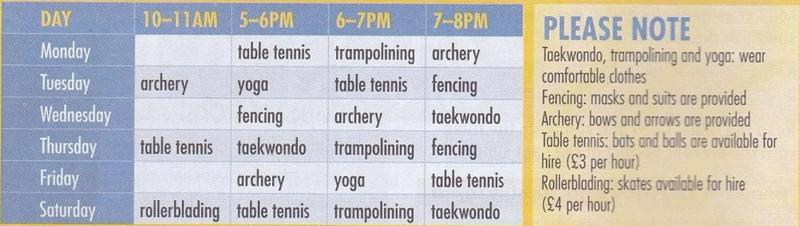
Textbook figure: Pulse 2 Student's Book, p.90.
| Short form | Meaning |
|---|---|
| am | morning |
| pm | afternoon (and evening) |
| per | for each (for example £3 per hour = £3 for each hour) |
Short forms: Pulse 2 Student's Book, p.90 (Skills builder).
To answer a timetable question, find the row (day) and the column (time) and read the cell where they meet. For questions about equipment, the note under the timetable gives the answer.
Lucy and Nina want to play table tennis once a week, but they are not free until 7 pm.
- Find the 7-8pm column.
- Look for table tennis in that column: it is in the Friday row.
Answer: Friday. (The other table tennis sessions are earlier: Monday and Saturday at 5-6pm, Tuesday at 6-7pm and Thursday at 10-11am.)
Table tennis bats and balls are available for hire at £3 per hour. For 2 hours: 2 × £3 = £6.
Show answerHide answer
7.5Moving advice into a "problem and action" table
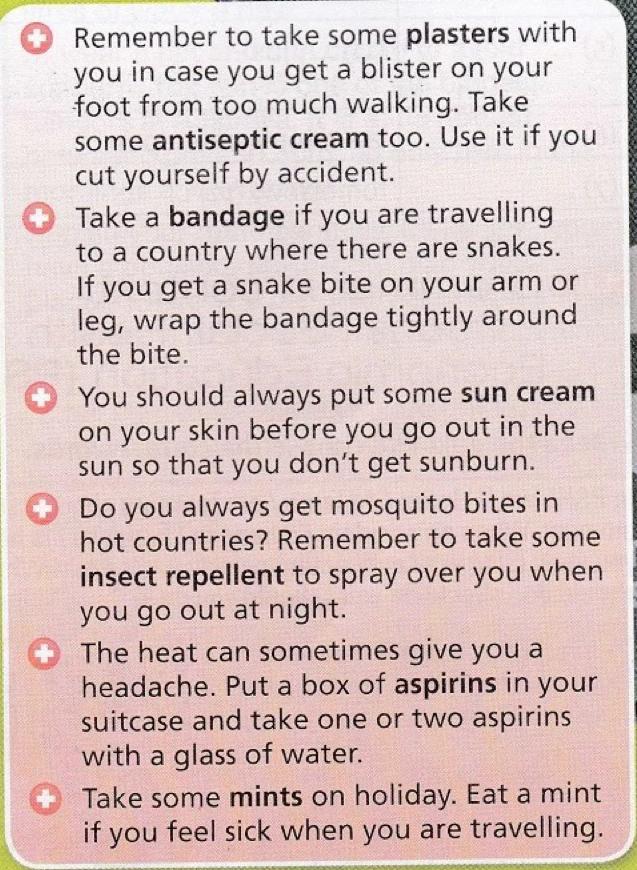
Textbook figure: Pulse 2 Student's Book, p.100.
An advice text can be turned into a short table. The bold words in the text are the items; the problem is in the same sentence.
| Problem | Item or action |
|---|---|
| blister on your foot | plasters |
| cut by accident | antiseptic cream |
| snake bite on arm or leg | bandage, wrapped tightly round the bite |
| sunburn | sun cream, put on before you go out in the sun |
| mosquito bites | insect repellent, sprayed on when you go out at night |
| headache | one or two aspirins with a glass of water |
| feeling sick when travelling | a mint |
Show answerHide answer
7.6Traps and a final check
| Trap | Example | What to do |
|---|---|---|
| Too strong: only, all, always | "Teenagers only get money from parents" | Look for the other sources in the chart |
| Wrong group | Girls and boys mixed up in the statements (girls buy clothes; boys buy computer games) | Underline who each fact is about |
| Wrong time slot | Table tennis on Monday, but at 5-6pm, not 7-8pm | Check both the row and the column |
| Extra words | "a glass of water" for "Item" | Count your words; drop articles |
| Spelling | aspirins written as "asprins" | Copy from the text letter by letter |
7.7Practice: a notice to a form
The Integrated skills pages give you the chart, the timetable and the advice. In the exam the text is new, so use the same moves on a notice. Read the labels first, then read the text with a pencil, one label at a time.
Notice: "The Recycling Club will meet in the library, not the science lab as before, every Thursday at 4 p.m. Bring two old newspapers each week. The fee is RM2 for a month."
| Label | Answer | Why |
|---|---|---|
| Place | library | the science lab is the old place |
| Day | Thursday | the day word in the text |
| Time | 4 p.m. | a number with p.m. |
| Bring | old newspapers | 2 words; "two" tells how many |
| Fee | RM2 | keep the unit RM |
Show answerHide answer
Summary
- Information transfer: read, find the detail that matches each label, and copy it in no more than three words and/or a number.
- Use the key of a chart; add the percentages to check they make 100%. Know 10% = a tenth, 25% = a quarter, 50% = half, 75% = three-quarters.
- For a table, take one person (or one problem) at a time.
- In a timetable, match the row and the column; am = morning, pm = afternoon, per = for each.
- For advice, match each problem with its item or action.
- Check for too-strong words, wrong group, wrong time, extra words and spelling.