Reading charts, timetables, leaflets and other non-linear texts
What this chapter covers
- {'I can say what a non-linear text is and name the parts I use to read it': 'title, rows, columns, key, notes and small print (8.1)'}
- I can follow a five-step method to answer True/False questions and short-answer gaps on a non-linear text (8.2)
- I can read a transport map and a ticket information box, and work out journey times and the cheapest ticket (8.3)
- I can read a timetable with a notes box, find a day and time that fit several conditions, and work out hire costs (8.4)
- I can read bar charts, pie charts and line graphs, and compare and add the numbers (8.5)
- I can read leaflets, advice lists and signs, and tell advice (should) from obligation and prohibition (must, mustn't) (8.6)
- I can spot trap words and copy a short answer of no more than five words and/or a number exactly (8.7)
This unit is about non-linear texts: maps, timetables, charts, leaflets and signs. In Pulse 2 you meet them in the Integrated skills pages: a tram map and ticket information (page 80), a leisure centre timetable (page 90) and a holiday first aid list (page 100). In the UASA they are tested in Paper 1 Part 4. In Form 2 the texts have more conditions (age, day, time, price) and the questions often ask you to combine two facts or do a short sum.
8.1What is a non-linear text?
| Part | What it does | Example in Pulse 2 |
|---|---|---|
| title / heading | says what the text is about | Hopfield Leisure Centre (p.90) |
| row and column | a row goes across, a column goes down; the answer is where they meet | Day (row) and time (column) in the timetable |
| key / legend | explains colours and symbols | Metrolink line colours and symbols (p.80) |
| notes box / small print | gives rules, conditions and extra costs | Please note box (p.90); Ticket information (p.80) |
| bullet points | a short list of separate pieces of advice | First aid advice (p.100) |
| Paper 1 Part 4 | What you get |
|---|---|
| Text | One non-linear text |
| Questions | Four True/False statements and four sentences with a gap to fill |
| Marks and time | 8 marks, 1 mark each; about 20 minutes |
Show answerHide answer
8.2The five-step method
| Step | What to do |
|---|---|
| 1. Skim | Read the title and look at the boxes for 30 seconds. What is this text, and who is it for? |
| 2. Read the question | Underline the key words and any trap word (only, every, all, free, except). |
| 3. Scan | Find the row, box or line that has the same idea. The words may be different (per hour = for each hour). |
| 4. Compare | Check every part of the statement, and the notes box. Do you need a sum? |
| 5. Answer and check | Write True or False, or copy the words. Read the full sentence again with your answer in the gap. |
8.3Maps and ticket information
Page 80 shows the map of the Manchester Metrolink, a tram system with 37 stations. Each tram line has its own colour, and a table gives the approximate journey time of each line. Beside the map is a box of ticket information.
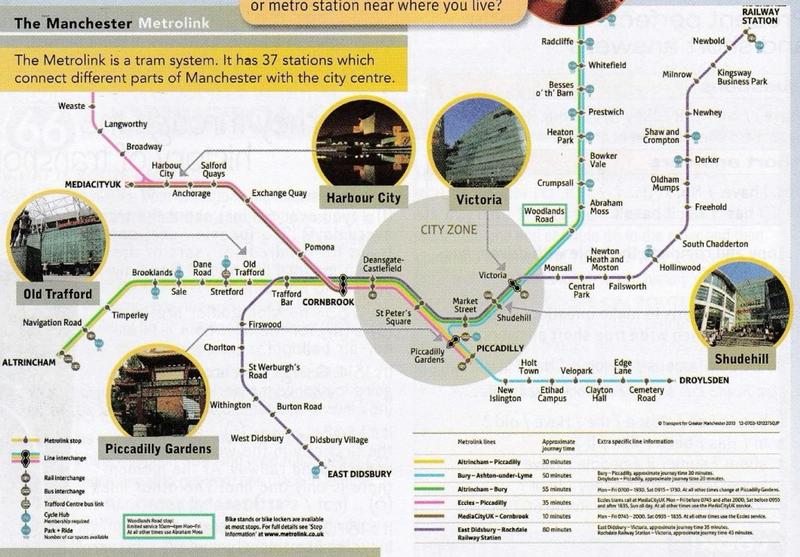
Pulse 2 Student's Book (Form 2), p. 80, Integrated skills.
| Line | Approximate journey time |
|---|---|
| Altrincham to Piccadilly | 30 minutes |
| Bury to Ashton-under-Lyne | 50 minutes |
| Altrincham to Bury | 55 minutes |
| Eccles to Piccadilly | 35 minutes |
| MediaCityUK to Cornbrook | 10 minutes |
| East Didsbury to Rochdale Railway Station | 80 minutes |
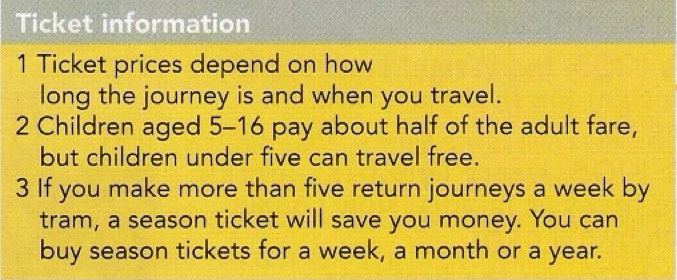
Pulse 2 Student's Book (Form 2), p. 80.
Key words: six-year-old, full adult fare. Scan: "Children aged 5 to 16 pay about half of the adult fare." Six is in that group.
Answer: False
2. A four-year-old can travel free.
Scan: "children under five can travel free". Four is under five.
Answer: True
3. Mr Lim makes eight return journeys a week. Which ticket saves him money?
Scan: "more than five return journeys a week ... a season ticket will save you money". Eight is more than five.
Answer: a season ticket
Show answerHide answer
8.4Timetables with a notes box
The Hopfield Leisure Centre timetable on page 90 has the days down the side and four time slots across the top. The Please note box gives the rules. The Skills builder on page 90 explains short forms: am = morning, pm = afternoon, per = for each.
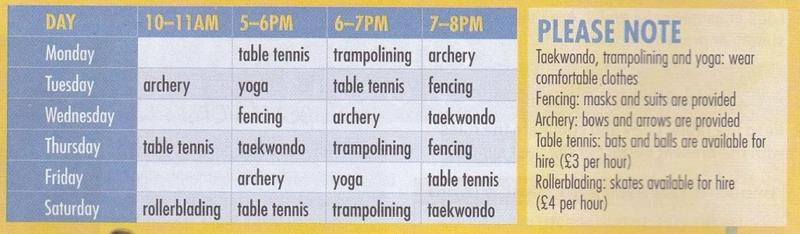
Pulse 2 Student's Book (Form 2), p. 90, Integrated skills.
Look for table tennis in the 7-8 pm column only: Friday. The other table tennis sessions are at 5-6 pm, 6-7 pm or 10-11 am.
Answer: Friday
How many times a week can you do archery?
Count the cells: Monday 7-8, Tuesday 10-11, Wednesday 6-7, Friday 5-6.
Answer: four times
Three friends hire rollerblading skates for one hour. How much do they pay?
The note says skates are £4 per hour. 3 × £4 = £12
| Activity | Equipment (from the note) |
|---|---|
| Taekwondo, trampolining, yoga | No equipment; wear comfortable clothes |
| Fencing | Masks and suits are provided |
| Archery | Bows and arrows are provided |
| Table tennis | Bats and balls can be hired, £3 per hour |
| Rollerblading | Skates can be hired, £4 per hour |
Show answerHide answer
8.5Charts: bars, pies and lines
| Chart | Good for | Read first |
|---|---|---|
| Bar chart | comparing amounts | title, the axis label and the scale (what one gridline means), the colour key |
| Pie chart | parts of a whole (the parts add up to 100%) | title, the total, the percentage of each slice |
| Line graph | change over time | title, the months or days along the bottom, the scale up the side |
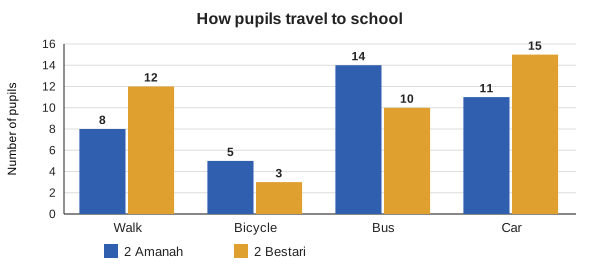
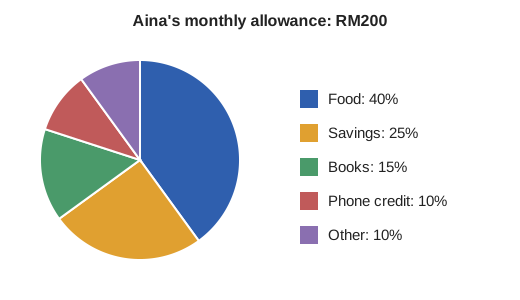
2 Bestari: 15; 2 Amanah: 11. 15 − 11 = 4 more
2. Altogether, 2 Amanah has ______ pupils. (Text A)
8 + 5 + 14 + 11 = 38
3. Aina saves ______ every month. (Text B)
Savings are 25% of RM200. 25% is a quarter, and RM200 ÷ 4 = RM50
4. True or False: Aina spends more on books than on phone credit and other things together. (Text B)
Books 15%. Phone credit and other: 10% + 10% = 20%. 15% is less than 20%. False
Show answerHide answer
8.6Leaflets, advice lists and signs
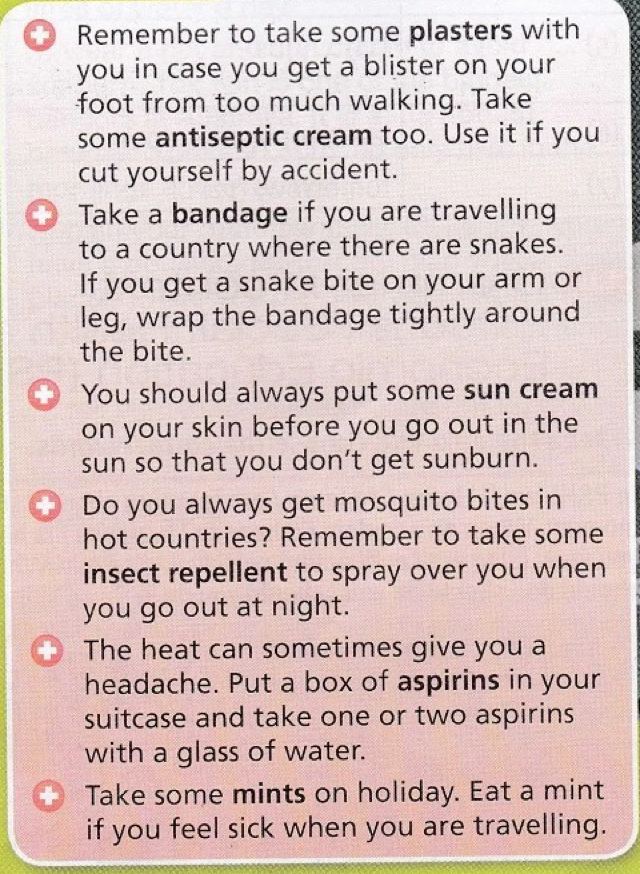
A leaflet gives advice in short pieces. On page 100 a list of holiday health tips has the main item in bold in each point. Each point has a problem and an action.
Pulse 2 Student's Book (Form 2), p. 100, Integrated skills.
| Problem | What to take or do |
|---|---|
| blister from too much walking | put on a plaster |
| a cut | use antiseptic cream |
| snake bite on an arm or leg | wrap a bandage tightly around the bite |
| sunburn | put sun cream on your skin before you go out in the sun |
| mosquito bites | spray insect repellent when you go out at night |
| headache | take one or two aspirins with a glass of water |
| feeling sick when travelling | eat a mint |
Advice and rules: should, must and mustn't
Page 96 has a bedroom sign with five rules, and a list of five rules for social networking sites. They show the difference between a rule and advice.
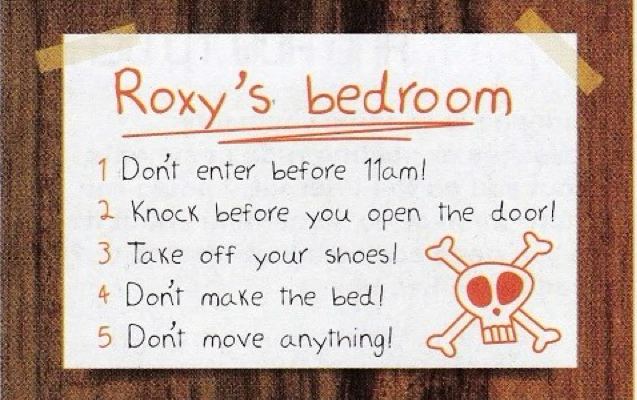
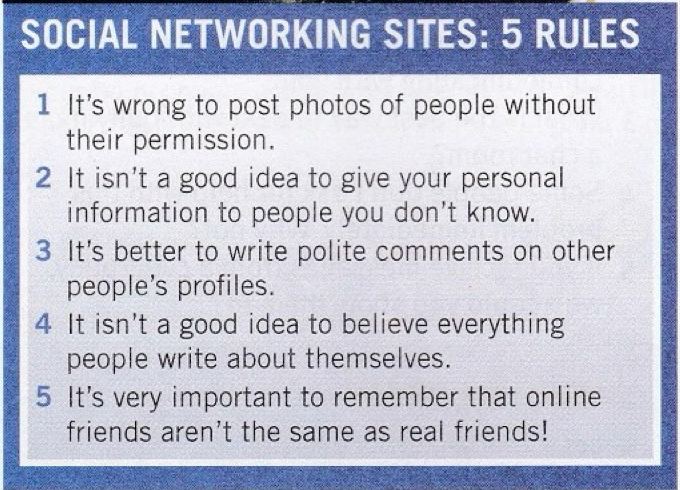
Pulse 2 Student's Book (Form 2), p. 96, Grammar should / must.
| Use | Form | Example |
|---|---|---|
| advice, a recommendation | should / shouldn't + base verb | You should put on sun cream. You shouldn't forward nasty messages. |
| obligation (a rule) | must + base verb | You must knock before you open the door. |
| prohibition (not allowed) | mustn't + base verb | You mustn't enter before 11 am. |
Show answerHide answer
8.7True or false traps and short answers
A statement is True only if every part matches the text. If the text does not say it, the answer is False.
| Trap | Text says | Statement | Answer |
|---|---|---|---|
| only | Swimmers can go river rafting. | River rafting is only for boys. | False |
| every / all | The first 50 get a free cap. | Every camper gets a free cap. | False |
| provided / hire | Skates are available for hire. | Skates are provided free. | False |
| age limit | Children under five travel free. | A five-year-old travels free. | False (five is not under five) |
| two parts | Half price for children aged 5 to 16. | A 17-year-old pays half price and an adult pays full price. | False (17 is not in the group) |
| same idea | Wrap the bandage tightly. | The bandage should be firm and not loose. | True |
Short answers
- Copy no more than five words and/or a number from the text, spelt exactly the same.
- Keep the unit: RM, £, %, minutes, a.m. or p.m.
- If a sum is needed, do it, and write the answer with its unit.
- Do not repeat words that are already in the sentence.
A group of 5 campers pays ______ each. 10% of RM180 is RM18. RM180 − RM18 = RM162
Two brothers go. Together they pay ______. RM180 + RM160 = RM340
Show answerHide answer
Summary
- Part 4 has one non-linear text, four True/False statements and four short-answer gaps: 8 marks in about 20 minutes.
- Use the five steps: skim, read the question, scan, compare, answer and check.
- Read the title, headings, key and notes box first. In tables, find the row and column.
- Watch the trap words only, every, all, free, provided, for hire, except, and age limits such as under five and more than five.
- Pie charts give percentages of a total; read the scale on bar charts and line graphs, and check the title.
- should = advice; must = rule; mustn't = not allowed.
- For short answers copy no more than five words and/or a number, with its unit.