Gapped texts and how texts hold together
What this chapter covers
- I can describe Paper 1 Part 5 of the UASA: one text, six gaps (35 to 40), eight sentences A to H, two of them extra, 6 marks (9.1)
- I can find what it, they, them, this, that, one and there point back to, and use them to match a sentence to a gap (pp.70, 75) (9.2)
- I can read the job of linking words (contrast, result, reason, addition, time, alternative, example) and choose the one that joins two ideas correctly (pp.63, 82, 92, 102) (9.3)
- I can find the topic sentence of a paragraph and choose a sentence that stays on the topic (pp.63, 95) (9.4)
- I can check time order, cause and result, and the tense of a gap sentence (pp.70, 82, 102) (9.5)
- I can follow a six-step method to complete a gapped text of six gaps in about 20 minutes (9.6)
- I can rule out the two extra sentences that seem to fit but do not, and check my answers by reading the text again (9.7)
In Paper 1 Part 5 six sentences have been taken out of a text, and you choose them from a list of eight to put them back in the right places. A sentence is never right just because it is about the same topic: it must join the sentence before the gap and the sentence after it. The Pulse 2 units teach you the pieces of this: the pronouns in the letter on page 70, the time words in the blog post on page 82, the linking words in the email on page 92 and the order of ideas in the instant messages on page 102. This unit puts them together and gives you a method that works every time.
9.1What Part 5 looks like
| Part 5 at a glance | Details |
|---|---|
| Questions | 6 (Questions 35 to 40), 1 mark each, 6 marks in all |
| Time | about 20 minutes |
| Text | one text with a title, such as a personal story, a recount, a diary, an email or a short article. The topics are the ones you meet in Pulse 2: money and jobs, journeys, sport and luck, health and personal problems. |
| Sentences | Eight sentences, A to H, for six gaps. Six sentences fit the gaps and two are extra. Any sentence can go in any gap, and a sentence is used only once. |
| Answer | blacken one letter on the answer sheet for each gap |
Read the text below. Six sentences have been removed from the article.
Choose from the sentences (A - H) to fit each gap (35 - 40).
[6 marks]
A gapped text is a text with sentences missing. A sentence you place in one gap is no longer free for the others, so every answer you are sure of makes the next one easier. Because two sentences are extra, you cannot just use up what is left: the last gap needs checking too.
| Clue | Question to ask | See |
|---|---|---|
| Reference words | What does it, them, this or one point back to? | 9.2 |
| Linking words | Does however, so, instead or then join the two ideas in the right way? | 9.3 |
| Topic sentences | Does the sentence start or stay on the main idea of the paragraph? | 9.4 |
| Logical order and tense | Does it come at the right time, in the right tense? | 9.5 |
9.2Reference words: what does it point back to?
Writers do not repeat the same noun again and again. In the Using pronouns box on page 70, Pulse 2 says that we use pronouns "to avoid repeating names and nouns". A reference word points back to something already said. When a gap sentence starts with a reference word, the thing it points to must be just before the gap.
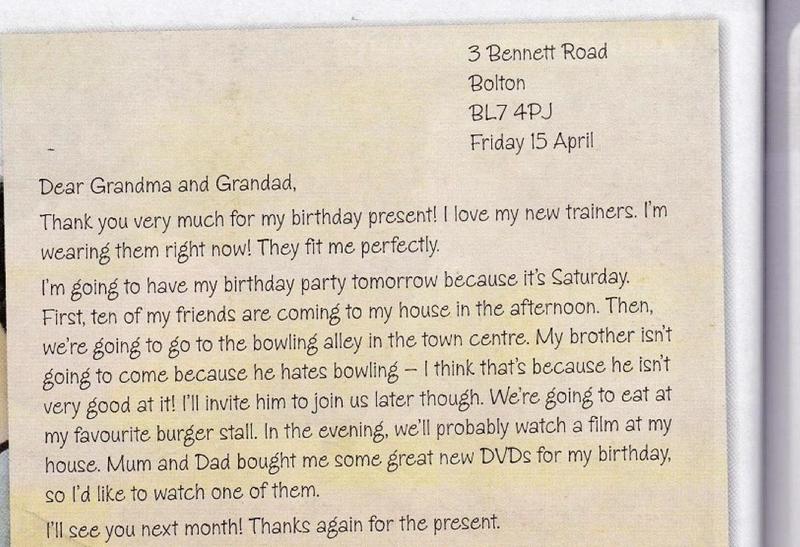
Pulse 2 Student's Book (Form 2), p. 70, Writing: an informal letter.
| Reference word | Points back to | Example |
|---|---|---|
| he / him / his, she / her | one person (check male or female) | Paul's brother hates bowling, so Paul will invite him later. |
| it / its | one thing, animal, place or activity | Paul's brother is not good at bowling, so he does not like it. |
| they / them / their | two or more people or things | Paul loves his new trainers and is wearing them now. |
| this / that | a whole idea or action in the sentence before | Many athletes repeat the same actions before a match. This makes them feel safe. |
| these / those | several things or ideas just mentioned | The Amish avoid modern gadgets. These include phones and computers. |
| one / ones | a noun already named (instead of repeating it) | Paul got some new DVDs and he would like to watch one tonight. |
| there / then | a place or a time already named | We went to Penang in June. We stayed there for three days, and it rained a lot then. |
| so / not | a whole clause (after think, hope, believe) | Will it rain? I hope not. / Is she coming? I think so. |
My cousin Amir bought two cheap tickets for the football match. (gap) He was so happy that he could not sleep that night.
A They were the last two tickets left in the shop.
B It was the last ticket left in the shop.
Two tickets are plural, so They fits and It does not. The answer is A. Always count: one or many? person or thing?
"Andrew has never used a computer. He prefers hunting with a bow and arrow, and his father taught him to do this. Andrew's parents live on a farm. It is far from any city, so they hardly ever visit one."
(Write what each of the six words in bold means.)
Show answerHide answer
Note that "He" and "him" both point to Andrew, and "this" points to an action, not a noun.
9.3Linking words and what they do
A linking word tells you how the new sentence is related to the last one. In Pulse 2, Natalie's email on page 92 has because and anyway, and the blog on page 82 has also and but. Know the job of the word, and test whether the two ideas really have that relationship.
| Job | Words | Example | The sentence before the gap usually has ... |
|---|---|---|---|
| Adding | also, too, as well, besides, in addition | We also went to the London Eye. | one idea; this gives another of the same kind |
| Contrast | but, however, although, even though, in spite of, on the other hand | It was fun, but Mum thought it was a bit scary. | an idea that goes the opposite way |
| Result | so, as a result, therefore, that is why | I've never been here before, so I'm really excited. | the cause |
| Reason | because, since, as, because of | My parents say no because they think camp is dangerous. | the result (the reason comes after) |
| Time order | first, then, next, after that, later, meanwhile, finally, at last | First, ten friends are coming. Then, we are going bowling. | an earlier step or event |
| Alternative | or, instead, instead of, otherwise | Instead of earning money, why not spend less? | a suggestion or an action that is replaced |
| Example | for example, for instance, such as, like | Try new sports such as skateboarding. | a general idea |
| Moving on | anyway, by the way, as for | Anyway, I'm going to practise more. | a side comment or a disappointment, before the writer returns to the main point |
The school canteen sells healthy food. (gap) A burger and chips still cost RM6.
A As a result, prices are low.
B However, it is not cheap.
A burger and chips that costs RM6 is not cheap. "Healthy" is a good point and "not cheap" is a bad point, so the contrast word However works. As a result would need a cause: healthy food does not cause low prices. The answer is B.
(a) The Amish avoid modern gadgets, ______ mobile phones and televisions.
(b) It was raining heavily, ______ I stayed at home and read.
(c) He repaired his old phone ______ buying a new one.
(d) Jo loves tennis. ______, she is not a good player.
Show answerHide answer
9.4Topic sentences and the shape of a paragraph
A paragraph is about one main idea, and the topic sentence says what it is. It is usually the first sentence. The information leaflet on page 95 (Cyberbullying and how to deal with it) shows the shape well: each of the five tips starts with a short sentence that gives the advice (Don't reply, Block, Talk to someone, Save the evidence, Help the victims), and the sentences that follow give the reasons and the details.
| Where is the gap? | What usually fits | Example |
|---|---|---|
| At the start of a paragraph | a topic sentence: the general idea the next sentences explain | Another good habit is to keep a diary. Write down what you did and how you felt. |
| In the middle | a detail, an example or a reason that links to the sentences before and after | Sleep is important. Teenagers need about nine hours every night. Without it, they find it hard to learn. |
| At the end of a paragraph | a result, a feeling, a comment or a conclusion | We collected RM800 for the old folks' home. We felt very proud of our work. |
| At the end of the text | an ending: a hope, a lesson, advice or an opinion | I hope you feel better soon. |
(gap) Bullies love it when they get a reaction, so they hope you will answer angrily. If you say nothing, they soon lose interest.
A Do not reply to nasty messages.
B Many teenagers use social networking sites.
C It is easy to make a new friend online.
The sentences after the gap are all about replying and reactions. A is the topic sentence: it gives the advice that the paragraph explains. B and C are about the same big topic (the internet), but neither leads to "so they hope you will answer".
"(gap) She wakes up at 5.30 a.m. to cook breakfast. Then she sends my brother and me to school before she goes to work at the clinic."
A My mother has a very busy morning. B The clinic opens at 8.00 a.m. C My brother is in Year 4.
Show answerHide answer
9.5Logical order, tense and the writer's plan
Ideas in a text come in a logical order, an order that makes sense. The gap sentence must come at the right point.
| Kind of order | Where you find it | Clues to look for |
|---|---|---|
| Time order | recounts, plans, blogs, a person's day | times (6.30 a.m.), days, first, then, after that, later, finally, yesterday, today, tomorrow |
| Cause, then result | stories and articles | because, so, as a result; feelings after events |
| General, then details | articles and leaflets | a big idea first, then for example, such as |
| Problem, then answer | emails and messages asking for advice | a worry or a question, then advice (I think you should ...) |
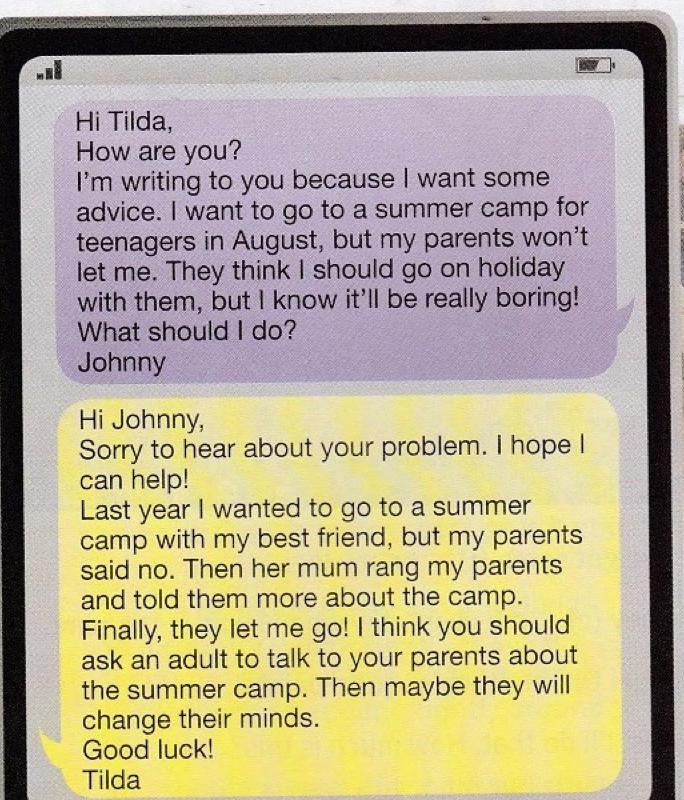
Pulse 2 Student's Book (Form 2), p. 102, Writing: an instant message.
Look at the plan of Tilda's reply: (1) she is sorry for his problem, (2) she tells what happened to her last year, using Then and Finally in time order, (3) she gives advice with should, and (4) she ends with Good luck! A gap sentence that breaks this plan, for example an advice sentence in the middle of the story, is wrong.
Check the tense
The gap sentence normally uses the same tense as the sentences around it. Page 102 of Pulse 2 reminds you to use different tenses, but each tense must match its time word.
| Text | Fits | Does not fit |
|---|---|---|
| Last year I wanted to go to a summer camp. (gap) | My parents said no. | My parents say no. |
| We haven't been to the museum yet. (gap) | I hope we will have time tomorrow. | I hoped we had time yesterday. |
| I have lived here since 2011. (gap) | I have many friends here now. | I had many friends here tomorrow. |
P After that, she put the cake in the oven.
Q Mira wanted to bake a cake for her father's birthday.
R First, she mixed flour, eggs, sugar and butter.
S Finally, she decorated it with strawberries.
Show answerHide answer
9.6The six-step method
| Step | What you do | Why |
|---|---|---|
| 1. Skim the text | Read the title and the whole text quickly, skipping the gaps. Who? Where? When? Story, email or facts? Which tense? | You know the topic and the tense. |
| 2. Read the options | Read sentences A to H. Circle reference words and linking words, and underline names, times and things. | These are your clues. |
| 3. Look both ways | For each gap, read the sentence before and the sentence after. Underline the nouns, the time words and any pointers. | The right sentence joins both sides. |
| 4. Match the strongest clue first | Start with the gap that has the clearest clue: a plural them after the gap, a Finally, a name. | Each sentence is used once, so every match makes the rest easier. |
| 5. Cross out and continue | Cross out each sentence you use. Do the harder gaps with the sentences that are left. | Fewer choices, fewer mistakes. |
| 6. Read it all again | Read each paragraph with your sentences in it. Do the pointers, the linking words and the time order work? | You catch two answers that are swapped. |
Part 5 is only 6 marks, so keep to about 20 minutes. Do not spend a long time on one gap: leave it, do the others, and come back with fewer sentences left.
Read the text below. Six sentences have been removed from the article.
Choose from the sentences (A - H) to fit each gap (35 - 40).
The Lucky Ribbon
Before every big match, our netball captain, Farah, does the same thing. (35) ______ She says that it keeps her calm.
Farah is not the only one. (36) ______ Hamidah always puts her left shoe on first, and Mei Ling taps the floor three times before she walks on to the court.
Our coach, Cikgu Salmah, does not believe that these habits bring luck. (37) ______ She says that they simply help the players to feel calm and ready.
Last month, we lost the semi-final. (38) ______ Everyone said that was the reason we lost, but Cikgu Salmah only smiled.
Last week, we played the final. (39) ______ We won by five goals, and Farah scored the winning goal.
Now the whole team ties a blue ribbon in their hair before a match. (40) ______ Even Cikgu Salmah has started to wear one!
A Many of her teammates have their own little habits too.
B It does not bring luck, but it makes us feel like one team.
C That day, Farah had forgotten her ribbon at home.
D She ties her hair with a small blue ribbon that her grandmother gave her.
E Netball is a popular sport in many Malaysian schools.
F Even so, she lets the girls follow their own habits.
G This time, Farah remembered her ribbon.
H Hamidah's habit is to put her right shoe on first.
| Gap | Clues before and after | Answer |
|---|---|---|
| (38) | Strongest clue first. After the gap, Everyone said that was the reason needs an action just before it. C gives the reason for losing: Farah forgot her ribbon, and That day points to the day of the semi-final. | C |
| (35) | The sentence after the gap has it, which needs a thing named before it. D names the ribbon, and She is Farah. | D |
| (37) | The coach does not believe in luck. F starts with Even so (contrast), and she points to the coach. They after the gap needs habits just before it. | F |
| (36) | After Farah is not the only one, the gap must say who else: A. Her points to Farah, and the next sentence gives examples (Hamidah and Mei Ling). H also names Hamidah, but it repeats the next sentence and says right shoe, which contradicts left. | A |
| (39) | The final comes after the lost semi-final. G says This time (the earlier time was the semi-final), and the win follows from remembering the ribbon. | G |
| (40) | The sentence before the gap has a blue ribbon, so it in B points to the ribbon. B explains why the whole team wears one. | B |
Step 6: read the text again with the sentences in it. The pointers (it, that, she, they) and the time order work, so the answers are 35 D, 36 A, 37 F, 38 C, 39 G, 40 B. E and H are left over. E is about netball in general and joins nothing, and H repeats and contradicts the text, so they are the two extra sentences.
9.7Ruling out sentences that only seem to fit
When two sentences seem to fit one gap, test each one against these checks. A sentence that fails one check is a distractor for that gap.
| Check | The sentence is wrong if ... | Example of a wrong choice |
|---|---|---|
| Pointer | its reference word does not match (one or many, he or she, person or thing) | "They were delicious." after "Mum made a chocolate cake." |
| Link | its linking word does the wrong job | "So, we won the game." after "Our best player was ill." |
| Topic | it belongs to a different paragraph | a sentence about lunch in a paragraph about the morning walk |
| Order and tense | it happens too early or too late, or the tense is different | "We go home happily." in a story in the past |
| Repeat | it says again what the text already says | "We left at 7.00." when the text already gives the time |
| Contradiction | it does not agree with the sentence after the gap | "It was very easy." before "I tried five times before I got it right." |
Kavitha joined the school choir in January. (gap) Now she is not afraid of singing on stage any more.
E At first, she was very shy and sang softly.
F She has always loved singing in front of people.
Both are about Kavitha and singing. But the sentence after the gap says "Now she is not afraid any more". That means she was afraid before. E gives the "before" picture. F contradicts it. The answer is E.
"Every Saturday, Haziq helps his grandfather at the pasar tani. (a) ______ It sells bananas, papayas and pineapples from their farm. The stall is very busy in the morning. (b) ______ By noon, most of the fruit is sold, so they pack up and go home."
E Many customers come early to get the freshest fruit.
F On Sundays, his sister helps them too.
G His grandfather has a small fruit stall there.
H She sells vegetables and fish at the next stall.
Show answerHide answer
(b) E: it explains why the stall is busy in the morning.
F and H are extra. F is about Sundays, but the text is about Saturday, so it does not fit gap (b) either, and if it filled gap (a), It sells bananas would have no stall to point to, because F names only the sister. H does not fit either gap: She needs a woman named before it, and nobody in the text is a woman or a girl.
Summary
- Part 5: one text, six gaps (35 to 40) and eight sentences, A to H. Six sentences fit and two are extra, and each sentence is used once. 6 marks, about 20 minutes.
- Reference words (he, she, it, they, them, this, that, one, there) must point back to a matching noun or idea just before the gap: one or many, male or female, person or thing.
- Linking words have jobs: adding, contrast, result, reason, time order, alternative, example. Test the relationship between the two ideas.
- A gap at the start of a paragraph usually needs a topic sentence; a gap at the end of the text usually needs an ending, a feeling, a hope or advice.
- Check the logical order and the tense: not too early, not too late, same tense as the text.
- Six steps: skim the text, read the options and mark the clues, look both ways, match the strongest clue first, cross out and continue, read it all again.
- When two sentences seem to fit, rule out the one that fails a check (the two extra sentences always fail at least one): wrong pointer, wrong link, wrong topic, wrong order or tense, a repeat, or a contradiction.