Writing short messages: emails, blog posts and instant messages
What this chapter covers
- I can describe the four short messages in Pulse 2 and say who each is for and what it must do (10.1)
- I can lay out an informal letter and use subject and object pronouns and future forms (10.2)
- I can write a blog post with the present perfect, already and yet, and really and a bit before adjectives (10.3)
- I can write an email that uses adjectives and emoticons to show how I felt, and put words in the right order (10.4)
- I can ask for advice and give advice in an instant message, using different tenses and checking them (10.5)
- I can use the phrases for favours, travel information, arrangements and health in writing (10.6)
- I can plan, write and check a short message of about 80 words for Paper 2 Part 1 (10.7)
In Tingkatan 1 you wrote one short message to a friend. In Tingkatan 2 the messages are more varied and the language is a step harder: a thank-you letter that talks about plans, a blog post about a holiday, an email that shows feelings, and an instant message that gives advice. Pulse 2 teaches them on the Writing pages 70, 82, 92 and 102, and trains the matching speaking functions on pages 69, 81, 91 and 101. In the UASA they all lead to Paper 2 Part 1: one short communicative message, 20 marks.
10.1Four short messages at a glance
| Text | Page | Reader | Job of the message | Language focus |
|---|---|---|---|---|
| Informal letter | 70 | Grandma and Grandad | Thank for a present and tell about plans | Subject and object pronouns; future forms |
| Blog post | 82 | Anyone who reads the blog | Say what you have and have not done on holiday | Present perfect; really and a bit + adjective |
| 92 | A friend (Luke) | Tell a friend about a game and how you felt | Adjectives for feelings; emoticons; verb tenses | |
| Instant message | 102 | A friend (Johnny, Jenny) | Ask for advice, or give advice from your own experience | Different tenses; checking verbs |
10.2The informal letter: pronouns and plans
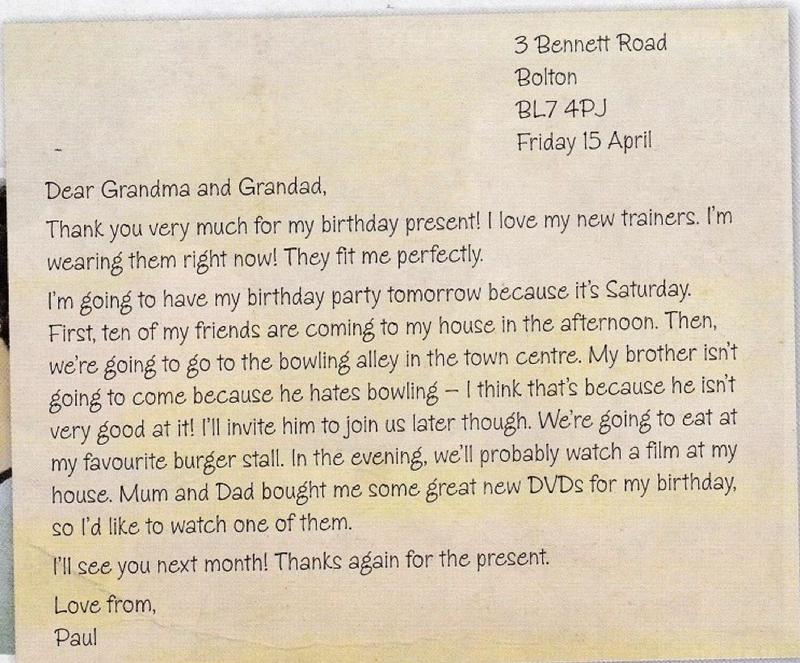
Pulse 2 Student's Book (Form 2), p. 70, Writing.
A letter has a fixed shape. Paul's letter has these parts:
| Part | What it looks like | Tip |
|---|---|---|
| Address and date | Top right: street, town, postcode, then the day and date | Only in a paper letter; an email has no address |
| Greeting | Dear Grandma and Grandad, | Dear + name; capital letters |
| Paragraph 1 | Thank you for the present and say what you like about it | Thank first, then give a detail |
| Paragraph 2 | Your plans: First ... Then ... In the evening ... | Use order words and future forms |
| Paragraph 3 | I'll see you next month! Thanks again. | A short, warm closing |
| Sign-off | Love from, Paul | Name on its own line |
Subject and object pronouns
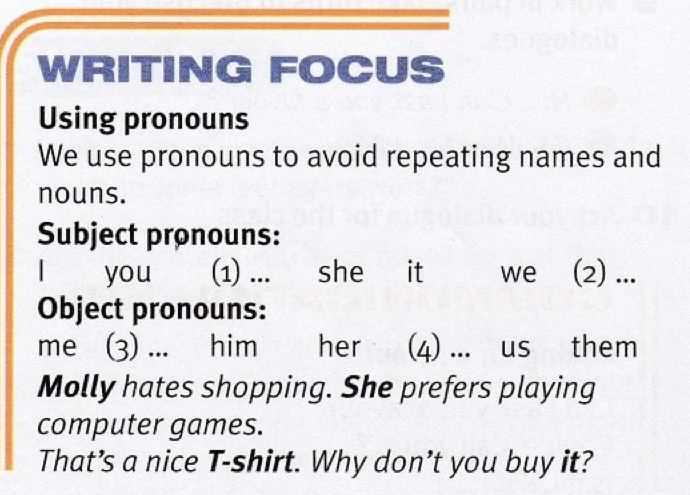
Pulse 2 Student's Book (Form 2), p. 70, Writing focus.
| Singular | Plural | Where it goes | |
|---|---|---|---|
| Subject | I, you, he, she, it | we, you, they | Before the verb: She prefers computer games. |
| Object | me, you, him, her, it | us, you, them | After the verb or a preposition: I'll invite him. They fit me. |
Use a pronoun for something already mentioned: I love my new trainers. I'm wearing them right now! If you repeat the noun every time, the writing sounds heavy and loses marks for Organisation.
"Me and my friend went there." The safe order is My friend and I went there.
"My brother hates bowling. He isn't good at
"Tilda helped
Talking about plans
Paul uses three ways to speak about the future. Page 70's checklist asks you to check them.
| Form | Use | From the letter |
|---|---|---|
| be going to + verb | A plan you have already decided | I'm going to have my birthday party tomorrow. |
| will / 'll + verb | A decision at the moment of speaking, an offer, or a prediction (with probably) | I'll invite him to join us. We'll probably watch a film. |
| present continuous | A fixed arrangement with a person or a time | Ten of my friends are coming to my house. |
Show answerHide answer
10.3The blog post: what you have and have not done
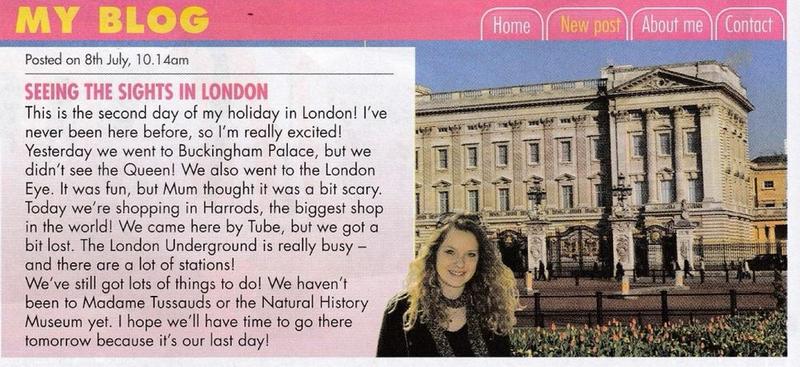
Pulse 2 Student's Book (Form 2), p. 82, Writing.
A blog post has a title, a date and time and a friendly, chatty voice. The writer on page 82 is on holiday and uses four time references in three short paragraphs (your own Writing task asks for two short paragraphs, built on notes about now, already done and not done yet):
| Time | Tense | Example |
|---|---|---|
| Now | Present simple or present continuous | Today we're shopping in Harrods. The London Underground is really busy. |
| Yesterday | Past simple | Yesterday we went to Buckingham Palace. |
| Up to now | Present perfect | I've never been here before. We haven't been to Madame Tussauds yet. |
| Tomorrow | will | I hope we'll have time to go there tomorrow. |
really and a bit
Before an adjective in informal writing, really = very (stronger) and a bit = a little (weaker).
| Not very ... | With a bit | Strong feeling | With really |
|---|---|---|---|
| It wasn't very fast. | It was a bit slow. | It was hot. | It was really hot. |
| The meal wasn't very cheap. | The meal was a bit expensive. | I'm hungry. | I'm really hungry! |
"It was
"I'm
"We went to
Show answerHide answer
10.4The email: adjectives and feelings
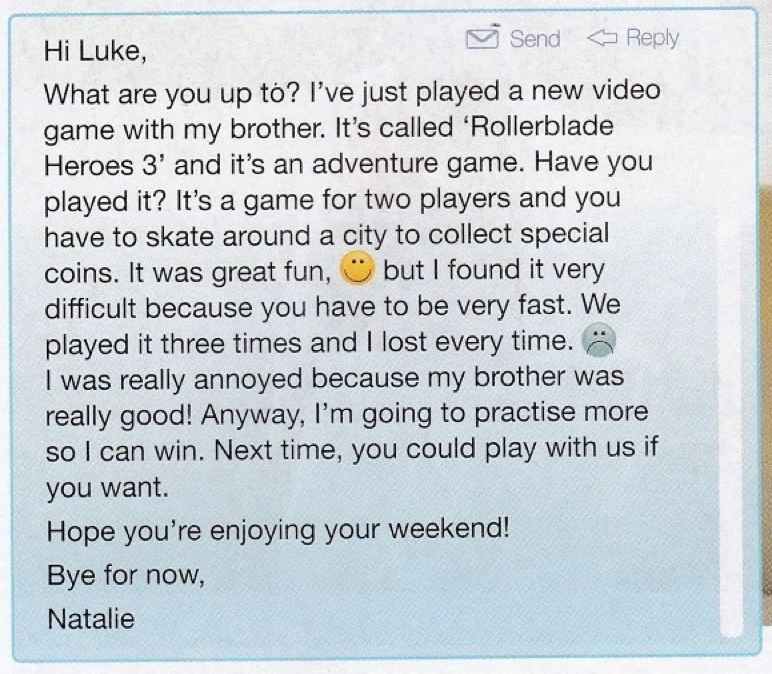
Pulse 2 Student's Book (Form 2), p. 92, Writing.
Natalie's email has Hi + name at the start and her name at the end. In between she tells Luke what she did, how she felt and what she plans next, and she invites him (you could play with us).
| Part | From Natalie's email |
|---|---|
| Greeting | Hi Luke, |
| Opening question | What are you up to? |
| What happened | I've just played a new video game with my brother. ... We played it three times and I lost every time. |
| Feelings | It was great fun. ... I found it very difficult. ... I was really annoyed. |
| Plans and invitation | I'm going to practise more. Next time, you could play with us if you want. |
| Closing and sign-off | Hope you're enjoying your weekend! Bye for now, Natalie |
Using adjectives and emoticons
Adjectives go before a noun (a nice weekend) or after be and look (The game looks fun. They looked unhappy.). An emoticon is a small face that shows a feeling. Use it for friends only, and not instead of a word.
| Feeling | Adjectives |
|---|---|
| Happy | happy, delighted, excited, pleased |
| Not happy | unhappy, sad, annoyed, disappointed, embarrassed |
| Surprised | surprised, amazed, shocked |
| Worried | worried, nervous, scared |
"I was
"She's a
"The game
Show answerHide answer
10.5The instant message: asking for and giving advice
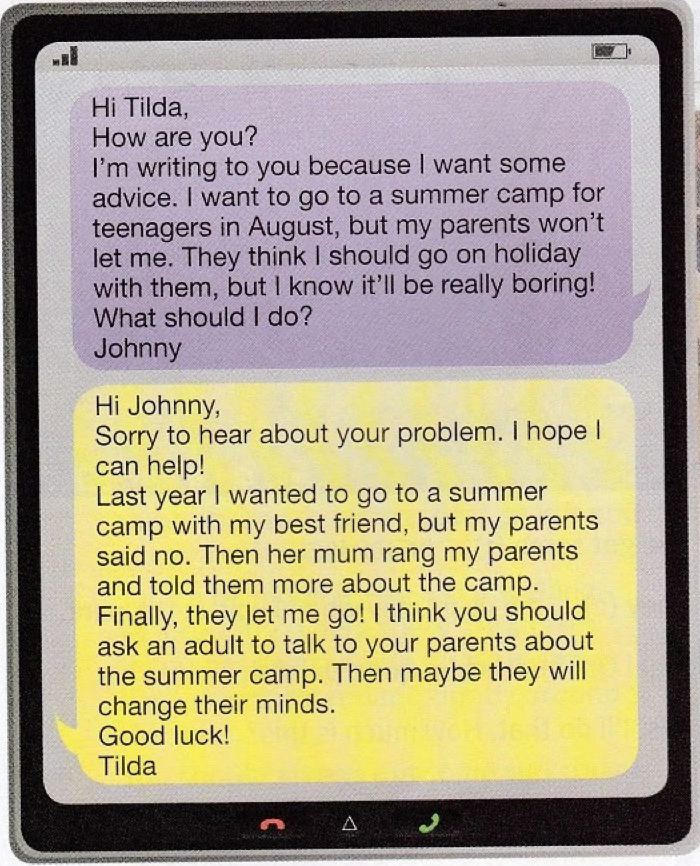
Pulse 2 Student's Book (Form 2), p. 102, Writing.
The message that asks for advice has four steps: greet, say why you are writing (I'm writing to you because I want some advice), explain the problem, and ask What should I do?
The reply that gives advice also has a set order. Tilda's reply works like this:
| Step | Tilda's words |
|---|---|
| 1. Greeting and sympathy | Hi Johnny, Sorry to hear about your problem. I hope I can help! |
| 2. A similar experience | Last year I wanted to go to a summer camp ... but my parents said no. Then her mum rang my parents ... Finally, they let me go! |
| 3. Advice | I think you should ask an adult to talk to your parents. Then maybe they will change their minds. |
| 4. Good wishes and name | Good luck! Tilda |
Using different tenses
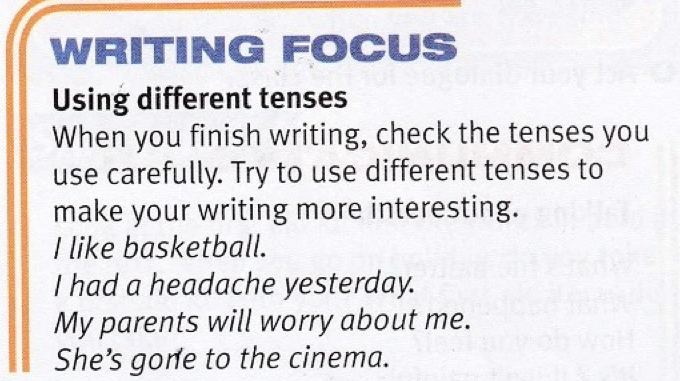
Pulse 2 Student's Book (Form 2), p. 102, Writing focus.
| Tense | Example | Use |
|---|---|---|
| Present simple | I like basketball. / They think I should go. | Facts, habits and opinions |
| Past simple | I had a headache yesterday. | A finished event |
| Future with will | My parents will worry about me. | A prediction |
| Present perfect | She's gone to the cinema. / We've lived here since 2011. | A result now, or a time up to now (for / since) |
Finish by checking each verb for the four things on the page 102 checklist: spelling, tense, agreement with the subject (she goes) and word order (What should I do?, not What I should do?).
"I think you
"My parents
"I
Show answerHide answer
10.6Speaking functions that feed your writing
Each unit's Integrated skills page practises one function in a short dialogue. The same phrases appear in notes and messages, so learn them as chunks.
| Function (page) | Useful phrases from the dialogue and the Communication kit |
|---|---|
| Asking for a favour (69) | Can I ask you a favour? / Could you lend me ..., please? / Is it OK if I ...? / Would you mind helping me with ...? / I'll pay you ... to ... / OK, it's a deal! |
| Asking for travel information (81) | Could you tell me how to get to ...? / How do I get to ...? / Where do I change (trains)? / How much is it? / What time does it leave? |
| Making arrangements (91) | Shall we go to ...? / What do you want to do? / Let's go / do / play ... / What time does it start? / Where shall we meet? / Do you want a lift? / I'll see you outside / near / at ... |
| Talking about health (101) | What's the matter? / What happened? / How do you feel? / It's / It isn't painful. / I think you should ... / Why don't you ...? / Hope you feel better soon! |
Chris: Shall we go to the leisure centre on Saturday?
Lucy: Yes, let's go in the morning. What time does it start?
The same idea in an instant message
Hi Lucy, shall we go to the leisure centre on Saturday morning? It starts at ten, so let's meet outside at quarter to ten. Do you want a lift?
10.7From textbook to Paper 2 Part 1
All four texts follow the same method you used in Tingkatan 1. It is now one level harder because you must choose the right type of text, tense and tone yourself.
| Step | What to do |
|---|---|
| 1. Read the task | Who is the reader? Why am I writing (thank, advise, invite, tell)? How many words (about 80)? Underline every question or request: these are the content points. |
| 2. Plan | Note one answer and one detail or reason for each point. Choose the tenses: past for what happened, present for feelings and facts, future for plans. |
| 3. Write | Greeting, opening, body in two or three short paragraphs, closing, sign-off, name. |
| 4. Check | All points covered? Capitals, full stops, question marks? Verb tense, spelling and agreement? Pronouns instead of repeats? Informal but correct (no |
The examiner gives 0 to 5 in four areas: content, communicative achievement (format and tone), organisation (linking) and language, so 4 × 5 = 20 marks.
Sorry to hear about your problem. I hope I can help!
Last year I wanted a phone too, but my mum said no. Then I saved some of my pocket money and showed her a list of good reasons. She was really surprised, and finally she agreed!
I think you should talk to your parents calmly and promise to follow their rules. They will probably change their minds.
Good luck!
Hana
This reply has 73 words, inside the 70 to 100 range for "about 80". It covers all the points on page 102's plan (sympathy, a similar experience, advice), uses past simple, present simple and will, and ends with a friendly sign-off.
Show answerHide answer
Summary
- Four short messages: informal letter (p.70), blog post (p.82), email (p.92) and instant message (p.102). Each needs a greeting, a body that covers every point, a closing and your name.
- Use subject pronouns (I, you, he, she, it, we, they) before verbs and object pronouns (me, you, him, her, it, us, them) after verbs; do not repeat nouns.
- Plans: be going to, will and the present continuous. Letter order words: First, Then, In the evening.
- Blog: present perfect with already / yet / never; past simple with a finished time; really = very, a bit = a little, both before an adjective.
- Email: Hi + name, feelings with adjectives (before a noun or after be and look), emoticons for friends only.
- Instant message for advice: sympathy, a similar experience, advice with I think you should ..., good wishes. Use several tenses and check spelling, tense, agreement and word order.
- Paper 2 Part 1: about 80 words, 20 marks, four areas of 5 marks. Read, plan, write, check.