Writing from notes: note expansion and extended writing
What this chapter covers
- I can describe Paper 2 Part 2 of the UASA (note expansion, 20 marks) and how it is marked (11.1)
- I can read a writing task and its notes and decide the text type, the reader and the tenses (11.2)
- I can plan a text with one paragraph for each note, each with a topic sentence (11.3, p.70, p.82)
- I can expand a short note into full sentences with details, examples, reasons and feelings, using pronouns, really and a bit, and adjectives (11.4, pp.70, 82, 92)
- I can link ideas with although, however, so that, while, who and which (11.5)
- I can use the past simple, present perfect, present continuous, be going to and will correctly in one text (11.6, pp.82, 102)
- I can write an informal letter, blog post, email, advice reply or advice leaflet and say what each needs (11.8, pp.70, 82, 92, 102, 72-73, 104-105)
- I can write a text of about 100 words from notes and check it for notes, linking, tenses, spelling and punctuation before I hand it in (11.7, 11.9)
In Paper 2 Part 2 you get a short task and a few notes, and you turn the notes into a full text of about 100 words, in paragraphs. This is note expansion. In Form 1 the notes were mostly about a trip or a friend. In Form 2 the topics are wider (journeys, luck, health, money) and the examiner expects more: a mix of tenses, linking words that show reason and contrast, and details that make the reader see what happened. The four writing pages in Pulse 2 (pages 70, 82, 92 and 102) and the two group projects (pages 72-73 and 104-105) give you a model of a good text, a short checklist, and the grammar to use.
11.1What Part 2 looks like
| Paper 2 Part 2 at a glance | Details |
|---|---|
| Marks | 20 marks (half of Paper 2). Part 1, the short message, is the other 20. |
| Type of task | Note expansion: a short text written from notes. It can be an essay, a narrative (a story of what happened), an article or a letter. |
| Standards tested | 4.1.3 narrate factual and imagined events and experiences; 4.1.4 express opinions and common feelings; 4.1.5 organise and sequence ideas; 4.2.1 punctuation; 4.2.2 spelling |
| Level | B1 Low (CEFR) |
| Length | The task gives the number, so follow it. The Form 1 papers asked for about 90 words; in Form 2 a safe target is about 100 words, about 30 words for each note. If a question gives a different number, follow it. |
| The rule | You must use all the notes. |
In about 100 words, write an essay about a journey that you will never forget.
You must use the notes below to help you.
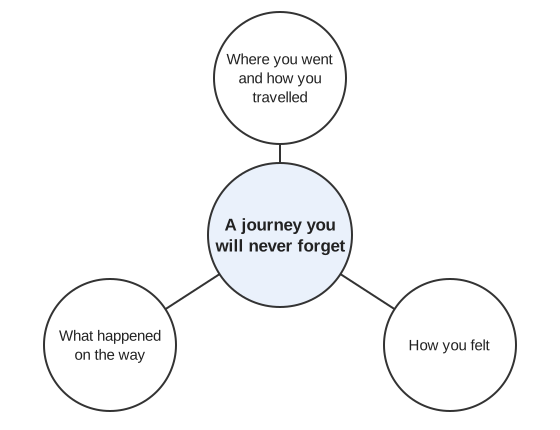
The marks are shared across four areas (5 marks each, as in Form 1): Content (every note used, nothing off the topic), Communicative achievement (it reads like a real essay or narrative, with a clear opening and ending), Organisation (paragraphs and linking words) and Language (grammar, vocabulary, spelling and punctuation).
Standards and marks from the Form 2 JSU for Paper 2 (publisher JSU, 2026); the writing models and checklists are from Pulse 2, pp.70, 82, 92, 102.
Show answerHide answer
11.2Reading the task and the notes
Before you write, read the task and answer four questions.
| Ask | Look for | In the journey task |
|---|---|---|
| 1. What is the topic? | the words after write about | a journey you will never forget |
| 2. What type of text? | essay, narrative, article, letter, message | an essay: title, beginning, middle, ending |
| 3. How many words? | In about ... words | about 100 words |
| 4. Which tenses? | when did it happen? is it a habit? is it still going on? | mostly past simple; present perfect for what you have learnt since |
Turn each note into questions
Change every note into two or three wh- questions. Your answers become your sentences.
| Note | Questions to answer |
|---|---|
| Where you went and how you travelled | Where did you go? When? Who was with you? How did you travel? Why were you going? |
| What happened on the way | What did you see? What went wrong or right? What did you do about it? |
| How you felt | How did you feel at the start and at the end? Why? What have you learnt? |
Show answerHide answer
11.3Planning your paragraphs
Spend about 5 minutes on a plan. The easiest plan gives one paragraph to each note, with a short title.
| Part | What goes in it | Words (for about 100) |
|---|---|---|
| Title | a short name, e.g. A Journey I Will Never Forget | (not counted) |
| Paragraph 1 | Note 1, with an opening sentence that tells the reader the topic | about 30 |
| Paragraph 2 | Note 2, with two or three details | about 40 |
| Paragraph 3 | Note 3, ending with a closing sentence | about 30 |
Look at how the models in Pulse 2 are built. Paul's letter on p.70 has three paragraphs: thanks for the present (the opening), plans for the party (the long middle paragraph) and a short ending that looks ahead. The blog post on p.82 has three short paragraphs and moves through the notes in order: where she is and how she feels with what she has done, what she is doing now, and what she has not done yet. The blog task under it asks you to write two short paragraphs. The task on each page tells you how many paragraphs to write, so count them.
Each paragraph starts with a topic sentence: a sentence that gives its main idea. The other sentences give supporting details.
P1 (where, how): last December; KL to Butterworth; train; family; first long train ride; excited
P2 (what happened): window seat, paddy fields; train stopped near Ipoh, one hour (track problem); ate sandwiches; played cards
P3 (feelings): late but happy; proud; learnt to stay calm
Short notes, not sentences. Tick each point when you have used it.
Show answerHide answer
11.4Expanding a note into sentences
This is the main skill of Part 2. Take one note and build it up, step by step.
| Step | Add | Example |
|---|---|---|
| 1. A full sentence | a subject and a verb in the right tense | The train stopped. |
| 2. When or where | a time or place | The train stopped near Ipoh at noon. |
| 3. A describing word | an adjective, or really / a bit + adjective | The long train stopped near Ipoh at noon. Everyone was a bit worried. |
| 4. A detail or example | what happened, such as, for example | There was a problem with the track. |
| 5. A reason, a result or a feeling | because, so, how you felt | ... so we waited for an hour and I felt really bored. |
The note "train stopped" (2 words) has become: Near Ipoh, the long train stopped because there was a problem with the track, so we waited for an hour and I felt really bored. (25 words). Do this for each note and you reach about 100 words. Choose your two or three best details for each note.
Words from the Pulse 2 Writing focus boxes
| Use | What to do | Example |
|---|---|---|
| Pronouns (p.70) | Use subject and object pronouns so that you do not repeat names and nouns. | |
| really and a bit (p.82) | really = very; a bit = a little. Both come before an adjective, in informal writing. | The Underground is really busy. Mum thought it was a bit scary. |
| Adjectives (p.92) | Before a noun, or after be and look, to say how you feel or what something is like. | It looks fun. The game was very difficult. I was really annoyed. |
| Different tenses (p.102) | Use a mix of tenses, and check each one. | I like basketball. I had a headache yesterday. My parents will worry. She has gone to the cinema. |
Copying the note:
Ideas that are not about the task, such as a long description of the train driver's uniform. Stay on the notes.
Repeating one idea to reach the word count:
Writing far too much about one note and only one sentence about another. About 30 to 35 words for each note.
(a) went to Melaka - by coach
(b) ate - Jonker Street - hungry
(c) lost - wallet - worried
Show answerHide answer
(a) During the school holidays, we went to Melaka by coach. The journey took about two and a half hours.
(b) We were really hungry, so we ate at a stall in Jonker Street. I had chicken rice balls and they were delicious.
(c) At the market, I lost my wallet, and I felt very worried because my pocket money was in it.
Check: a full sentence with a subject and a past verb, plus a time, place, reason or feeling.
11.5Linking words and keeping ideas together
Linking words join ideas so that your text flows, and they are part of the Organisation score. In Form 2 you are expected to use a wider choice than and and then.
| Job | Linking words | Example |
|---|---|---|
| order | first, then, next, after that, later, finally, in the end | First, ten friends are coming. Then, we are going bowling. (p.70) |
| adding | and, also, besides that, what is more | We went to Buckingham Palace. We also went to the London Eye. (p.82) |
| contrast | but, however, although, though | Although we arrived late, I felt happy. I'll invite him, though. |
| reason | because, as, since | My brother isn't coming because he hates bowling. (p.70) |
| result | so, as a result | The train stopped, so we waited. |
| purpose | to, so that, so I can | I'm going to practise more so I can win. (p.92) |
| time | when, while, as soon as, before, after, since | While we waited, we played cards. |
| ending | in the end, all in all, anyway | Anyway, I'm going to practise more. (p.92) |
Also join ideas with who, which and where
Instead of two short sentences, make one longer sentence with who (people), which (things) or where (places). This is a good way to move from A2 to B1.
| Two short sentences | One joined sentence |
|---|---|
| I have a cousin. He lives in Kuching. | I have a cousin who lives in Kuching. |
| We ate a sandwich. My mother made it. | We ate a sandwich which my mother made. |
| We visited Harrods. It is the biggest shop in the world. | We visited Harrods, which is the biggest shop in the world. |
| That is the beach. We played football there. | That is the beach where we played football. |
Commas: put a comma after a linking word that starts a sentence (However, ...), and before so and but that join two full sentences.
Starting every sentence with Then or and then. Mix your linking words.
(a) The train was late. We had a good time. (although)
(b) I want to save money. I am going to get a part-time job. (so that or because)
(c) Molly has a brother. He plays the guitar. (who)
Show answerHide answer
(b) I am going to get a part-time job so that I can save money. (or: I am going to get a part-time job because I want to save money. / I want to save money, so I am going to get a part-time job.)
(c) Molly has a brother who plays the guitar.
11.6Tenses and the grammar to check
Tense consistency means staying in the same tense unless the time changes. Page 102 says it plainly: use different tenses to make your writing interesting, but check each one carefully.
| Time | Tense | Example from Pulse 2 |
|---|---|---|
| finished event, time known | past simple | Yesterday we went to Buckingham Palace. (p.82) |
| no exact time, or it still matters now | present perfect (have/has + past participle) | I have never been here before. We haven't been to Madame Tussauds yet. (p.82) |
| a period up to now | present perfect + for / since | I've been a supporter for two years / since 2012. (p.93) |
| happening now | present continuous | Today we are shopping in Harrods. (p.82) |
| plan or intention | be going to | I'm going to have my birthday party tomorrow. (p.70) |
| prediction, decision, hope | will | I hope we'll have time to go there tomorrow. (p.82) |
| habit or fact | present simple | The Underground is really busy. (p.82) |
Using the present perfect in your own text
In a text about "what you have already done and not done yet" (p.82), use already in positive sentences, yet in negatives and questions, and never/ever for experience. Make the past participle from the irregular verbs list on p.111 of Pulse 2 (go - went - gone, see - saw - seen, be - was/were - been).
| Check | Wrong | Right |
|---|---|---|
| time word shows past simple | Yesterday I saw the palace. | |
| past participle | I have already seen the palace. | |
| negative + yet | We haven't visited the museum yet. | |
| for or since | I have lived here for ten years. / since 2016. | |
| subject-verb agreement | My mother has packed lunch. | |
| past form | My brother bought a kite. We were tired. |
"Last year I (want / wanted / have wanted) to go to a summer camp, but my parents said no. I (haven't gone / didn't go / don't go) to a camp since then, but I (have / had / am having) a new plan for next year."
Show answerHide answer
11.7Worked example: from notes to essay
Here is the whole method on the journey task in 11.1.
| Step | What you do | Time |
|---|---|---|
| 1. Read the task | topic, text type, word count, tenses | about 5 minutes |
| 2. Ask questions | turn each note into wh- questions | |
| 3. Plan | title + one paragraph for each note, in short notes | |
| 4. Write | a topic sentence, then two or three details for each note | about 25 minutes |
| 5. Link | linking words inside and between paragraphs | |
| 6. Check | all notes used? tenses, spelling, punctuation; count the words | about 5 to 10 minutes |
A Journey I Will Never Forget
Last December, my family travelled by train from Kuala Lumpur to Butterworth to visit my grandparents. It was my first long train journey, so I was really excited.
At first, everything went well. We sat by the window and watched the paddy fields pass by. However, the train stopped for an hour near Ipoh because of a problem with the track, so we ate the sandwiches that my mother made.
Although we arrived late, I felt happy and proud because I did not complain once. I have learnt that a delay can be fun if you stay calm.
| Why it scores well | Where you can see it |
|---|---|
| Content: all three notes | P1 where and how; P2 what happened; P3 how I felt, with reasons |
| Communicative achievement | title; opening sentence that gives the topic; closing sentence with a lesson |
| Organisation | three paragraphs; so, At first, However, because, Although, if; that my mother made joins two ideas |
| Language | past simple throughout the story, present perfect (I have learnt) for what is true now; really before an adjective |
| Length | about 100 words, about 30 to 40 for each note |
11.8Different text types from Pulse 2
The note expansion task can ask for different kinds of text. The four writing pages and two projects show what each type needs, and the same ideas (notes, paragraphs, linking, checking) work for all of them.
| Text type | What it needs | Language to use |
|---|---|---|
| Informal letter (p.70) | Dear ... at the start, your name at the end; thanks, then plans; three paragraphs | pronouns; I'm going to ..., we'll ...; First, Then |
| Blog post (p.82) | a title; where you are and how you feel; what you have done, what you are doing, what you have not done yet | present perfect; really and a bit; past simple |
| Email (p.92) | Hi ... at the start, your name at the end; about something you did; how you felt; a friendly ending | adjectives for feelings; past simple; Anyway; Hope you ... |
| Reply giving advice (p.102) | show you understand the problem; give an example of a similar situation and say what happened; then advise | different tenses; I think you should ...; Then maybe ... |
| Poster / fact file (pp.72-73) | facts, reasons why something is in danger, in your own words; different types of information | present simple for facts; because for reasons |
| Advice leaflet (pp.104-105) | headings (When to visit, Where to visit, What to do, ...); do and don't; a friendly ending | You should ..., You shouldn't ...; imperatives (Buy tickets in advance) |
1. Say you understand: Sorry to hear about your problem. I hope I can help.
2. Give an example: Last year I wanted to join a camp too, but my parents said no. Then my friend's mum rang them and told them more about the camp. Finally, they let me go!
3. Give your advice: I think you should ask an adult to talk to your parents. Then maybe they will change their minds.
Show answerHide answer
(a) You should try the local food, such as laksa and cendol.
(b) You shouldn't swim in the river after heavy rain.
(c) You should carry water because the weather is very hot at midday.
Check: should / shouldn't + base verb, and a reason joined with because.
11.9Checking your work
Keep 5 to 10 minutes at the end. The group projects on pp.72-73 and 104-105 show how real writers do it: make a draft, read it, and then revise it. Check the grammar, the spelling and the punctuation separately.
| Check | Ask yourself |
|---|---|
| Notes | Did I use every note? Did I give a reason for each feeling or opinion? |
| Paragraphs | One paragraph for each note? A title, an opening and an ending? |
| Linking | At least four different linking words, not only and and then? |
| Tenses | Right tense in each sentence? Past forms correct (went, bought, felt)? Have/has + past participle? |
| Agreement | he goes, she has, they were: do the subject and the verb match? |
| Spelling | Check the words you are unsure of (p.105: use a dictionary, and spell tricky words letter by letter). |
| Punctuation | capital letters for names and the start of sentences; full stops; commas after linking words and in lists |
| Length | About the number of words asked? Count one line and multiply by the number of lines. |
Find the errors and write a better version.
Show answerHide answer
Better: Last Sunday, my family went to the market. We bought fruit and then we ate lunch at a small stall. All in all, I felt happy because we spent the whole day together.
Summary
- Paper 2 Part 2 is note expansion: a text of about 100 words from three or so notes, 20 marks. Follow the number of words in the task. You must use all the notes.
- Marks go to Content, Communicative achievement, Organisation and Language (5 each). The JSU standards are 4.1.3 to 4.1.5, 4.2.1 and 4.2.2.
- Read the task: topic, text type, word count, tenses. Turn each note into wh- questions.
- Plan one paragraph for each note, each with a topic sentence. Follow the paragraph count in the task (the letter task on p.70 asks for three, the blog task on p.82 for two).
- Expand each note: full sentence, then when or where, a describing word (really, a bit), a detail, and a reason or feeling.
- Use a wide choice of linking words (although, however, so that, while, who, which), and pronouns so that you do not repeat nouns (p.70).
- Use different tenses correctly: past simple, present perfect (already, yet, for, since), present continuous, be going to, will (pp.82, 102).
- Check before you finish: notes, paragraphs, linking words, tenses, agreement, spelling, punctuation, length.