Vocabulary: money, transport, sport and luck, health and personal issues
What this chapter covers
- I can use the money and shopping words buy, sell, cost, spend, save, earn, pay for, borrow and lend correctly (p.65)
- I can name jobs and chores such as babysit, pet sit, do the ironing and lay the table, and ask for a favour politely (p.71)
- I can name forms of transport and use by + transport, and use verbs of movement such as sail, climb, cross, push and arrive (pp.74, 77, 83)
- I can use the words for sport and competitions (captain, coach, opponent, tournament) and play, do and go with sports (pp.84, 93)
- I can complete the luck superstitions with the right verb and partner word, such as cross your fingers and walk under a ladder (p.87)
- I can name common health problems, their causes and advice, and give advice with should, shouldn't, must and mustn't (pp.97, 103)
- I can understand the words for personal issues such as bullying, stress, diet and relationship (p.103)
- I can choose between easily confused words such as borrow / lend, win / beat and earn / win
The Form 2 reading and writing papers use the topics of Pulse 2, Units 6 to 9: money, journeys, sport and luck and health. In this unit you revise the vocabulary lists from the Vocabulary and Listening pages and the Study guides, learn which words go together, and practise using the words in short texts and sentences of your own.
12.1How to learn these word groups
Each unit of Pulse 2 ends with a Study guide that lists the vocabulary of the unit. Use those lists as your checklist.
| Unit and topic | Word groups | Study guide |
|---|---|---|
| Unit 6 Money | jobs and chores; money and shopping | p.71 |
| Unit 7 Journeys | transport; verbs of movement (1) | p.83 |
| Unit 8 Good luck, bad luck | sport and competitions; verbs of movement (2) | p.93 |
| Unit 9 Health | health problems; personal issues | p.103 |
- Learn in topic groups. The book's own advice is to keep a page for each topic, such as "sport and competitions", and add new words to it.
- Learn the partner words. Do not learn spend alone: learn spend money on, spend time.
- Learn the forms. Many verbs of movement are irregular: fly, flew, flown. Check the irregular verbs list at the back of the book.
- Use each word in a sentence about your own life. "I save RM5 every week" is easier to remember than "save = keep money".
12.2Money, shopping, jobs and chores
Word lists: buku teks Pulse 2, ms. 65 and 71.
Money and shopping (p.65)
| Word | Meaning and partner words | Example |
|---|---|---|
| buy / sell | give money and get a thing / give a thing and get money | Some stalls sell second-hand clothes. I want to buy a jacket. |
| cost | the price of something (the thing is the subject) | How much does this bag cost? |
| spend | use money (or time); spend money on a thing | I spent RM20 on a T-shirt. |
| save | keep money for later; not spend it | She wants to save her birthday money. |
| earn | get money by working | He earns RM6 an hour. |
| pay for | give money for something you buy or use | I'll pay for the coffees. |
| borrow / lend | take something for a short time / give it for a short time | Can I borrow your pen? Can you lend me your pen? |
| lose | cannot find something any more; not win | I lost my bus ticket. |
| swap | give one thing and take another | We swapped our old games. |
| win | get a prize or first place | He won RM50 in a quiz. |
| collect | bring things or money together (for charity, or as a hobby) | They collect money for sick children. |
The message board on p.63 adds more useful words: pocket money (money parents give you), a tip (a piece of advice), a bargain (something good at a low price), second-hand (used before), sort out (put things in order and decide what to keep), apply (ask for a job) and recycle.
Jobs and chores (p.71)
| Group | Words |
|---|---|
| Chores at home | do the ironing, do the washing-up, do the gardening, lay the table, make the beds, tidy your room, clean the windows |
| Jobs to earn money | babysit, pet sit, wash cars, take dogs for walks, deliver newspapers |
Show answerHide answer
12.3Transport and verbs of movement (1)
Word lists: buku teks Pulse 2, ms. 74 (transport), 77 and 83.
Forms of transport (pp.74, 83)
| Group | Words |
|---|---|
| Road | bicycle, motorbike, lorry, coach, caravan, horse and carriage |
| Rail | tram, the Underground (the Tube in London) |
| Water | ship, ferry, yacht |
| Air | plane, helicopter, hot-air balloon |
A lorry carries large, heavy things. A helicopter takes people by air in an emergency. A motorbike is a fast, noisy vehicle for one or two people. A ferry carries people and cars on short journeys across the sea. A coach takes large groups on long journeys by road.
On p.74 the book says by + transport with no a or the: by bus, by ship, by plane. But on foot: on foot. Use in or on for a particular vehicle: live in a caravan, travel in a hot-air balloon, travel on the Underground.
Verbs of movement (1) (p.77)
| Verb | Meaning | Past simple / past participle |
|---|---|---|
| sail | travel on water in a boat or ship | sailed / sailed |
| fly | travel through the air | flew / flown |
| climb | go up (a hill, a mountain) | climbed / climbed |
| drive | control a car or lorry | drove / driven |
| cross | go from one side to the other | crossed / crossed |
| fall | go down quickly by accident | fell / fallen |
| crash | hit something with a loud noise | crashed / crashed |
| carry | hold and take something from one place to another | carried / carried |
| pull / push | move something towards you / away from you | pulled / pulled; pushed / pushed |
| follow | go behind someone or something | followed / followed |
| arrive | reach a place (arrive in a town or country, arrive at a building) | arrived / arrived |
| take off / land | leave the ground / come down to the ground (planes) | took off / taken off; landed / landed |
Show answerHide answer
12.4Sport, competitions and luck
Word lists: buku teks Pulse 2, ms. 84 (sport and competitions, play, do and go), 87 and 93.
Sport and competitions (pp.84, 93)
| Group | Words |
|---|---|
| People | captain (leader of a team), champion (the best), coach (trains a team), loser, opponent (the person or team you play against), supporter (a fan), winner |
| Things and places | goal, match, race, stadium, team, tournament (a competition made of many matches) |
| Use | For | Example |
|---|---|---|
| play | ball sports and games | Ben plays tennis on Saturday. |
| do | activities such as judo, archery, gymnastics | Kate does judo at school. |
| go + -ing | swimming, running and similar activities | I go running in the park. |
Phrases about sport: be in a school team, be captain of a team, take part in a tournament, win a match. You beat an opponent but you win a match.
Verbs of movement (2) and luck (p.87)
These twelve words come from the "Good (and bad) luck" superstitions: touch, carry, break, drop, spill, walk, cross, open, pick, scratch, meet, put.
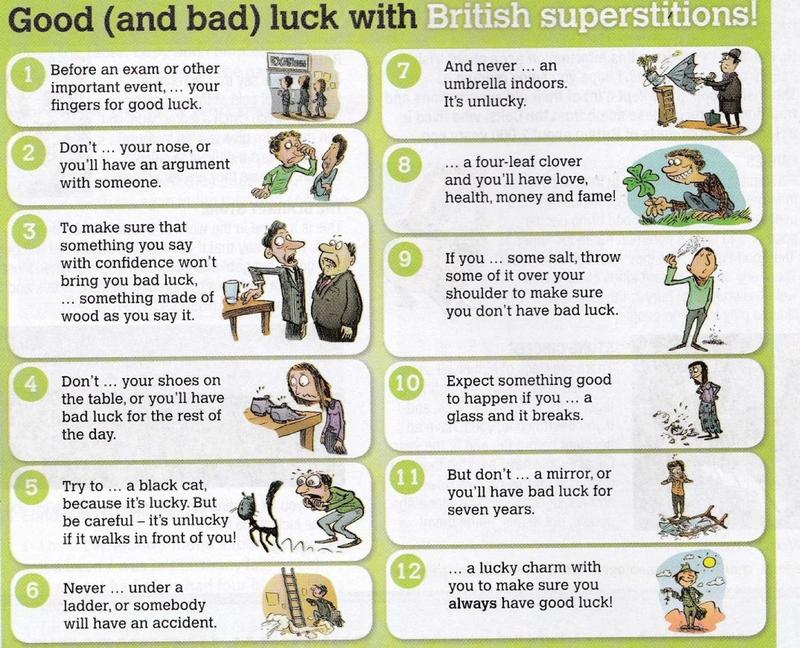
Good (and bad) luck with British superstitions: buku teks Pulse 2, ms. 87.
| Lucky | Unlucky |
|---|---|
| cross your fingers; touch wood; meet a black cat; pick a four-leaf clover; drop a glass and it breaks; carry a lucky charm | scratch your nose; put shoes on the table; walk under a ladder; open an umbrella indoors; spill salt (throw some over your shoulder to stop bad luck); break a mirror |
Show answerHide answer
12.5Health and personal issues
Word lists: buku teks Pulse 2, ms. 97 and 103.
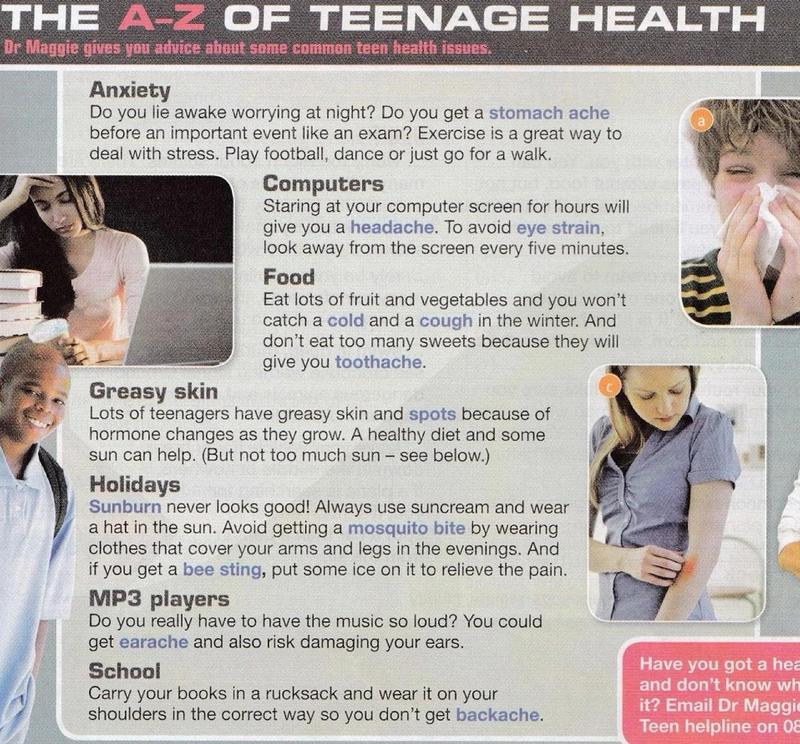
The A-Z of teenage health: buku teks Pulse 2, ms. 97.
Health problems and what the textbook says
| Problem | Cause | Advice |
|---|---|---|
| stomach ache | worry (anxiety) before an exam | take exercise: play football, dance, go for a walk |
| headache, eye strain | staring at a computer screen for hours | look away from the screen every five minutes |
| cold, cough | winter | eat lots of fruit and vegetables |
| toothache | too many sweets | do not eat too many sweets |
| spots | hormone changes as you grow | a healthy diet and some sun (not too much) |
| sunburn | too much sun | use suncream and wear a hat |
| mosquito bite | being outside in the evening | wear clothes that cover your arms and legs |
| bee sting | a bee | put some ice on it to relieve the pain |
| earache | very loud music | turn the music down (loud music can damage your ears) |
| backache | carrying books or a school bag in the wrong way (for example on one shoulder) | wear a rucksack on both shoulders in the correct way |
Personal issues (p.103)
appearance, arguments, bullying, depression, diet, exercise, health, relationship, social life, stress, vegetarian. Bullying is when someone hurts or frightens a weaker person again and again. Stress is a feeling of worry and pressure. A vegetarian does not eat meat.
| You want to | Say |
|---|---|
| ask about a problem | What's the matter? What happened? How do you feel? |
| describe pain | It's painful. / It isn't painful. I've got a headache. |
| give advice | I think you should ... / You should ... / Why don't you ...? / You shouldn't ... |
| show you care | Hope you feel better soon! |
- should / shouldn't give advice: "You should go to the doctor if you feel ill." "You shouldn't forget to eat fruit and vegetables."
- must / mustn't are stronger: "He must go to the hospital if his condition gets serious." "You mustn't react to a bully's behaviour."
- Questions: "Should you tell an adult?" Short answer: "Yes, you should."
Show answerHide answer
12.6Choosing the right word
| Pair | Difference | Example |
|---|---|---|
| borrow / lend | borrow from someone; lend to someone | Can I borrow your bike? I will lend you mine. |
| win / beat | win a match; beat a team or person | Our team beat Healey School and won the match. |
| earn / win | earn by working; win in a game or prize draw | She earns money by babysitting. |
| save / spend | keep / use | Don't spend it all; save some. |
| lose / miss | lose a thing or a game; miss a bus or a person | We missed the last bus. |
| sting / bite | a bee stings; a mosquito bites | I got a bee sting and a mosquito bite. |
Show answerHide answer
Summary
- Learn vocabulary in topic groups: money and shopping, jobs and chores, transport, verbs of movement, sport and competitions, luck, health, personal issues.
- earn by working, win in a game, save for later, spend now, borrow from and lend to a person, pay for a thing.
- Travel by bus / ship / plane. arrive in a city, arrive at a place. Irregular verbs: fly, flew, flown; drive, drove, driven; fall, fell, fallen.
- play ball games, do judo, go swimming. You beat an opponent and win a match.
- Luck verbs and their partners: cross your fingers, touch wood, scratch your nose, walk under a ladder, open an umbrella, break a mirror, spill salt.
- Health: have a headache / cold / cough; use should and shouldn't for advice, must and mustn't for strong rules. No to after them.