Module 0 : Faisons connaissance ! Dix bonnes raisons d'apprendre le français
What this chapter covers
- I can match eight teenagers to their interests and say what each one likes (les sciences, l'aventure, la cuisine, les collections, les poèmes, le collège, le cinéma, les projets humanitaires) (1.1)
- I can use je vais + infinitive for a plan and je voudrais + infinitive for a wish (Je vais réviser mon cours. Je voudrais visiter le Sénégal.) (1.1)
- I can give the ten good reasons for learning French and join a reason with pour + infinitive or parce que + a full clause (1.2)
- I can name the places, songs, books, films and countries that go with each reason, and say where French is spoken (1.2)
- I can use my book to find a word, a verb table, a grammar rule or the learning contract (dico p. 109, tableaux p. 125, précis p. 121) (1.3)
- I can revise A1 French by introducing myself, asking a question with est-ce que, describing hair and clothes with agreement, naming my favourite sport, saying where I live, telling the time and presenting my family (1.4)
Module 0 of Adosphère 2 is only five pages long (book pp. 8-12), but it sets up the whole year. It does three jobs. First, it lets you meet eight French-speaking teenagers who come back in Modules 1 to 8. Second, it gives ten good reasons to learn French. Third, it lets you revise the A1 French you learned in Tingkatan 1 with a short quiz. In the UASA paper these pages feed Partie 1 (grammar and vocabulary), Partie 2 (reading short texts) and Partie 3 (writing about yourself).
| Part | Book pages | What it does |
|---|---|---|
| Faisons connaissance ! | 8-9 | eight teenagers talk about what they love; a matching game and a dice game |
| Dix bonnes raisons d'apprendre le français ! | 10-11 | ten reasons, each with a photo (A to K); you choose your own three reasons |
| Apprendre à apprendre | 11 | how to use your book: dictionary, verb tables, grammar summary, learning contract |
| Révise ton français ! | 12 | an eight-question quiz that revises Tingkatan 1 French, plus a song |
1.1Faisons connaissance : the eight teenagers
Pages 8 and 9 show eight young people. Each one speaks in a speech bubble about something he or she loves. The question in exercise 1 is À ton avis, qui aime… ("In your opinion, who likes…"), and the answer comes from clues in the bubbles. Match each interest to the speaker, using the key word in the bubble.
| Who | Clue in the bubble | Interest |
|---|---|---|
| Jeanne | réviser mon cours de sciences… observer les étoiles avec mon télescope | les sciences (science) |
| Hugo | regarder le sport à la télé… j'adore l'aventure | l'aventure (adventure) and sport |
| Akiko | mon anniversaire… un pique-nique… préparer un gros gâteau | la cuisine (cooking) |
| Antoine | dans mon sac… une BD, des pièces de monnaie, mon porte-clés préféré | les collections d'objets (collecting things) |
| Manon | dimanche… dans ma chambre… pour écrire des poèmes | les poèmes (poems) |
| Étienne | Au Québec, je vais au collège en voiture… en France, j'habite chez mon correspondant | le collège (school life, exchange) |
| Wassim | les copains disent que je ressemble à un acteur de cinéma… je voudrais être réalisateur | le cinéma (cinema) |
| Émilie | visiter le Sénégal… Madagascar… participer à des projets humanitaires | les projets humanitaires (humanitarian projects) |
Three structures in the bubbles (one step up from Tingkatan 1)
| Structure | Use | Examples from the bubbles |
|---|---|---|
| je vais + infinitive | a plan or something about to happen (the near future) | Je vais réviser mon cours de sciences. / Je vais organiser un pique-nique. |
| je voudrais + infinitive | a wish or dream, politely: "I would like to…" | Je voudrais visiter le Sénégal. / Je voudrais être réalisateur. |
| j'adore / j'aime + noun | say what you love or like | J'adore l'aventure. |
| mon rêve, c'est de + infinitive | "my dream is to…" | Mon rêve, c'est de participer à des projets humanitaires. |
After je vais and je voudrais the second verb stays in the infinitive:
Aller here does not mean "go": je vais réviser is "I am going to revise", not "I go revise".
Show answerHide answer
2. Émilie (le Sénégal and Madagascar). Étienne speaks of Québec, which is in Canada, not Africa.
3. Je vais réviser mon cours de sciences.
4. Je voudrais visiter le Sénégal.
1.2Dix bonnes raisons d'apprendre le français
The question is Pourquoi apprendre le français ? ("Why learn French?"). The ten answers are in the book's list below. Every reason begins with Pour + an infinitive (visiter, comprendre, lire…), except reason 9, which begins with Parce que and a full clause.
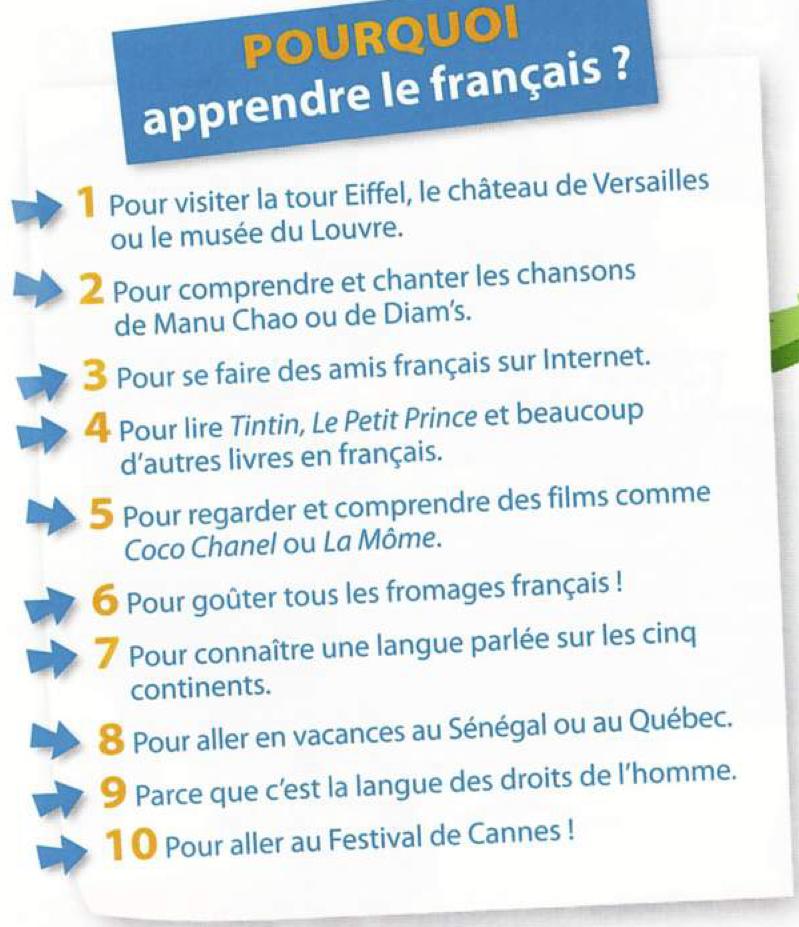
Adosphère 2, p. 10
| No. | Reason (my English) | Photo | Key vocabulary |
|---|---|---|---|
| 1 | to visit the Eiffel tower, the Château de Versailles or the Louvre | D (Versailles) | visiter, la tour Eiffel, le château, le musée |
| 2 | to understand and sing songs by Manu Chao or Diam's | B (a singer on stage) | comprendre, chanter, une chanson |
| 3 | to make French friends on the Internet | K (Skype logo) | se faire des amis, Internet |
| 4 | to read Tintin, Le Petit Prince and many other French books | A (books) | lire, un livre, beaucoup de |
| 5 | to watch and understand films such as Coco Chanel or La Môme | C (film poster) | regarder, un film |
| 6 | to taste all the French cheeses | F (cheese and grapes) | goûter, un fromage |
| 7 | to know a language spoken on the five continents | E (the green world map) | connaître, une langue parlée, un continent |
| 8 | to go on holiday to Senegal or Québec | J (the Québec balloon) | aller en vacances |
| 9 | because it is the language of human rights | H (the Declaration of Human Rights) | les droits de l'homme |
| 10 | to go to the Cannes Film Festival | G (Palme d'or) | aller au Festival de Cannes |
The photos are lettered A to K (there is no I) across pp. 10-11, and in exercise 2 you match each photo to one reason. The book's example is photo A → reason 4. Use the key word in the reason (livres, fromages, films, Cannes) to find its picture.
Pour + infinitive or parce que + clause
| Pattern | Meaning | Example |
|---|---|---|
| Pour + infinitive | "in order to…": purpose, the same subject | J'apprends le français pour lire Tintin. |
| Parce que + subject + verb | "because…": a cause with its own verb | J'apprends le français parce que c'est la langue des droits de l'homme. |
| Parce qu' before a vowel | the e drops | J'apprends le français parce qu'on a un super livre ! (the book's own example, p. 11) |
Where is French spoken?
Reason 7 says French is spoken on all five continents. The book's examples are in France (Europe), Senegal (Africa), Québec in Canada (North America) and, in the speech bubbles, Madagascar (Africa).
Show answerHide answer
2. Reason 6, Pour goûter tous les fromages français !
3. J'apprends le français parce que c'est amusant. (a clause with its own verb)
4. Parce que needs a subject and a verb. Use Pour lire Tintin, or Parce que je voudrais lire Tintin.
1.3Apprendre à apprendre : comment utiliser son livre ?
At the foot of p. 11 four children show how to use the book. This is a learning-to-learn task: you will use it in every module.
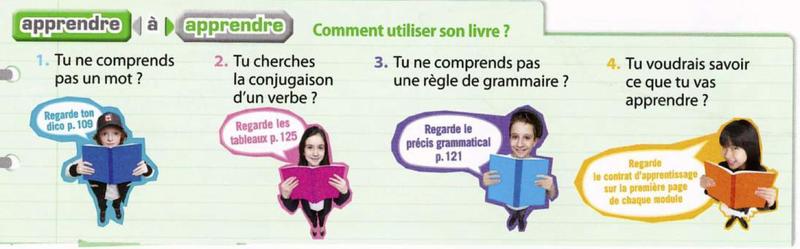
Adosphère 2, p. 11
| Your problem | Where to look |
|---|---|
| Tu ne comprends pas un mot ? (a word you do not know) | ton dico, p. 109 |
| Tu cherches la conjugaison d'un verbe ? (a verb form) | les tableaux, p. 125 |
| Tu ne comprends pas une règle de grammaire ? (a grammar rule) | le précis grammatical, p. 121 |
| Tu voudrais savoir ce que tu vas apprendre ? (what you will learn) | le contrat d'apprentissage, first page of each module |
Instruction words in Module 0
| French | English |
|---|---|
| Observe et lis | Look and read |
| Écoute et associe | Listen and match |
| Joue avec la classe | Play with the class |
| Imagine d'autres questions | Imagine other questions |
| Choisis la bonne réponse | Choose the right answer |
| Amuse-toi à réviser | Have fun revising |
1.4Révise ton français ! The eight A1 points
Page 12 is a quiz of eight "How do you say it?" questions, each with three choices. The book gives the solutions upside down at the foot of the page. Each question hides one rule from Tingkatan 1. Here are the eight rules, so that you can see why one choice is right.
| No. | To… | Correct model | Rule behind it |
|---|---|---|---|
| 1 | introduce yourself | Je m'appelle Rémi et j'ai 13 ans. | age uses avoir (j'ai), never être; name uses s'appeler |
| 2 | interview a classmate | Est-ce que tu aimes le sport ? | est-ce que + statement order makes a yes/no question |
| 3 | say what you and a classmate have in common | On est brun(e)s. | on = "we" (both of us); adjective agrees (brun m., brune f., plural -s) |
| 4 | talk about clothes | J'ai un t-shirt vert et des baskets blanches. | adjective agrees with the noun: baskets is feminine plural, so blanches |
| 5 | say your favourite sport | Je joue au football. | jouer à + sport (à + le = au); also faire du sport in general |
| 6 | say where you live | Chez moi, c'est à côté de la bibliothèque. | à côté de + place (de la); chez moi = "at my place" |
| 7 | tell the time | Il est dix heures moins le quart. | moins le quart = quarter to; it is 9:45 |
| 8 | talk about your family | Mon père et ma mère s'appellent Lisa et Marc. | mon + masculine, ma + feminine; ils s'appellent with -ent |
The solutions printed in the book are 1c, 2c, 3a, 4b, 5a, 6a, 7c, 8b.
Agreement of adjectives (colours and looks)
| Adjective | Masculine singular | Feminine singular | Masculine plural | Feminine plural |
|---|---|---|---|---|
| brun (dark-haired) | brun | brune | bruns | brunes |
| blanc (white) | blanc | blanche | blancs | blanches |
| vert (green) | vert | verte | verts | vertes |
In question 3 the other two choices are wrong: On est les cheveux bruns uses être with hair (hair is something you have), and On a les cheveux brunes has the wrong agreement, because cheveux is masculine plural and needs bruns. The right answer is On est brun(e)s (brun(e) with the e in brackets because a classmate may be a boy or a girl).
Telling the time
| Time | French |
|---|---|
| 9:00 | Il est neuf heures. |
| 9:15 | Il est neuf heures et quart. |
| 9:30 | Il est neuf heures et demie. |
| 9:45 | Il est dix heures moins le quart. |
| 9:55 | Il est dix heures moins cinq. |
(a) Je m'appelle Karim et je suis 14 ans / Je m'appelle Karim et j'ai 14 ans.
(b) Je joue du basket / Je joue au basket.
(c) Write 3:45 in French.
Show answerHide answer
(b) Je joue au basket: jouer à + sport, à + le = au.
(c) Il est quatre heures moins le quart.
1.5The song and the games
On p. 12 there is a song (Dans Adosphère, toi tu préfères…) that lists the module's interests: les collections, la télévision, lire des poèmes, faire la cuisine, tourner des films, la nature, l'aventure, l'école en France, le cours de sciences, l'humanitaire. Notice tu préfères and tu aimes: the tu form of -er verbs ends in -es.
On p. 8, exercises 3 and 4 are games: roll two dice in a group, answer the question with that number, and score a point; then invent new questions. Good questions use Est-ce que tu aimes…, Qu'est-ce que tu préfères ? or Pourquoi tu apprends le français ?
1.6Summary for the exam
| Topic | Remember |
|---|---|
| The eight teenagers | Jeanne = sciences, Hugo = adventure and sport, Akiko = cooking, Antoine = collections, Manon = poems, Étienne = school (Québec), Wassim = cinema, Émilie = humanitarian projects |
| Plans and wishes | je vais + infinitive; je voudrais + infinitive; mon rêve, c'est de + infinitive |
| Ten reasons | pour + infinitive; parce que + clause; reasons cover monuments, songs, Internet, books, films, cheese, five continents, holidays, human rights, Cannes |
| Learning to learn | word = dico p. 109; verb = tableaux p. 125; rule = précis p. 121; aims = contrat d'apprentissage |
| A1 revision | j'ai 13 ans; est-ce que; agreement (blanches); jouer au; à côté de; moins le quart; mon père, ma mère |
1.
2.
3.
4.
5.