Bahasa Perancis questions, module 3
Nama / NameKelas / ClassTarikh / Date
Manon : localiser, la maison et la chambre
44 marks. Use Practice to check each answer as you go, or Exam to answer everything first. The item types follow the school UASA paper: multiple choice, Partie 1 (prepositions of place, c'est / il est, the verb vouloir), Partie 2 (vrai ou faux, questions on a text, a table to read) and Partie 3 (a short message).
Section A: choix multiple
10 marksChoisissez la bonne réponse A, B, C ou D. Choose the correct answer A, B, C or D.
1
Question 1
Quel est le genre du livre « Paroles » de Jacques Prévert ? What kind of book is "Paroles" by Jacques Prévert?
Show answerHide answer
A
Paroles is a book of poems by the poet Prévert, so un recueil de poésies. Un roman policier is a detective novel, un journal intime a diary.
2
Question 2
Quel château a quatre tours rondes et a été construit par le roi François Ier ? Which château has four round towers and was built by King François I?
Show answerHide answer
A
Chambord (16th century, near Blois and the Loire). Chenonceau looks like a bridge on the river Cher; Versailles belongs to Louis XIV; Vincennes is not one of the three châteaux in the book.
3
Question 3
Dans le dialogue, où est le carnet de Manon ? In the dialogue, where is Manon's notebook?
Show answerHide answer
D
Her father suggests the chair, behind the sofa, under the window and the shelves, but Jeanne's idea works: the notebook is entre les deux coussins of the sofa.
4
Question 4
Choisissez la bonne forme. Choose the correct form.
Mon sac est à côté ______ fauteuil.
Mon sac est à côté ______ fauteuil.
Show answerHide answer
C
Fauteuil is masculine: de + le = du: à côté du fauteuil. De la is for a feminine noun, des for a plural.
5
Question 5
Choisissez la bonne réponse. Choose the right answer.
Regarde la terrasse. ______ très grande.
Regarde la terrasse. ______ très grande.
Show answerHide answer
B
The adjective très grande describes la terrasse (feminine): Elle est très grande. C'est needs a noun phrase after it.
6
Question 6
Choisissez la bonne réponse. Choose the right answer.
Voilà mes livres de poésie. ______ sur l'étagère.
Voilà mes livres de poésie. ______ sur l'étagère.
Show answerHide answer
A
Mes livres = masculine plural, and sur l'étagère tells us where, not what: Ils sont sur l'étagère. Ce sont would need a noun after it.
7
Question 7
Choisissez la bonne forme du verbe vouloir. Choose the correct form of vouloir.
Les ados ______ changer leur chambre.
Les ados ______ changer leur chambre.
Show answerHide answer
C
Les ados = ils, so veulent. Veut is for il / elle.
8
Question 8
Trouvez l'intrus. Find the odd one out.
Show answerHide answer
D
Un fauteuil is a piece of furniture (an armchair). The other three are rooms of a house.
9
Question 9
Quelle phrase est correcte ? Which sentence is correct?
Show answerHide answer
C
A needs veux (je + x); B needs voulez (vous); D needs voulons (nous). C: elles veulent is correct.
10
Question 10
Quel mot commence par le son [v] ? Which word begins with the sound [v]?
Show answerHide answer
B
vert begins with [v]. Bureau = [b], poème = [p], fenêtre = [f].
Section B: grammaire et vocabulaire (Partie 1)
12 marksRépondez à toutes les questions. Answer all the questions.
11
Question 11
Regardez le dessin et complétez les phrases avec les mots suivants. Attention : il y a deux mots en plus. Look at the picture and complete the sentences with the words below. Careful: there are two extra words.
(2) La petite table du salon est ______ les deux fauteuils.
(3) Les étagères sont ______ fauteuil.
(4) Le père de Manon est ______ la chaise.
sur / sous / entre / derrière / au-dessus du / dans
(1) Le bol de fruits est ______ la table.(2) La petite table du salon est ______ les deux fauteuils.
(3) Les étagères sont ______ fauteuil.
(4) Le père de Manon est ______ la chaise.
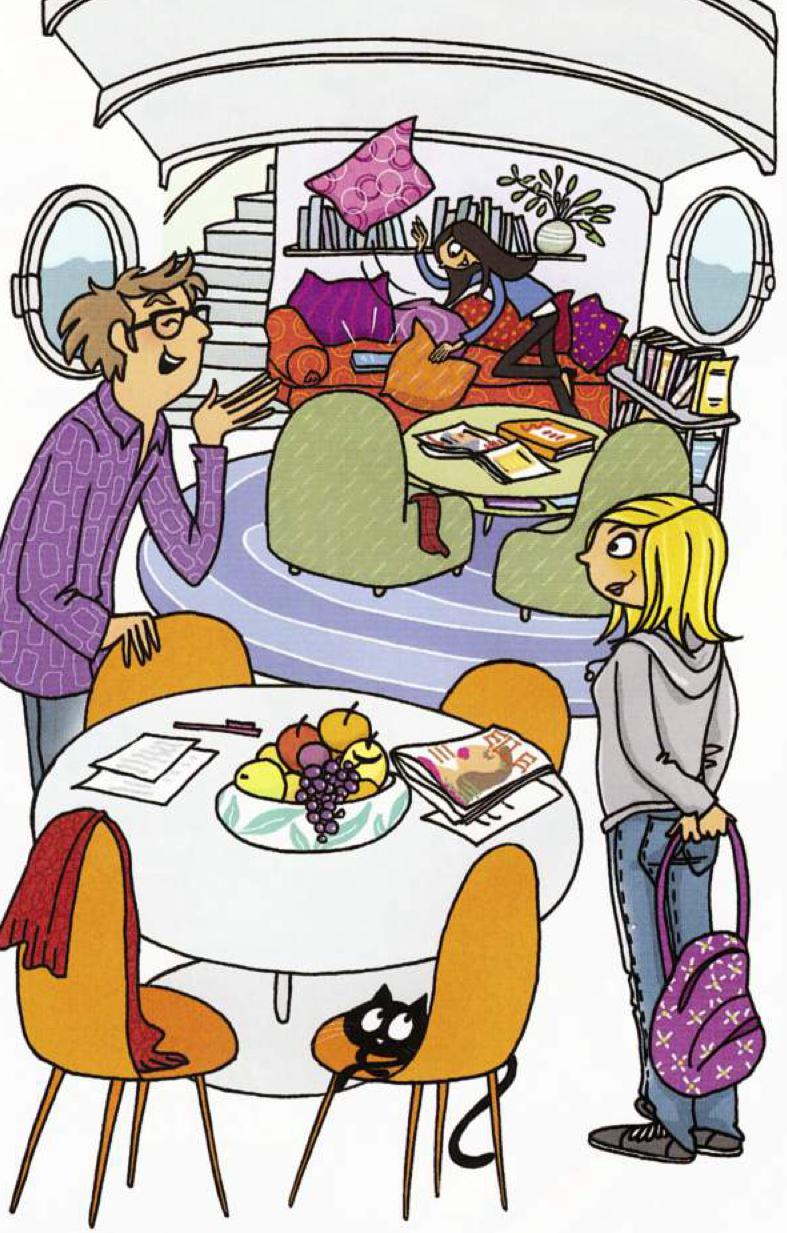
[1 mark]
(1)Gap (1)
Show answerHide answer
The fruit bowl stands on the round table.
Tick each point you got.
[1 mark]
(2)Gap (2)
Show answerHide answer
The small table is between the two armchairs.
Tick each point you got.
[1 mark]
(3)Gap (3)
Show answerHide answer
The shelves are above the armchair (book p. 26): au-dessus de + le = au-dessus du.
Tick each point you got.
[1 mark]
(4)Gap (4)
Show answerHide answer
He stands behind the chair, with his hand on its back. sous and dans are the extra words.
Tick each point you got.
12
Question 12
Complétez avec « c'est », « ce sont », « il est », « elle est », « ils sont » ou « elles sont ». Complete with the right expression.
Example: Voilà la cuisine. C'est une petite pièce.
Example: Voilà la cuisine. C'est une petite pièce.
[1 mark]
(a)Voilà la chambre de Manon. ______ petite.
Show answerHide answer
It describes la chambre (feminine, singular).
Tick each point you got.
[1 mark]
(b)Regarde ! ______ mes livres de poésie.
Show answerHide answer
Plural noun phrase after it.
Tick each point you got.
[1 mark]
(c)Mes parents ? ______ sur la terrasse.
Show answerHide answer
Where they are: ils sont (not ce sont, because no noun follows).
Tick each point you got.
[1 mark]
(d)Qu'est-ce que c'est ? ______ un bateau.
Show answerHide answer
It identifies something with un + noun.
Tick each point you got.
13
Question 13
Complétez avec le verbe « vouloir » au présent. Complete with the verb "vouloir" in the present tense.
Example: Tu veux un grand lit ?
Example: Tu veux un grand lit ?
[1 mark]
(a)Manon ______ retrouver son carnet.
Show answerHide answer
Tick each point you got.
[1 mark]
(b)Nous ______ des posters sur les murs.
Show answerHide answer
Tick each point you got.
[1 mark]
(c)Je ne ______ pas changer ma chambre : je l'adore !
Show answerHide answer
je + veux (with the x, not veut).
Tick each point you got.
[1 mark]
(d)Où est-ce que vous ______ habiter ?
Show answerHide answer
Tick each point you got.
Section C: compréhension écrite (Partie 2)
16 marksLisez les documents et répondez. Read the documents and answer.
14
Question 14
Lisez le message et répondez « Vrai » ou « Faux ». Read the message and answer "Vrai" or "Faux".
À bientôt !
Jeanne
Message de Jeanne
Salut ! Je suis chez Manon. Elle habite sur une péniche : c'est une maison originale ! Dans le salon, il y a un grand canapé et des étagères au-dessus du fauteuil. Il y a aussi une petite table entre les deux fauteuils. Manon cherche son carnet : il est entre les coussins du canapé. Sa chambre est petite, mais c'est sa pièce préférée parce qu'elle est tranquille.À bientôt !
Jeanne
[1 mark]
(a)Manon habite sur une péniche.
Show answerHide answer
Vrai
Elle habite sur une péniche.
[1 mark]
(b)Les étagères sont sous le canapé.
Show answerHide answer
Faux
The shelves are au-dessus du fauteuil (above the armchair), not under the sofa.
[1 mark]
(c)La petite table est entre les deux fauteuils.
Show answerHide answer
Vrai
Il y a une petite table entre les deux fauteuils.
[1 mark]
(d)Le carnet de Manon est sous la table.
Show answerHide answer
Faux
It is entre les coussins du canapé.
15
Question 15
Lisez le texte de Manon et répondez aux questions. Read Manon's text and answer the questions.
Ma chambre
Ma chambre est petite. J'ai deux lampes et un petit bureau, mais je n'ai pas d'étagères pour ranger mes livres. Je veux un grand tableau pour écrire des poèmes sur mes murs, mais il n'y a pas de place. Heureusement, j'ai mon carnet et mon ordinateur !
[1 mark]
(a)Combien de lampes y a-t-il dans la chambre de Manon ? Écrivez le nombre en lettres. How many lamps? Write the number in letters.
Show answerHide answer
Tick each point you got.
[1 mark]
(b)Qu'est-ce que Manon n'a pas pour ranger ses livres ? What does Manon not have to put her books away?
Show answerHide answer
She has no shelves for her books (pas d'étagères).
Tick each point you got.
[1 mark]
(c)Pourquoi est-ce que Manon n'a pas de grand tableau ? Why does Manon not have a big board?
Show answerHide answer
Tick each point you got.
[1 mark]
(d)Qu'est-ce que Manon veut, et pour quoi faire ? What does Manon want, and what for?
Show answerHide answer
The verb vouloir + noun, then pour + infinitive.
Tick each point you got.
16
Question 16
Regardez le tableau des chambres de trois ados et répondez « Vrai » ou « Faux ». Look at the table of three teenagers' bedrooms and answer "Vrai" or "Faux".
| Objets | Léo | Inès | Yanis |
|---|---|---|---|
| lampes | 2 | 1 | 3 |
| étagères | 0 | 4 | 2 |
| posters | 5 | 0 | 3 |
| coussins | 3 | 6 | 0 |
[1 mark]
(a)Il y a des étagères dans la chambre de Léo.
Show answerHide answer
Faux
Léo, étagères: 0.
[1 mark]
(b)Inès a six coussins.
Show answerHide answer
Vrai
Inès, coussins: 6.
[1 mark]
(c)Yanis n'a pas de coussins.
Show answerHide answer
Vrai
Yanis, coussins: 0.
[1 mark]
(d)Au total, il y a neuf posters dans les trois chambres.
Show answerHide answer
Faux
5 + 0 + 3 = 8 (huit), not 9.
17
Question 17
Quel château est-ce ? Choisissez la bonne réponse. Which château is it? Choose the right answer.
[1 mark]
(a)« Je ressemble à un pont sur l'eau. »
Show answerHide answer
Chenonceau
Chenonceau is built on the river Cher and looks like a bridge on the water.
[1 mark]
(b)« Mes jardins sont célèbres. Je suis près de Paris. »
Show answerHide answer
Versailles
Gardens à la française, near Paris.
[1 mark]
(c)« J'ai quatre tours rondes et je suis près de Blois et de la Loire. »
Show answerHide answer
Chambord
Chambord, built under King François I in the 16th century.
[1 mark]
(d)« Le soleil est le symbole du roi qui habite ici. »
Show answerHide answer
Versailles
The sun is the symbol of Louis XIV (17th century), the king of Versailles.
Section D: production écrite (Partie 3)
6 marksÉcrivez en français. Write in French.
18
Question 18
Vous écrivez un message à Félix pour décrire votre chambre (30 à 40 mots). You write a message to Félix to describe your bedroom (30 to 40 words).
- Dites comment est votre chambre. Say what your room is like.
- Dites trois choses qu'il y a dans votre chambre et où elles sont. Name three things in your room and where they are.
- Dites une chose que vous n'avez pas. Say one thing you do not have.
- Dites ce que vous voulez changer. Say what you want to change.
[6 marks]
(a)Your message to Félix
Show answerHide answer
Model answer: Cher Félix, ma chambre est petite. J'ai un lit à côté de la fenêtre et un bureau. Il y a des posters sur les murs. Je n'ai pas de tapis, mais je veux un grand tapis bleu ! À bientôt ! (39 words)
Tick each point you got.