Manon : localiser, la maison et la chambre
What this chapter covers
- I can say where something is with sur, sous, dans, devant, derrière, entre, à côté de, au-dessus de and use du, de la, de l', des correctly after them (2.1)
- I can name the rooms of a house, the main furniture and objects, and say in which room I do an activity (Je prends ma douche dans la salle de bains.) (2.2)
- I can choose between C'est / Ce sont and Il / Elle est, Ils / Elles sont to identify and to describe (2.2)
- I can conjugate vouloir and use it with a noun or an infinitive to express a wish (Je veux un grand lit. Je veux changer la couleur des murs.) (2.3)
- I can describe my bedroom with il y a, j'ai, il n'y a pas de and place words (2.3)
- I can use ne ... pas, ne ... jamais, ne ... plus and pas de / d' in simple sentences (2.3)
- I can name three famous French châteaux and say when, where and by whom they were built, and recognise a poem, a detective novel and a diary (2.4)
- I can hear and say the sounds [b] / [p] and [f] / [v] (2.5)
Module 2 of Adosphère 2 is called Manon. Manon is a French girl who lives on a péniche (a houseboat), writes poems in her notebook (son carnet) and loses her things all the time. Through her you learn to say where things are, to show your home, to describe your bedroom and to express a wish with the verb vouloir. In the UASA paper these topics come back in Partie 1 (prepositions of place, c'est / il est, vouloir, rooms and furniture), Partie 2 (texts and tables with vrai ou faux) and Partie 3 (describing your room in a short message).
| Lesson | Book pages | You learn to |
|---|---|---|
| Leçon 1 : Où est mon carnet ? | 26-27 | locate things in space; furniture of the living room |
| Leçon 2 : Ma maison, ce n'est pas une maison… | 28-29 | name the rooms of a house; c'est / il est; write a poem |
| Leçon 3 : Change ta chambre ! | 30-31 | describe a bedroom; the verb vouloir |
| Leçon 4 : La vie de château | 32 | three famous French châteaux |
| Mon cours de littérature | 33 | kinds of books: poetry, detective novel, diary |
| Entraîne-toi, Évaluation DELF, Ton dico | 34-36 | practice, sounds [f] / [v] and [b] / [p], DELF-style test and the word list |
2.1Locating things in space
In Lesson 1 (book p. 26), Manon cannot find her notebook. Her father suggests places one after the other: sur la chaise, à côté de la table, derrière le canapé, sur la petite table, sous la fenêtre, à côté des livres, sur les étagères au-dessus du fauteuil. Her friend Jeanne has the idea: sous les coussins. The notebook is entre les deux coussins du canapé. Look at the picture and find each place.
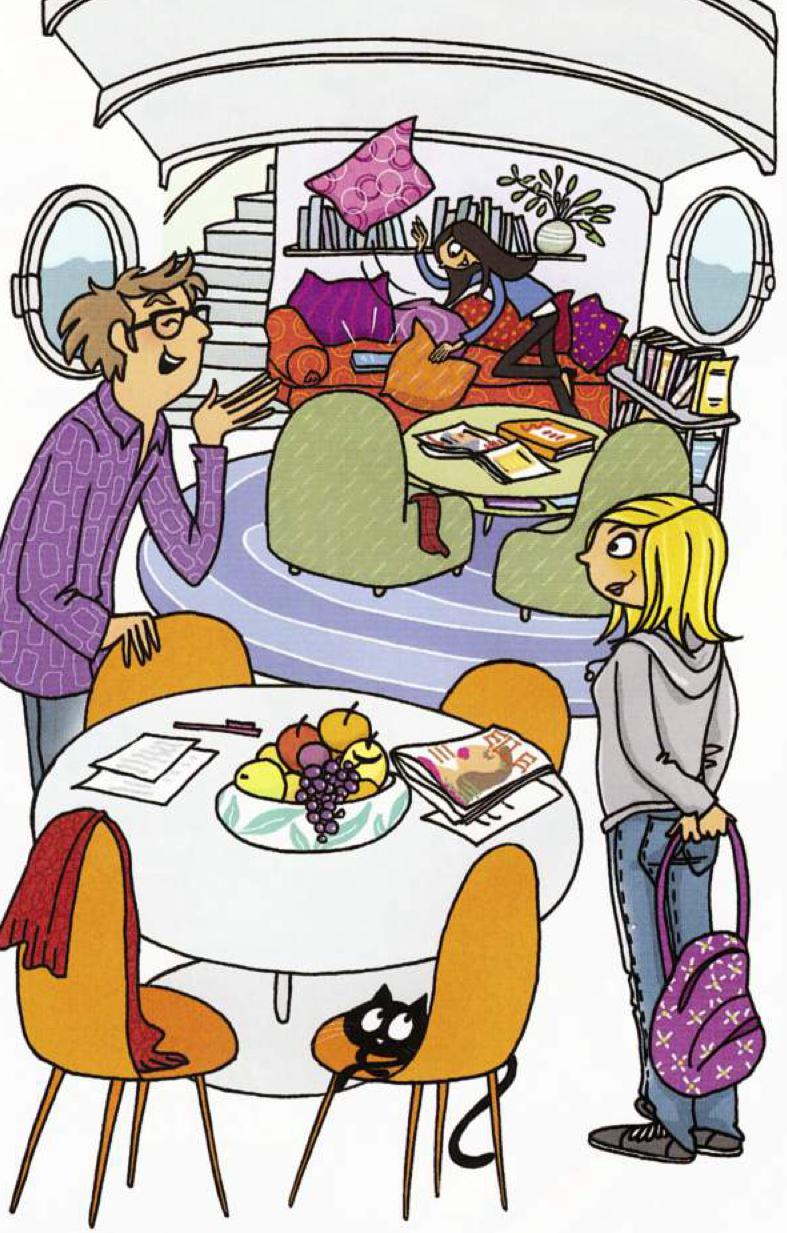
Adosphère 2, p. 26 (Leçon 1 « Où est mon carnet ? »).
Prepositions and adverbs of place (Pour localiser dans l'espace)
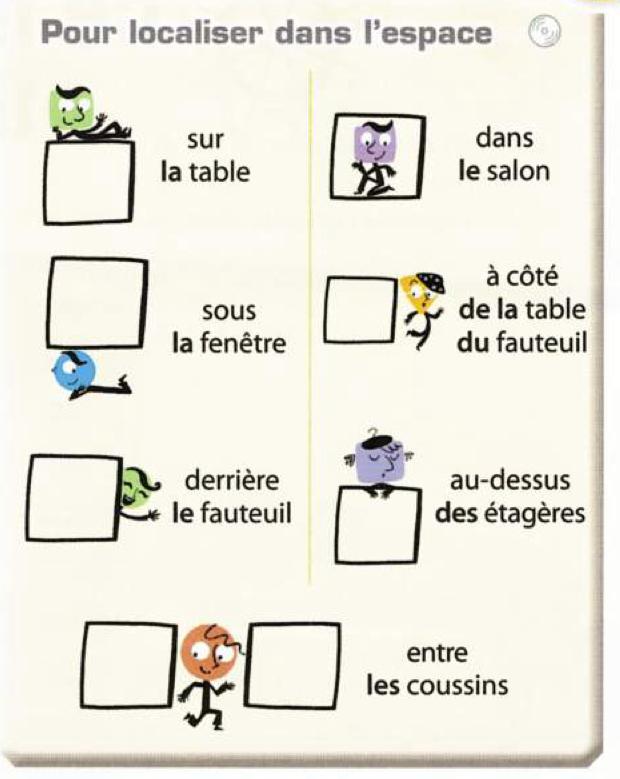
Adosphère 2, p. 27.
| French | English | Example |
|---|---|---|
| sur | on | sur la table, sur les étagères |
| sous | under | sous la fenêtre, sous les coussins |
| dans | in, inside | dans le salon, dans la maison |
| derrière | behind | derrière le canapé |
| devant | in front of | devant la télé |
| entre ... et ... | between | entre les deux coussins |
| à côté de | next to, beside | à côté de la table, à côté du sac |
| au-dessus de | above, over | au-dessus du fauteuil, au-dessus des étagères |
| près de | near | près du fauteuil (book p. 27, ex. 9) |
| à gauche / à droite | on the left / on the right | à droite dans le couloir |
de + article: du, de la, de l', des
Three of the place words end in de: à côté de, au-dessus de, près de. Before the article, de changes:
| Noun | de + article | Example |
|---|---|---|
| masculine (le) | du (not | à côté du canapé, au-dessus du fauteuil |
| feminine (la) | de la | à côté de la table |
| before a vowel (l') | de l' | à côté de l'escalier |
| plural (les) | des | à côté des livres, au-dessus des étagères |
The living room (le salon)
| Masculine | Feminine | Plural |
|---|---|---|
| un canapé (sofa) | une chaise (chair) | des étagères (shelves) |
| un fauteuil (armchair) | une table (table) | des coussins (cushions) |
| un carnet (notebook) | une fenêtre (window) | des livres (books) |
(a) Le carnet est ______ coussins. (between the two)
(b) Les livres sont ______ fauteuil. (above)
(c) Mon sac est ______ chaise. (next to)
Show answerHide answer
(b) au-dessus du fauteuil (de + le = du)
(c) à côté de la chaise (feminine)
2.2My house: rooms, furniture and c'est / il est
In Lesson 2 (pp. 28-29) Manon shows the plan of her houseboat. On the deck there is a terrace; the cut-away plan shows the rooms inside. Thirteen rooms are listed (a to m) and each has a number: 1 and 2 on the deck, 3 to 13 in the plan. The picture below is the deck and the plan (the book asks you to match each room to its number, ex. 4).
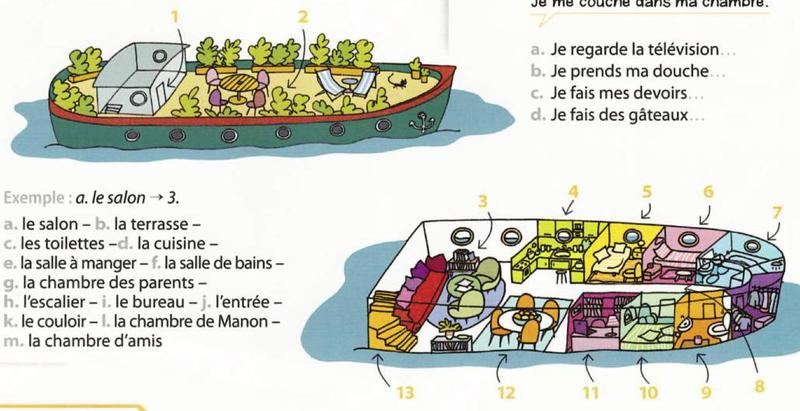
Adosphère 2, p. 29 (Leçon 2, ex. 4).
The rooms (les pièces)
| French | English | French | English |
|---|---|---|---|
| la maison | house, home | la cuisine | kitchen |
| l'appartement (m.) | flat, apartment | le salon | living room |
| la chambre | bedroom | la salle à manger | dining room |
| la salle de bains | bathroom | le bureau | study, office |
| les toilettes (f. pl.) | toilet | le couloir | corridor, hall |
| l'entrée (f.) | entrance | l'escalier (m.) | stairs |
| la terrasse | terrace | le jardin | garden |
Which room for which activity? (book p. 29, ex. 5; p. 35, ex. 6)
| Activity | Room |
|---|---|
| Je me couche. (I go to bed.) | dans ma chambre |
| Je regarde la télévision. | dans le salon |
| Je prends ma douche. (I take a shower.) | dans la salle de bains |
| Je fais mes devoirs. (I do my homework.) | dans ma chambre / dans le bureau |
| Je fais des gâteaux. (I bake cakes.) | dans la cuisine |
C'est, ce sont or il / elle est, ils / elles sont?
| Use it to... (answers Qu'est-ce que c'est ?) | Use it to... (answers Il / Elle est comment ?) | |
|---|---|---|
| Singular | C'est + noun: identify. C'est une île. C'est un bateau. C'est la cuisine. C'est Manon. | Il est / Elle est + adjective, place, profession: describe. Elle est bleue et tranquille. Il est sur l'eau. Elle est poète. |
| Plural | Ce sont + noun. Ce sont mes livres de poésie. | Ils / Elles sont + adjective or place. Ils sont sur l'étagère. |
A poem about a house (book p. 28)
Manon writes that her house is not a house: « ... c'est un bateau. Il marche sur l'eau. ... c'est une île dans la ville. Elle est bleue et tranquille. ... c'est un poisson qui nage. Il rêve de voyages. » Notice the pattern: c'est + noun, then il / elle est or another verb to describe. Her left-hand page is an acrostic: the first letters of Manon, Amie, Île, Secrète, Originale, traNquille hide the word MAISON.
(a) Voilà la terrasse. ______ très grande.
(b) ______ mes parents. ______ devant leur péniche.
(c) Qu'est-ce que c'est ? ______ un carnet.
Show answerHide answer
(b) Ce sont (plural noun phrase), Ils sont (place, plural)
(c) C'est (identifies a noun)
2.3My bedroom and the verb vouloir
Lesson 3 (pp. 30-31): three teenagers open the door of their bedroom. One is a boy under the roof with a guitar and posters; one has a colourful room with a green table, a rug and an orange ceiling; the third is Manon, whose room is small. The book asks you to find in the photos: un lit, un bureau, un tapis, le mur, le plafond, un ordinateur, une lampe.
| French | English | French | English |
|---|---|---|---|
| un lit | bed | un tapis | rug, carpet |
| un bureau | desk | un mur | wall |
| un ordinateur | computer | le plafond | ceiling |
| une lampe | lamp | une porte | door |
| un poster | poster | une étagère | shelf |
Useful sentences taken from the three bedroom texts (own paraphrase):
| You want to say | French |
|---|---|
| what there is | Il y a des posters sur les murs. / J'ai un petit bureau. |
| what there is not | Je n'ai pas d'étagères. / Il n'y a pas de place. |
| where | Mon lit est par terre. / Ma chambre est tout en haut de la maison. |
| a wish | Je veux un grand tableau pour écrire des poèmes. |
The verb vouloir (to want)
| French | English | Example |
|---|---|---|
| je veux | I want | Je veux un grand lit. |
| tu veux | you want | Tu veux changer de chambre ? |
| il / elle / on veut | he / she / one wants | Manon veut retrouver son carnet. |
| nous voulons | we want | Nous voulons des posters. |
| vous voulez | you want | Vous voulez changer votre chambre ? |
| ils / elles veulent | they want | Les ados veulent changer leur chambre. |
Saying no: ne ... pas, pas de, ne ... jamais, ne ... plus
In this module there are many negative sentences. The negative frame goes round the verb: ne + verb + pas, and ne becomes n' before a vowel.
| Form | Meaning | Example (book) |
|---|---|---|
| ne ... pas | not | Il n'est pas là. (p. 26) |
| ne ... pas de / d' + noun | no, not any | Je n'ai pas d'étagères. / Il n'y a pas de place. (p. 31) |
| ne ... jamais | never | Je ne perds jamais mes affaires. (p. 26, ex. 1) |
| ne ... plus | no longer, not any more | Le fauteuil n'est plus dans la maison. (the song, p. 27) |
(a) Il y a des étagères dans ma chambre.
(b) Je veux changer de chambre.
(c) J'ai un ordinateur.
Show answerHide answer
(b) Je ne veux pas changer de chambre.
(c) Je n'ai pas d'ordinateur. (un becomes d')
Describing your room: a model message
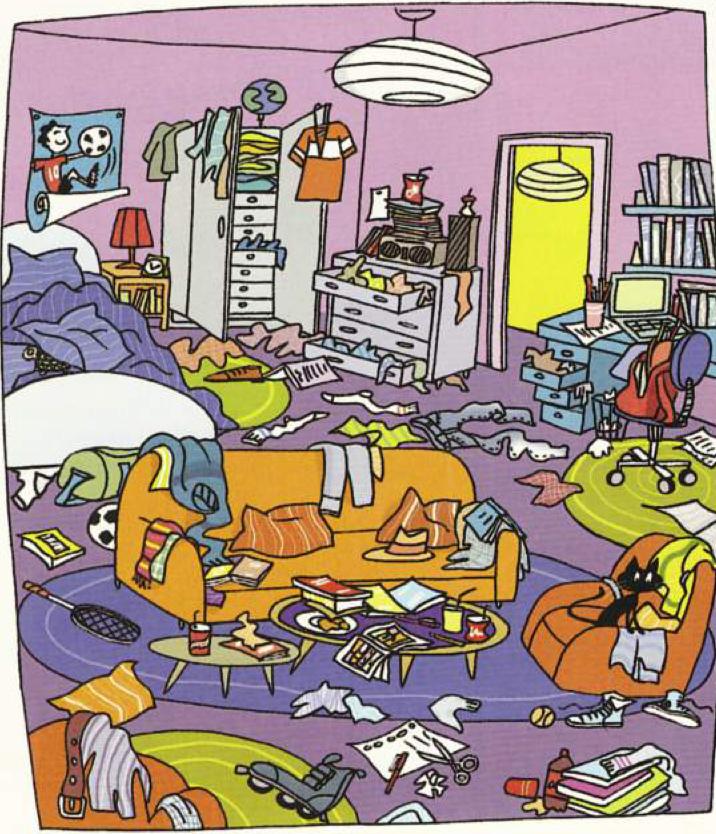
Adosphère 2, p. 34 (Entraîne-toi, ex. 1).
2.4Culture: châteaux and literature
La vie de château (book p. 32)
France has many castles (des châteaux) and they tell the history of the country. The book presents three. A century is written in Roman numerals with a small e: XVIe siècle (16th century), XVIIe siècle (17th century).
| When? (Quand ?) | Where? (Où ?) | Who? (Qui ?) | What is special? | |
|---|---|---|---|---|
| Chambord | XVIe siècle | near Blois and the Loire | built by King François Ier | four round towers, a park and a forest |
| Chenonceau | XVIe siècle | on the Cher (a river) | (not named in the book text) | looks like a bridge over the water |
| Versailles | XVIIe siècle | near Paris | King Louis XIV, whose symbol is the sun | famous gardens « à la française », the king's bedroom, the galerie des Glaces |
Mon cours de littérature (book p. 33)
| French | English | Book example |
|---|---|---|
| un recueil de poésies | a collection of poems | Paroles by Jacques Prévert (his photo is on the cover) |
| un roman policier | a detective novel | Le chat de Tigali (the story of an animal) |
| un journal intime | a diary (written with je) | Je t'écris, j'écris... |
| un poème, un poète / une poète | a poem, a poet | Manon is poète; Prévert is a famous poète |
2.5Sounds, learning to learn and the DELF test
Phonetics: [b] / [p] and [f] / [v] (book p. 35, ex. 10)
| Sound | Spelling | Examples from the module |
|---|---|---|
| [b] | b | bureau, bateau, belle |
| [p] | p | péniche, poème, place, petite |
| [f] | f (also ph) | fenêtre, fauteuil, forêt, fleurs |
| [v] | v | vert, viens, visiter, voir, vrai |
Learn to learn: improve your pronunciation (p. 35)
The book's three steps: (1) listen to the difficult sounds and repeat them several times; (2) stress the last syllable of the word and make the liaisons and the enchaînements (joining sounds across words) properly; (3) listen to the melody of French and use intonation.
The DELF test (p. 36): what to expect
| Skill | Task | Where to prepare |
|---|---|---|
| Listening | true or false about where things are (five sentences about where Manon's books, trainers (baskets), pencil case and pens are, using the rug, the chair and the desk as landmarks) | 2.1 |
| Speaking | express five wishes: Je veux faire le Tour de France. | 2.3 |
| Reading | read three short texts and decide which family lives in the flat in the picture | 2.2 (rooms), 2.3 |
| Writing | complete an e-mail and write five sentences about a bedroom | 2.3 |