Étienne : la nationalité, le caractère, le collège et l'emploi du temps
What this chapter covers
- I can say my nationality and origin and make nationality adjectives masculine, feminine and plural (Il est québécois. Elle est algérienne. Ils sont américains.) (1.1)
- I can ask questions with où, quand, pourquoi, comment, qu'est-ce que and the est-ce que form (Où est-ce que tu habites ?) (1.2)
- I can name the places and the school subjects of a collège and talk about my timetable (la cantine, le gymnase, la bibliothèque, les arts plastiques) (1.3)
- I can conjugate prendre, comprendre and apprendre in the present (je prends, nous comprenons, ils apprennent) (1.4)
- I can describe a character with adjectives and make them agree (motivé(e), timide, sérieux/sérieuse, sportif/sportive, bavard(e), gentil(le)) (1.5)
- I can say how often I do something with toujours, souvent, parfois, jamais and place the adverb correctly, including ne … jamais (1.6)
- I can read about a French collège (classes, brevet, holidays, class rules) and compare it with my school (1.7)
- I can put the stress (accent tonique) on the last syllable of a French word (col-lège, é-lève, col-lé-gien) (1.8)
Module 1 of Adosphère 2 is called Étienne. Étienne is a Canadian boy from Québec who spends three months in France with his French penfriend Wassim and goes to school in Wassim's collège. In this module you learn to say where you and your friends come from, to describe a character, to talk about your school life and timetable, and to ask questions. In the UASA paper these topics come back in Partie 1 (grammar and vocabulary: nationality adjectives, prendre / comprendre / apprendre, character adjectives), Partie 2 (short texts with questions, including vrai ou faux) and Partie 3 (writing a short message about yourself and your school).
| Lesson | Book pages | You learn to |
|---|---|---|
| Leçon 1 : Un Canadien au collège | 14-15 | say your nationality and origin; nationality adjectives; ask questions |
| Leçon 2 : Ma vie au collège en France | 16-17 | places and subjects of the school; prendre, comprendre, apprendre |
| Leçon 3 : Zap Collège | 18-19 | describe a character; character adjectives; adverbs of frequency |
| Leçon 4 : Grand jeu du collège français | 20 | how the French collège works (classes, exam, holidays) |
| Mon cours d'instruction civique, Entraîne-toi, Évaluation DELF | 21-24 | class rules, practice, sounds, a DELF-style test and the word list (Ton dico) |
1.1Nationality and origin
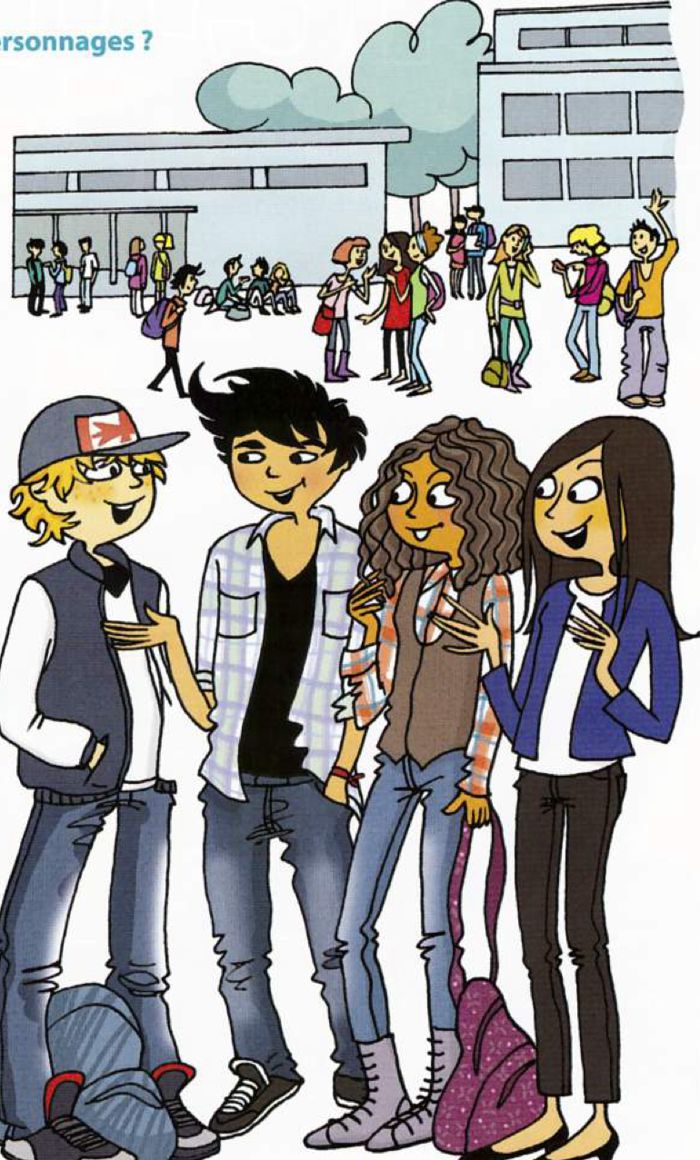
Lesson 1 starts in the playground of Wassim's collège. Wassim introduces Étienne to two girls, Émilie and Manon. They ask him why he is in France, where he lives and when he goes home. Then the friends find out that nearly everybody has an origin from somewhere else: Étienne is Canadian (from Québec), Wassim's family is of Algerian origin, Manon's grandfather is American, Émilie's father is Spanish and her mother is Malagasy (from Madagascar). Émilie then explains a Québec expression that Étienne uses: « c'est l'fun » means « c'est amusant » (it's fun).
Adosphère 2, p. 14
Say where you come from
| You want to say | French | English |
|---|---|---|
| your nationality | Je suis canadien. / Je suis française. | I am Canadian. / I am French. |
| where you come from | Je viens du Québec. | I come from Québec. |
| your family origin | Je suis d'origine algérienne. Ma mère est malgache. | I am of Algerian origin. My mother is Malagasy. |
| where you live | J'habite en France, chez mon correspondant. | I live in France, at my penfriend's. |
Nationality adjectives
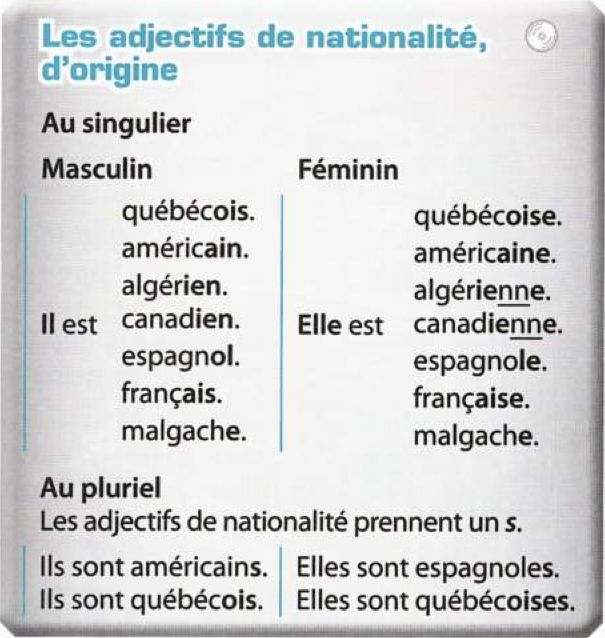
A nationality adjective agrees with the person. For a girl, you add -e (and sometimes double the consonant). In the plural, add -s.
Adosphère 2, p. 15
| Masculine (il est) | Feminine (elle est) | Rule |
|---|---|---|
| français, polonais, espagnol, allemand, québécois | française, polonaise, espagnole, allemande, québécoise | add -e |
| américain, marocain, mexicain | américaine, marocaine, mexicaine | add -e; -ain becomes -aine |
| algérien, canadien, italien | algérienne, canadienne, italienne | -ien becomes -ienne (double n) |
| malgache | malgache | ends in -e: no change |
Plural: Ils sont américains. Elles sont espagnoles. Ils sont québécois. (québécois already ends in -s, so it does not change in the masculine plural.)
Forgetting the double n:
Leaving the masculine form for a girl:
Nationality adjectives have no capital letter in French: un garçon canadien.
Show answerHide answer
1.2Asking questions
In the dialogue the friends ask many questions. There are two easy ways to ask: keep the word order of a statement and put the question word at the end (short form: Tu habites où ?; with pourquoi it comes first), or start with the question word and add est-ce que. The two forms have the same meaning.
| Question word | Meaning | Short form | With est-ce que |
|---|---|---|---|
| où | where | Tu habites où ? | Où est-ce que tu habites ? |
| quand | when | Tu rentres quand ? | Quand est-ce que tu rentres ? |
| pourquoi | why | Pourquoi tu es en France ? | Pourquoi est-ce que tu es en France ? |
| comment | how | C'est comment ? = Comment c'est ? | (the book gives only the two short forms) |
| qu'est-ce que | what | Qu'est-ce que tu aimes ? |
Show answerHide answer
1.3The collège: places and subjects
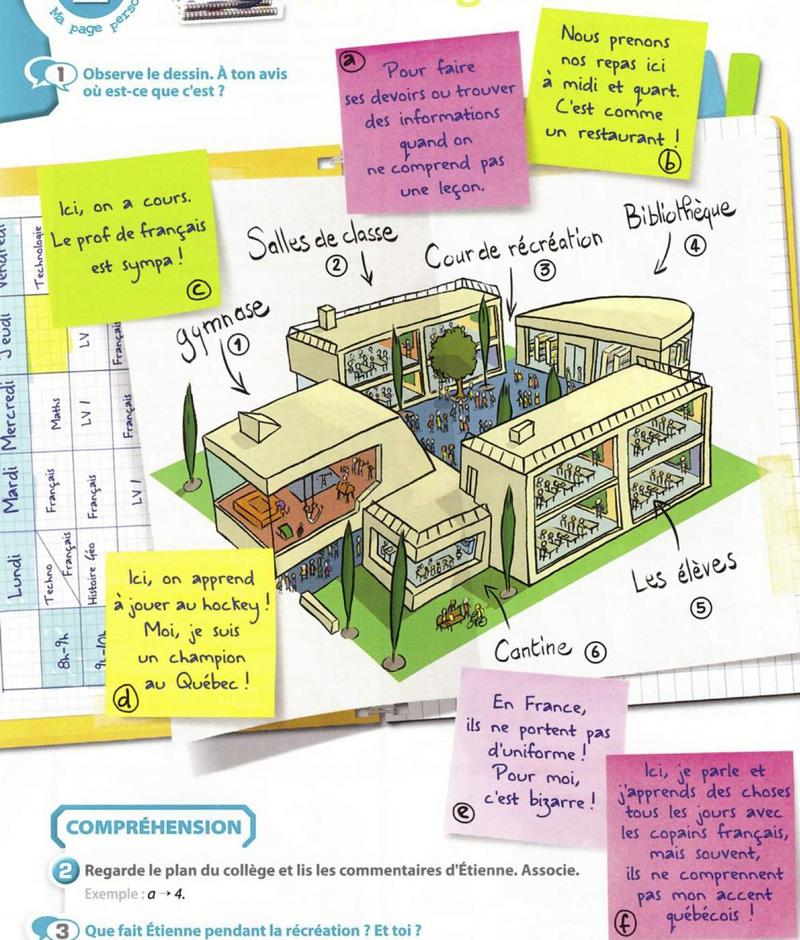
In Lesson 2 Étienne puts sticky notes on a plan of the French collège and comments on each place: the school has a gymnase, salles de classe, a cour de récréation, a bibliothèque and a cantine. Étienne notices that in France pupils do not wear a uniform, and that his French friends often do not understand his Québec accent.
Adosphère 2, p. 16
| Place | English | What you do there |
|---|---|---|
| le gymnase | gym | On apprend à jouer au hockey. (sport) |
| la salle de classe | classroom | On a cours. |
| la cour de récréation (la récré) | playground | you spend the break (la récréation) with friends |
| la bibliothèque | library | do homework, find information |
| la cantine | canteen | you eat lunch, comme un restaurant |
Subjects (les matières scolaires): le français, l'histoire-géographie, les sciences et vie de la Terre (SVT), la physique-chimie, la technologie, l'anglais, les arts plastiques, les mathématiques (les maths), la musique, le sport. Your favourite subject is ta matière préférée; the timetable is l'emploi du temps; a pupil in a collège is un collégien / une collégienne. To give the timetable, Étienne says the number of hours per week (le nombre d'heures par semaine): une heure, une heure et demie, trois heures, quatre heures.
Show answerHide answer
1.4Prendre, comprendre, apprendre
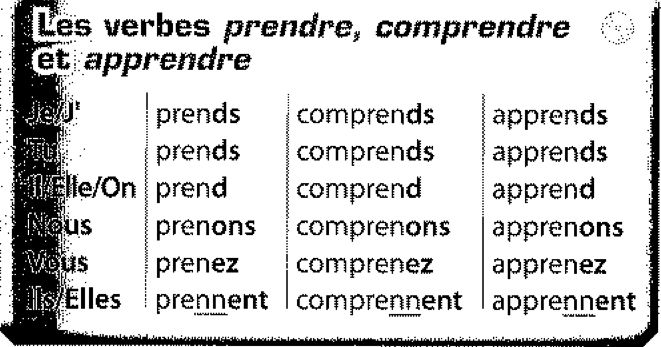
These three verbs follow the same pattern (comprendre and apprendre are built on prendre). Learn the group once.
Adosphère 2, p. 17
| prendre (to take, to have) | comprendre (to understand) | apprendre (to learn) | |
|---|---|---|---|
| je / j' | prends | comprends | apprends |
| tu | prends | comprends | apprends |
| il / elle / on | prend | comprend | apprend |
| nous | prenons | comprenons | apprenons |
| vous | prenez | comprenez | apprenez |
| ils / elles | prennent | comprennent | apprennent |
Pattern: je, tu end in -s, il ends in -d; nous / vous have one n (-nons, -nez); ils / elles have double n and -ent. Examples: Nous prenons nos repas à la cantine. Ils apprennent l'espagnol. Je ne comprends pas. Other expressions: prendre le bus, prendre un repas, prendre un stylo dans son sac, apprendre une langue.
Show answerHide answer
1.5Describing character
Lesson 3 is a comic strip, Zap Collège, by Téhem. It presents the characters of a school with a short portrait of each. Read the portraits and see how the author uses the adjectives.
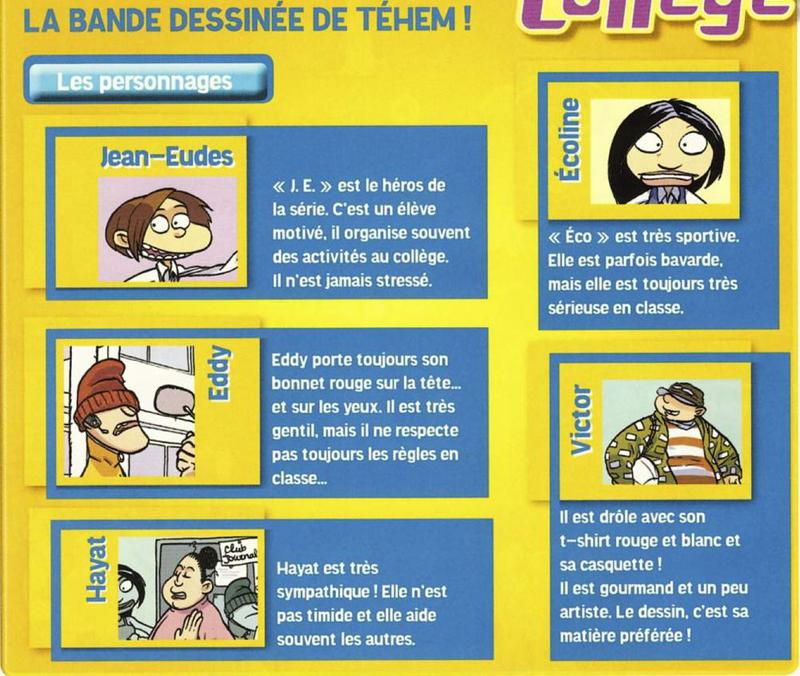
Adosphère 2, p. 18
| Character | What the book says (in short) |
|---|---|
| Jean-Eudes | the hero; a motivated pupil who often organises activities; never stressed |
| Eddy | always wears a red hat; very kind, but does not always respect the rules in class |
| Hayat | very nice; not shy; often helps others |
| Écoline | very sporty; sometimes talkative; always very serious in class |
| Victor | funny; likes food and a bit of an artist; his favourite subject is drawing |
Character adjectives and agreement
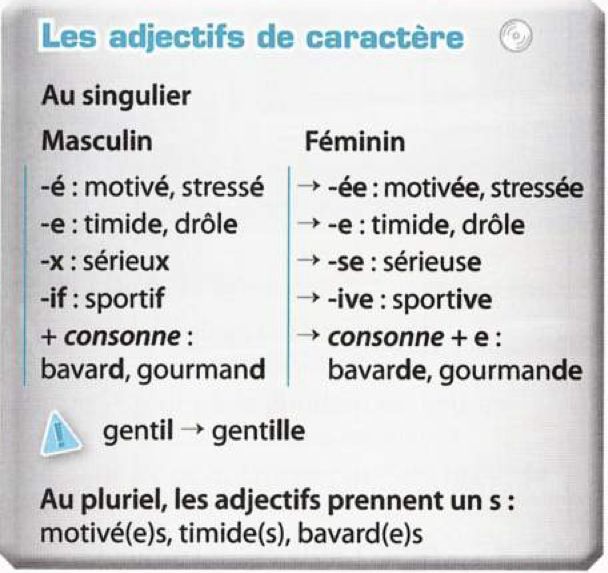
Adosphère 2, p. 19
| Masculine ending | Feminine | Examples |
|---|---|---|
| -é | -ée | motivé → motivée, stressé → stressée |
| -e | no change | timide, drôle (same for a boy and a girl) |
| -x | -se | sérieux → sérieuse |
| -if | -ive | sportif → sportive |
| consonant | consonant + e | bavard → bavarde, gourmand → gourmande |
| Careful: gentil → gentille (double l). Plural: add -s: motivés, timides, bavardes. | ||
Not agreeing with the girl:
Show answerHide answer
1.6How often? Adverbs of frequency
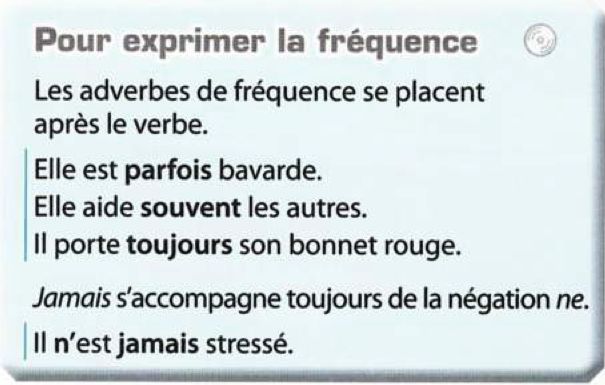
Adosphère 2, p. 19
| Adverb | Meaning | Example |
|---|---|---|
| toujours | always | Il porte toujours son bonnet rouge. |
| souvent | often | Elle aide souvent les autres. |
| parfois | sometimes | Elle est parfois bavarde. |
| ne … jamais | never | Il n'est jamais stressé. |
From the most frequent to the least frequent: toujours → souvent → parfois → jamais. The adverb goes after the verb (Il est souvent en retard). Jamais always comes with ne (n' before a vowel) in front of the verb: Je ne parle jamais en classe.
Show answerHide answer
1.7The French collège: culture and class rules
Lesson 4 is a board game about the four years of the French collège. A pupil enters in the sixième, then goes up to the cinquième, the quatrième and the troisième (four classes). Marks are out of 20 (16/20, très bien; 5/20 is a bad mark). At the end the pupils take an exam, le brevet des collèges. The school year has holidays in October (vacances de la Toussaint), December (Noël), February, April (Pâques) and the long summer holidays in July and August (les grandes vacances); after the collège the pupils go to the lycée.
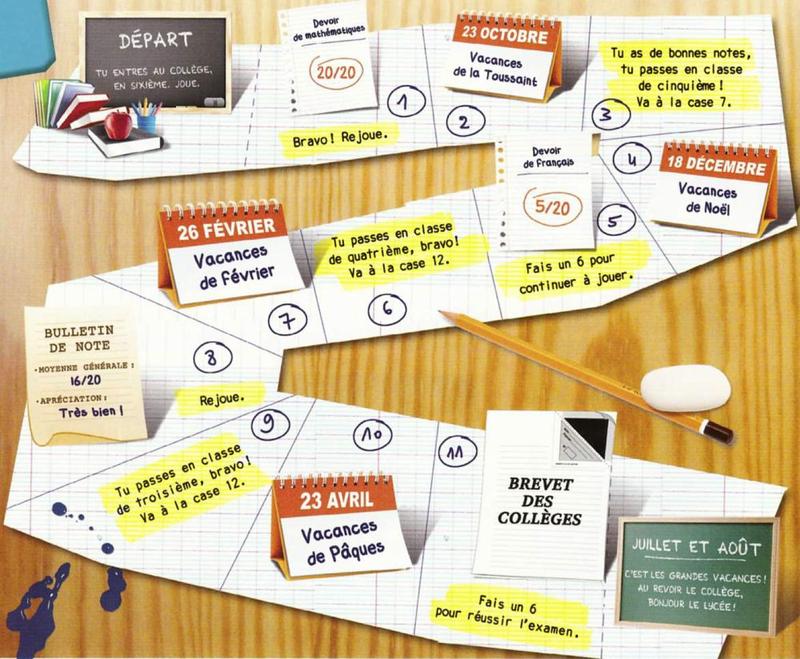
Adosphère 2, p. 20
| French | English |
|---|---|
| la sixième, la cinquième, la quatrième, la troisième | the four classes of the collège (first to last) |
| le brevet des collèges | exam at the end of the collège |
| une note, le bulletin de notes | a mark, the report card |
| les vacances (de Noël, de Pâques…) | holidays |
| le lycée | upper secondary school after the collège |
Class rules
In Mon cours d'instruction civique you read about the heure de vie de classe: pupils and teachers talk together about the class rules and about problems between pupils. Every pupil has the right to speak, or not to speak, and the duty to listen to others. The poster of class rules uses the negative ne … pas and positive sentences:
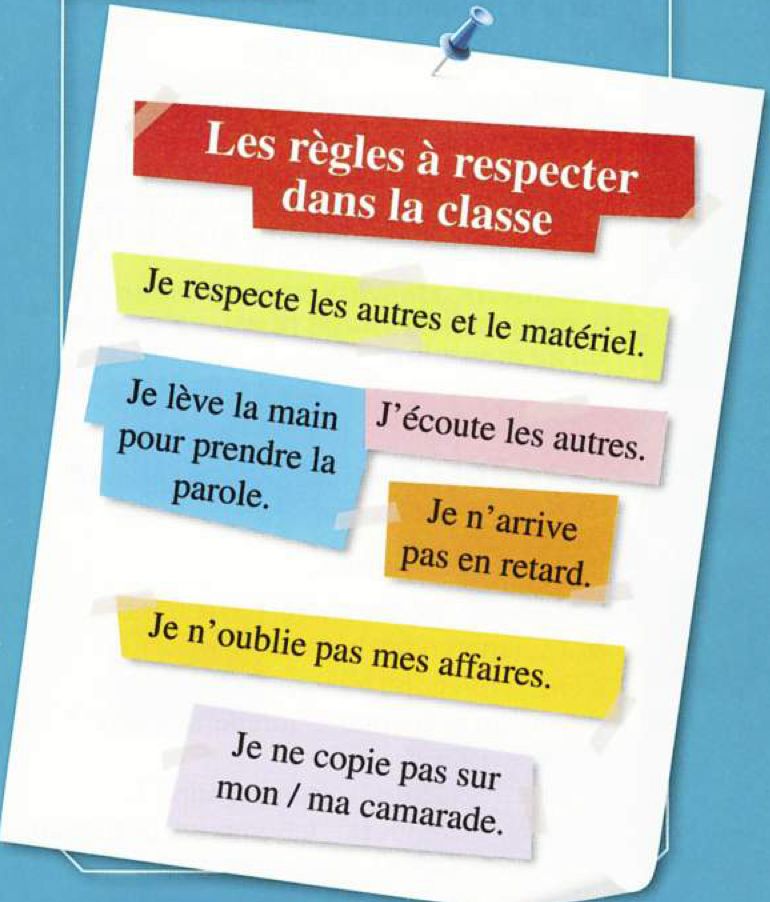
Adosphère 2, p. 21
| French | English |
|---|---|
| Je respecte les autres et le matériel. | I respect others and the equipment. |
| Je lève la main pour prendre la parole. | I raise my hand to speak. |
| J'écoute les autres. | I listen to others. |
| Je n'arrive pas en retard. | I am not late. |
| Je n'oublie pas mes affaires. | I do not forget my things. |
| Je ne copie pas sur mon camarade. | I do not copy from my classmate. |
Show answerHide answer
1.8Sounds: the stressed syllable
In French, the stress (l'accent tonique) falls on the last pronounced syllable of a word or group. It is not as strong as in English: all syllables are about the same length, only the last one is a little longer. Count the syllables first: a final silent -e is not a syllable of its own (caine is one syllable).
| Word | Syllables | Stress |
|---|---|---|
| québécois | qué-bé-cois (3) | on cois |
| américaine | a-mé-ri-caine (4) | on caine |
| collège | col-lège (2) | on lège |
| élève | é-lève (2) | on lève |
| collégien | col-lé-gien (3) | on gien |
| sérieux | sé-rieux (2) | on rieux |
Also practise the verb forms: il prend ends in a nasal vowel [prɑ̃] (the d is silent), but ils prennent is [prɛn] and you hear the n (the same for apprend / apprennent, comprend / comprennent). In prenons and prenez the middle e sounds [ə].
1.9Learning to learn and exam tips
- How to be well in the collège (p. 23): talk to friends or teachers when something is wrong, do an activity you like after school so you are less stressed, and ask for help when you do not understand.
- Vrai ou faux: find the sentence in the text, then check every detail (name, number, nationality, adverb). A statement with toujours or jamais is often false if the text says souvent or parfois.
- Production écrite (a short message of about 40 words): greet, give your nationality and where you live, describe your character with two adjectives that agree, say what you do souvent or jamais, and say your favourite subject.
Summary
| Topic | Remember |
|---|---|
| Nationality | Il est canadien / Elle est canadienne; add -e, -ien → -ienne, -ain → -aine; malgache unchanged; plural + -s; no capital letter |
| Origin | Je viens du Québec. Je suis d'origine algérienne. Ma mère est malgache. |
| Questions | où, quand, pourquoi, comment, qu'est-ce que + est-ce que; answer pourquoi with parce que |
| School | le gymnase, la salle de classe, la cour de récréation, la bibliothèque, la cantine, l'emploi du temps, la matière |
| Verbs | je prends, tu prends, il prend, nous prenons, vous prenez, ils prennent (same for comprendre, apprendre) |
| Character | motivé(e), stressé(e), timide, drôle, sérieux/sérieuse, sportif/sportive, bavard(e), gourmand(e), gentil(le) |
| Frequency | toujours, souvent, parfois, ne … jamais, after the verb |
| Culture | sixième → troisième, brevet, lycée, marks out of 20, no uniform in France |
1.
2.
3.
4.
5.