Bahasa Perancis questions, module 2
Nama / NameKelas / ClassTarikh / Date
Étienne : la nationalité, le caractère, le collège et l'emploi du temps
43 marks. Use Practice to check each answer as you go, or Exam to answer everything first. The item types follow the school UASA paper: multiple choice, Partie 1 (adjectives, verbs, matching), Partie 2 (vrai ou faux and questions on a text) and Partie 3 (a short message).
Section A: choix multiple
10 marksChoisissez la bonne réponse A, B, C ou D. Choose the correct answer A, B, C or D.
1
Question 1
Étienne vient du Québec. Complétez : « Il est ______. » Étienne comes from Québec. Complete: "He is ______."
Show answerHide answer
B
Étienne is a boy, so the masculine singular québécois. Québécoise is feminine and québécoises is feminine plural.
2
Question 2
Quel est le féminin de « espagnol » ? What is the feminine of "espagnol"?
Show answerHide answer
D
Add -e to the masculine form (espagnol → espagnole), with a single l. The consonant is not doubled here.
3
Question 3
Manon dit « Mon amie Sofia est ______. » Manon says "My friend Sofia is ______." (Sofia is a girl from Italy.)
Show answerHide answer
A
Sofia is a girl, so the feminine italienne with a double n. Italien is masculine, italiens is plural and italiene forgets the double n.
4
Question 4
Choisissez la bonne forme du verbe prendre. Choose the correct form of the verb prendre.
Wassim et Étienne ______ le bus ensemble.
Wassim et Étienne ______ le bus ensemble.
Show answerHide answer
C
Wassim et Étienne = ils, so ils prennent with the double n.
5
Question 5
Choisissez la bonne forme. Choose the correct form.
Nous ______ beaucoup de vocabulaire en français. (apprendre)
Nous ______ beaucoup de vocabulaire en français. (apprendre)
Show answerHide answer
B
nous takes -ons: nous apprenons.
6
Question 6
Choisissez le bon adjectif. Choose the correct adjective.
Écoline fait du sport tous les jours : elle est ______.
Écoline fait du sport tous les jours : elle est ______.
Show answerHide answer
C
Écoline is a girl and the masculine ends in -if, so the feminine is -ive.
7
Question 7
Quelle phrase est correcte ? Which sentence is correct? (Jean-Eudes is never stressed.)
Show answerHide answer
A
Jamais always goes with ne and the adverb comes after the verb: n'est jamais stressé.
8
Question 8
Où est-ce que les élèves mangent à midi ? Where do the pupils eat at midday?
Show answerHide answer
D
In the plan on p. 16 the canteen is where the meals are taken at midday, comme un restaurant.
9
Question 9
Trouvez l'intrus. Find the odd one out.
Show answerHide answer
C
La cantine is a place in the school. The other three are school subjects (matières).
10
Question 10
Quelle équivalence est correcte ? Which pair of questions has the same meaning?
Show answerHide answer
B
Only B keeps the same question word (quand) in both forms. A changes où to quand, C changes pourquoi to comment and D changes comment to pourquoi.
Section B: grammaire et vocabulaire (Partie 1)
16 marksRépondez à toutes les questions. Answer all the questions.
11
Question 11
Écrivez le féminin de ces adjectifs de nationalité. Write the feminine of these nationality adjectives.
[1 mark]
(1)allemand → …
Show answerHide answer
Add -e to a masculine ending in a consonant.
Tick each point you got.
[1 mark]
(2)mexicain → …
Show answerHide answer
-ain becomes -aine.
Tick each point you got.
[1 mark]
(3)polonais → …
Show answerHide answer
polonais ends in -s: the feminine is polonaise (the s sounds [z]).
Tick each point you got.
[1 mark]
(4)canadien → …
Show answerHide answer
-ien becomes -ienne.
Tick each point you got.
12
Question 12
Conjuguez les verbes entre parenthèses au présent. Put the verbs in brackets into the present tense.
[1 mark]
(1)Tu ______ (comprendre) le professeur de français ?
Show answerHide answer
tu takes -s.
Tick each point you got.
[1 mark]
(2)J'______ (apprendre) l'espagnol au collège.
Show answerHide answer
j' + apprends.
Tick each point you got.
[1 mark]
(3)Elles ______ (prendre) leurs stylos dans leur sac.
Show answerHide answer
elles takes -ennent, with a double n.
Tick each point you got.
[1 mark]
(4)Vous ne ______ (comprendre) pas l'exercice ?
Show answerHide answer
vous takes -ez.
Tick each point you got.
13
Question 13
Complétez avec l'adjectif qui convient. Faites l'accord. Attention : il y a deux mots en plus. Complete with the right adjective and make it agree. Careful: there are two extra words.
motivésportifgourmandbavardtimidedrôle
[1 mark]
(1)Écoline joue au hockey tous les jours : elle est ______.
Show answerHide answer
-if becomes -ive.
Tick each point you got.
[1 mark]
(2)Victor adore les gâteaux : il est ______.
Show answerHide answer
A boy, so no change.
Tick each point you got.
[1 mark]
(3)Lina et Mei parlent beaucoup en classe : elles sont ______.
Show answerHide answer
Feminine plural: bavard + e + s.
Tick each point you got.
[1 mark]
(4)Nadia aime le collège et fait toujours ses devoirs : elle est ______.
Show answerHide answer
A girl: motivé + e. The extra words are timide and drôle.
Tick each point you got.
14
Question 14
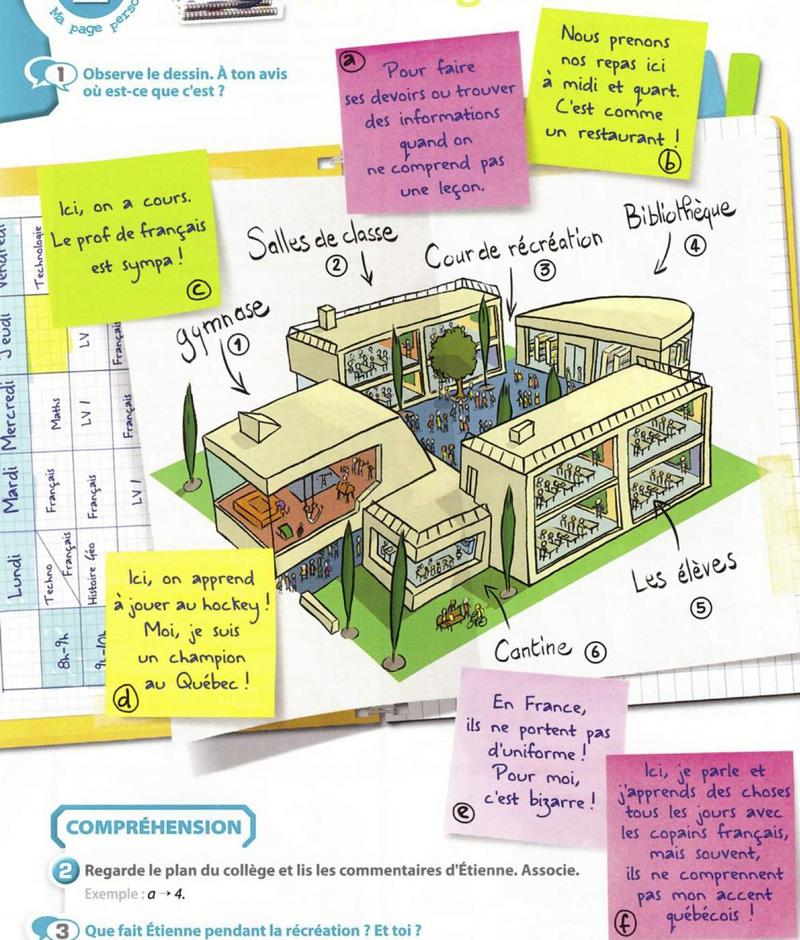
Regardez le plan du collège. Associez chaque phrase au bon numéro. Look at the plan of the school. Match each sentence with the right number.
[1 mark]
(a)« Ici, on apprend à jouer au hockey. »
Show answerHide answer
1
Hockey is played in the gym, number 1.
[1 mark]
(b)« Ici, on a cours. »
Show answerHide answer
2
Lessons are in the classrooms, number 2.
[1 mark]
(c)« Pour faire ses devoirs ou trouver des informations. »
Show answerHide answer
4
Homework and information: the library, number 4.
[1 mark]
(d)« Nous prenons nos repas ici à midi. »
Show answerHide answer
6
Midday meals: the canteen, number 6.
Section C: compréhension écrite (Partie 2)
11 marksLisez les documents et répondez aux questions. Read the documents and answer the questions.
15
Question 15
Lisez le message et répondez « Vrai » ou « Faux ». Read the message and answer "Vrai" (true) or "Faux" (false).
À bientôt !
Nora
Message de Nora
Salut ! Je m'appelle Nora. Je suis française, mais mon père est marocain. J'habite à Lyon, près du collège. Je suis sportive et parfois un peu bavarde. À midi, je mange toujours à la cantine avec mes copines. Ma matière préférée, c'est l'anglais, parce que j'apprends beaucoup de choses !À bientôt !
Nora
[1 mark]
(a)Nora est marocaine.
Show answerHide answer
Faux
Nora is French (je suis française); only her father is Moroccan.
[1 mark]
(b)Nora habite à Lyon.
Show answerHide answer
Vrai
J'habite à Lyon.
[1 mark]
(c)Nora n'est jamais bavarde.
Show answerHide answer
Faux
She is parfois un peu bavarde (sometimes), not never.
[1 mark]
(d)À midi, Nora mange à la cantine avec ses copines.
Show answerHide answer
Vrai
Je mange toujours à la cantine avec mes copines.
16
Question 16
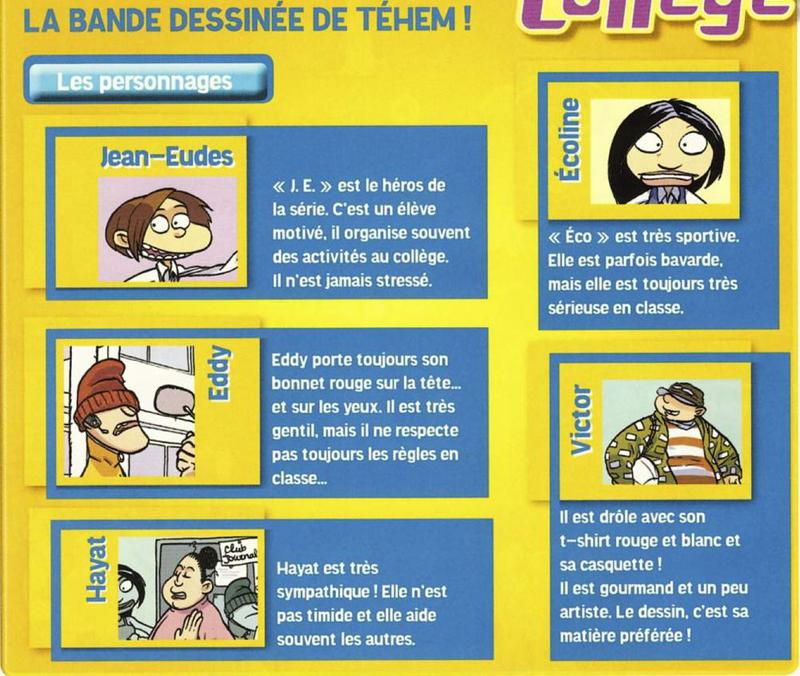
Lisez la présentation des personnages de Zap Collège et répondez. Read the presentation of the Zap Collège characters and answer.
[1 mark]
(a)Qui est toujours très sérieuse en classe ?
Show answerHide answer
« Éco » … est toujours très sérieuse en classe.
Tick each point you got.
[1 mark]
(b)Quel personnage n'est jamais stressé ?
Show answerHide answer
Il n'est jamais stressé.
Tick each point you got.
[1 mark]
(c)Qu'est-ce qu'Eddy ne respecte pas toujours ?
Show answerHide answer
Eddy is very kind but does not always respect the rules in class.
Tick each point you got.
17
Question 17
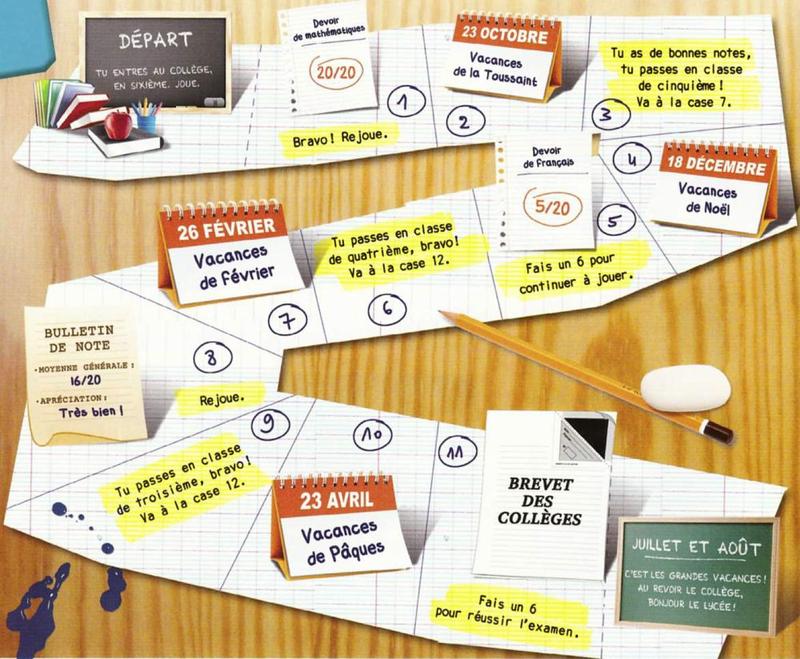
Observez le jeu du collège français. Vrai ou faux ? Look at the game of the French collège. True or false?
[1 mark]
(a)La première classe du collège est la sixième.
Show answerHide answer
Vrai
The game starts in the sixième.
[1 mark]
(b)À la fin du collège, il y a un examen : le brevet.
Show answerHide answer
Vrai
The last square before the summer holidays is the Brevet des collèges.
[1 mark]
(c)Il y a trois classes au collège.
Show answerHide answer
Faux
There are four: sixième, cinquième, quatrième, troisième.
[1 mark]
(d)Les grandes vacances sont en décembre.
Show answerHide answer
Faux
The long holidays are in July and August; December is the Christmas holiday.
Section D: production écrite (Partie 3)
6 marksÉcrivez un petit message. Write a short message.
18
Question 18
Répondez au message de Nora (environ 40 mots). Reply to Nora's message (about 40 words).
- Saluez et dites votre nom. Greet her and say your name.
- Dites votre nationalité et où vous habitez. Say your nationality and where you live.
- Décrivez votre caractère avec deux adjectifs. Describe your character with two adjectives.
- Dites ce que vous faites souvent, parfois ou jamais au collège, et votre matière préférée. Say what you often, sometimes or never do at school, and your favourite subject.
[6 marks]
(a)Your message to Nora
Show answerHide answer
Model answer: Salut Nora ! Je m'appelle Aina. Je suis malaisienne et j'habite à Kuala Lumpur. Je suis sérieuse et timide. Au collège, je parle parfois en classe et je ne suis jamais en retard. Ma matière préférée, c'est les maths. À bientôt ! Aina (41 words)
Tick each point you got.