Antoine : les achats, l'argent de poche et les passions
What this chapter covers
- I can count from 70 to 100 and beyond (soixante-dix, quatre-vingts, quatre-vingt-quinze, cent) and read and say prices (3.1)
- I can ask for and give a price (Combien ça coûte ? Ça fait 17,20 euros. C'est cher.) and buy something in a shop (3.1)
- I can replace a direct object with the pronoun le, la, l', les and put it in the right place, also in the negative and with aller + infinitive (3.2)
- I can ask questions with combien in three ways (Combien de pièces est-ce que tu as ?) and talk about pocket money and spending (3.4)
- I can talk about a passion or collection (Ma passion, c'est… Je suis fou de… Je me passionne pour…) (3.3)
- I can choose ce, cet, cette, ces to point to objects (3.3)
- I can name the shops and places where people buy things in France and read a poster for a vide-greniers (3.4)
- I can name the euro zone, coins and notes, and say which European currencies are not the euro (3.5)
- I can hear and say the sounds [ʃ] (cher) and [ʒ] (jeu) (3.5)
Module 3 of Adosphère 2 is called Antoine. Antoine is a boy with a passion for old coins and comics. He keeps small souvenirs such as a key ring, museum tickets and a sticker, and he does not like spending much money. He and his friends also go to a vide-greniers (a car-boot or garage sale). You learn to count from 70 to 100, to buy things and talk about prices, to talk about your pocket money and to talk about your passions. The grammar to master: object pronouns (le, la, l', les), ce / cet / cette / ces and questions with combien.
| Lesson | Book pages | You learn to |
|---|---|---|
| Leçon 1 : On l'achète ? | 38-39 | buy a gift, ask a price; object pronouns le, la, l', les |
| Leçon 2 : Ma passion : mes collections | 40-41 | talk about a collection and a passion; ce, cet, cette, ces |
| Leçon 3 : Grand vide-greniers | 42-43 | read a poster; combien questions; numbers 70-100 |
| Leçon 4 : Où acheter en France ? | 44 | kinds of shops and markets in France |
| Mon cours de géographie | 45 | the euro and the European Union |
| Entraîne-toi, Évaluation DELF, Ton dico | 46-48 | practice, sounds [ʃ] and [ʒ], DELF-style test and word list |
3.1Counting from 70 to 100 and saying prices
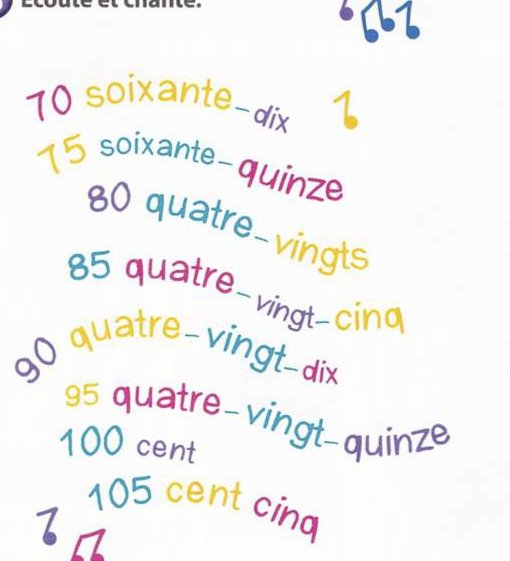
Adosphère 2, p. 43 (Leçon 3, exercice 8).
From 70 on, French builds numbers in a different way: the seventies are 60 + 10, 60 + 11... (70 is "sixty-ten"), and the eighties and nineties are counted in twenties (80 is "four-twenties", 90 is "four-twenty-ten").
| Number | French | How it is built |
|---|---|---|
| 70 | soixante-dix | 60 + 10 |
| 75 | soixante-quinze | 60 + 15 |
| 80 | quatre-vingts | 4 x 20 (with an -s when nothing follows) |
| 85 | quatre-vingt-cinq | 4 x 20 + 5 (no -s) |
| 90 | quatre-vingt-dix | 4 x 20 + 10 |
| 95 | quatre-vingt-quinze | 4 x 20 + 15 |
| 100 | cent | one hundred |
| 105 | cent cinq | 100 + 5 |
"
Write quatre-vingts only for 80 on its own; it loses the s before another number: quatre-vingt-un autocollants (81 stickers).
Prices and money (pp. 39, 48)
| Say | French | Example |
|---|---|---|
| Ask the price | Combien ça coûte ? / Quel est le prix ? | Combien coûte ce livre ? |
| Give the price | Ça coûte … euros. / Ça fait … euros. | Ça coûte 12,35 euros. Ça fait 17,20 euros. |
| Judge it | C'est cher. / Ce n'est pas cher. | Oh là là, 35 euros, c'est cher ! |
| Decide | Je le / la / les prends. J'achète… | Je la prends. |
A comma separates euros and cents, and you say the word euros in between: 9,40 € = neuf euros quarante; 13,20 € = treize euros vingt.
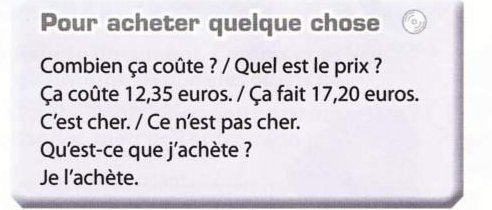
Adosphère 2, p. 39.
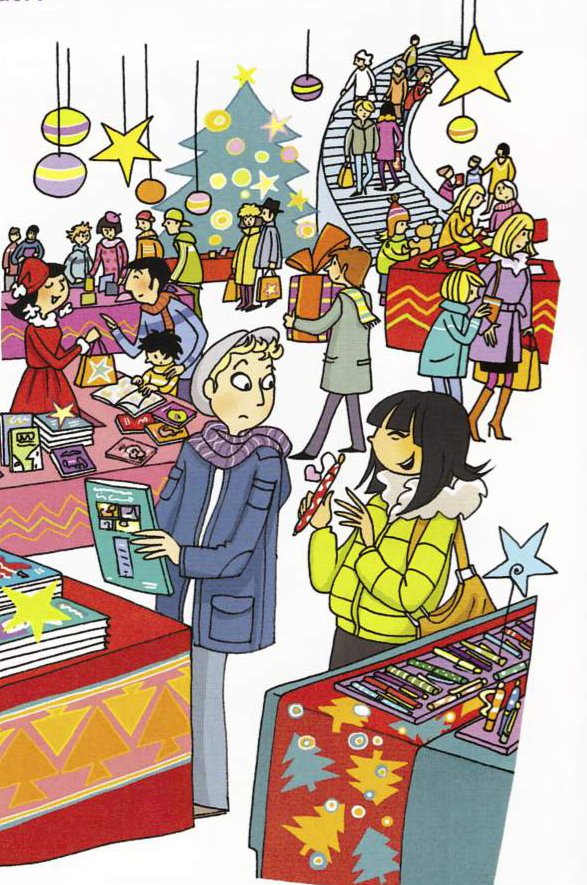
Adosphère 2, p. 38 (Leçon 1 « On l'achète ? »).
Show answerHide answer
(b) quinze euros cinquante
(c) 9,40 + 3,80 = 13,20: Ça fait treize euros vingt.
3.2Object pronouns: le, la, l', les
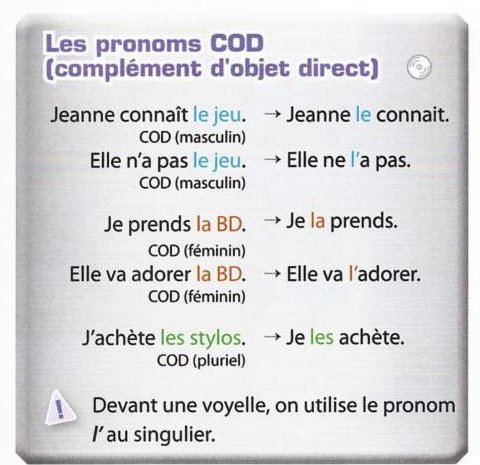
Adosphère 2, p. 39.
| Noun replaced | Pronoun | Example |
|---|---|---|
| masculine singular (le jeu) | le (l' before a vowel) | Jeanne connaît le jeu. → Jeanne le connaît. |
| feminine singular (la BD) | la (l' before a vowel) | Je prends la BD. → Je la prends. |
| plural (les stylos) | les | J'achète les stylos. → Je les achète. |
Where does the pronoun go? (p. 46)
- Before the verb: Je le prends.
- In the negative, ne … pas goes around pronoun + verb: Je ne le prends pas. Elle ne l'a pas.
- With the near future, before the infinitive: Je vais le prendre. Elle va l'adorer.
"
"
"
Show answerHide answer
(b) Je ne le prends pas.
(c) Tu vas l'acheter ?
3.3Passions and collections; ce, cet, cette, ces
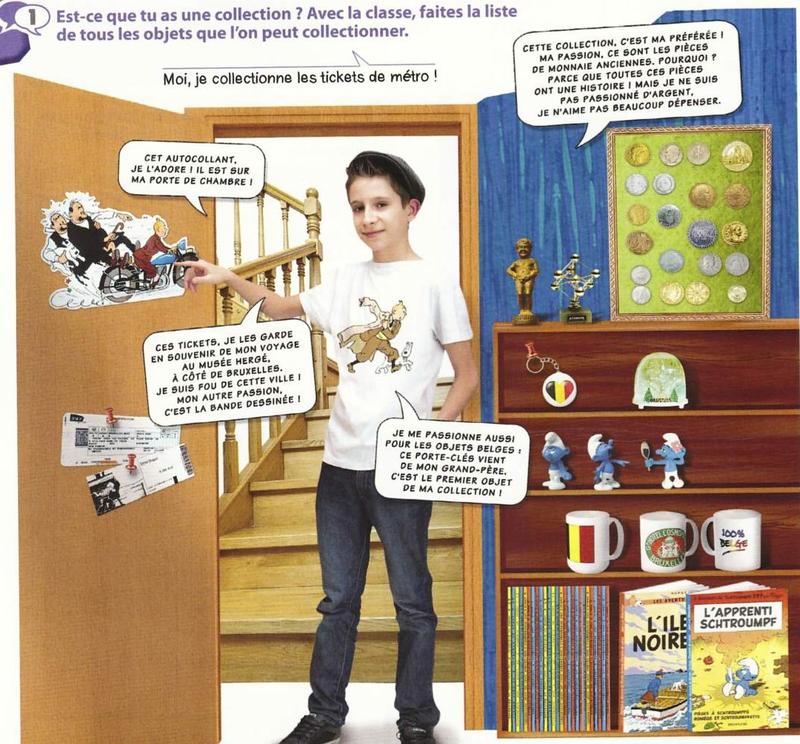
Adosphère 2, p. 40 (Leçon 2 « Ma passion : mes collections »).
Antoine collects des pièces de monnaie anciennes (old coins) because each coin has a story. He is not interested in money itself and does not like spending much. His first object was a key ring from his grandfather, he keeps museum tickets as a souvenir, and his other passion is la bande dessinée (comics).
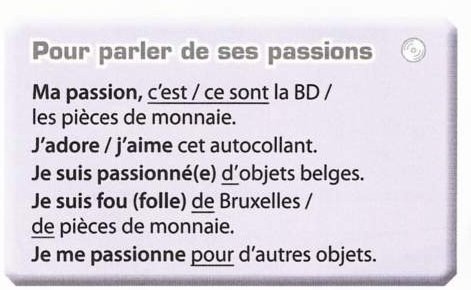
Adosphère 2, p. 41.
| French | English | Example |
|---|---|---|
| Ma passion, c'est / ce sont… | My passion is / are… | Ma passion, ce sont les pièces de monnaie. |
| J'adore / j'aime… | I love / like… | J'adore cet autocollant. |
| Je suis passionné(e) d'/de… | I am passionate about… | Je suis passionné d'objets belges. |
| Je suis fou (folle) de / d'… | I am crazy about… | Je suis fou de Bruxelles. |
| Je me passionne pour… | I am getting passionate about… | Je me passionne pour d'autres objets. |
| Je ne suis pas passionné d'argent. Je n'aime pas dépenser. | I am not interested in money. I don't like spending. | negative forms of the same expressions |
Demonstrative adjectives: this, that, these
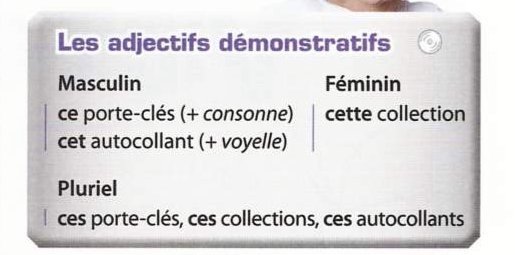
Adosphère 2, p. 41.
| Singular | Plural | |
|---|---|---|
| masculine, before a consonant | ce porte-clés | ces porte-clés, ces autocollants, ces collections |
| masculine, before a vowel sound | cet autocollant | |
| feminine | cette collection, cette pièce |
Show answerHide answer
(d) Je suis fou de pièces de monnaie.
3.4Questions with combien, pocket money and the vide-greniers
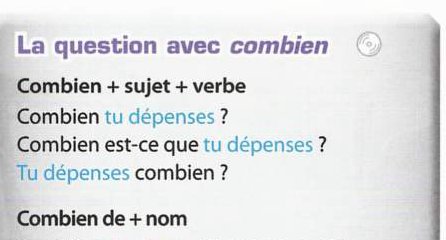
Adosphère 2, p. 43.
| Pattern | Example |
|---|---|
| Combien + subject + verb | Combien tu dépenses ? |
| Combien est-ce que + subject + verb | Combien est-ce que tu dépenses ? |
| subject + verb + combien | Tu dépenses combien ? |
| Combien de / d' + noun | Combien de pièces est-ce que tu as ? Tu as combien d'euros ? |
The teenagers' vide-greniers (p. 42)
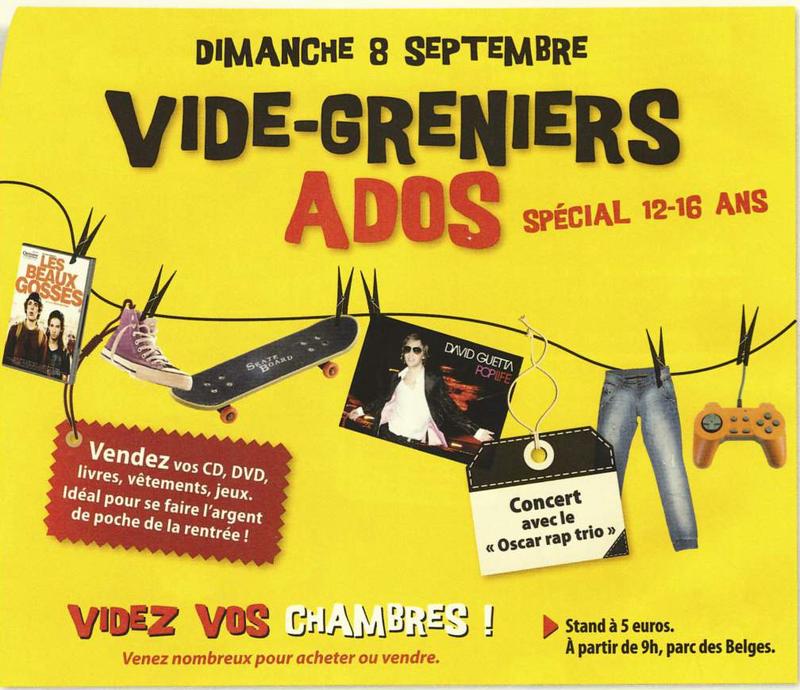
Adosphère 2, p. 42 (Leçon 3 « Grand vide-greniers »).
The poster invites teenagers (12 to 16) to vider leur chambre (empty their bedrooms): sell CDs, DVDs, books, clothes and games; a stand costs 5 euros; it starts at 9 am in the parc des Belges; it is a good way to earn l'argent de poche de la rentrée (back-to-school pocket money). Key verbs: acheter (to buy), vendre (to sell), gagner (to earn), dépenser (to spend), coûter (to cost).
French teenagers and pocket money (p. 48)
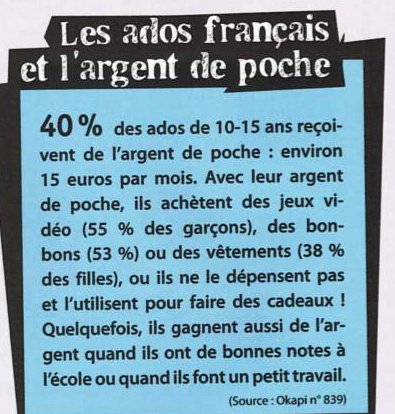
Adosphère 2, p. 48 (Évaluation DELF).
- 40 % of 10-15 year olds get pocket money, about 15 euros a month.
- They spend it on video games (55 % of boys), sweets (53 %) or clothes (38 % of girls); some save it for gifts.
- Some earn money with good marks at school or a small job (un petit travail).
Show answerHide answer
(b) Combien de pièces est-ce qu'elle a ? or Elle a combien de pièces ?
3.5Where to buy in France, the euro, and sounds
Où acheter en France ? (p. 44)
| French | English | You buy… |
|---|---|---|
| un grand magasin | department store | many things under one roof |
| une librairie | bookshop | books |
| un vide-greniers | car-boot sale, second-hand market | old or second-hand objects |
| un magasin de vêtements | clothes shop | clothes (les soldes = sales) |
| un marché | market | fruit and vegetables |
L'euro et l'Union européenne (p. 45)
The book says the European Union has 27 countries, and the euro (pièces et billets, coins and notes) is used in the 17 countries of the zone euro. Ten EU countries do not use the euro: Denmark, Sweden and Great Britain do not want to change, and seven others planned to change between 2014 and 2016. Other currencies: la livre (Great Britain), la couronne (Denmark, Sweden), le zloty (Poland), le leu (Romania).
Phonetics: [ʃ] and [ʒ] (pp. 39, 47)
| Sound | Spelling | Words | Tongue |
|---|---|---|---|
| [ʃ] | ch | cher, acheter, chose, chouette | forward |
| [ʒ] | j, g (before e, i) | jeu, argent, Jeanne | further back |
Practise: Je cherche quelque chose de chouette. J'achète un jeu pour Jeanne. Ces objets sont chers !