Patterns and Sequences
What this chapter covers
- Recognise and describe patterns of various sets of numbers and objects in everyday life (1.1.1)
- Explain the meaning of a sequence (1.2.1)
- Identify and describe the pattern of a sequence, then complete and extend the sequence (1.2.2)
- Describe the pattern of a sequence using numbers, words and algebraic expressions (1.3.1)
- Determine specific terms of a sequence (1.3.2)
- Solve problems involving sequences (1.3.3)
1.1Patterns
Patterns of objects
For objects, look at what is added (or taken away) from one picture to the next. Example 1 (textbook p. 3): add two dots to the previous object, or add one triangle to the previous object.
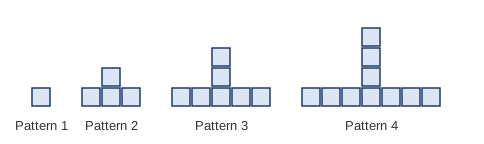
Patterns of numbers
A number pattern is made by adding, subtracting, multiplying or dividing the previous number.
| Numbers | Rule | Operation |
|---|---|---|
| −10, −4, 2, 8, … | Add 6 | +6 |
| 17, 7, −3, −13, … | Subtract 10 | −10 |
| 2, 6, 18, 54, … | Multiply by 3 | ×3 |
| 81, 27, 9, 3, … | Divide by 3 | ÷3 |
| 1, 1½, 2, 2½, … | Add ½ | +½ |
| −2.3, −2.6, −2.9, −3.2, … | Subtract 0.3 | −0.3 |
Example 2 (textbook p. 4): the six sequences in the table.
Odd and even numbers in a pattern
Even numbers can be divided by 2 exactly (2, 4, 6, 8, …). Odd numbers cannot (1, 3, 5, 7, 9, …).
Even numbers: 12, 22, 32, 42, 52, 62 (add 10)
The terms go up by 5 each time, so odd and even terms take turns. Taking every second term gives a rule of add 10.
Pascal's Triangle
Every row starts and ends with 1. Every other number is the sum of the two numbers above it.
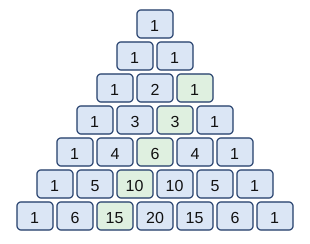
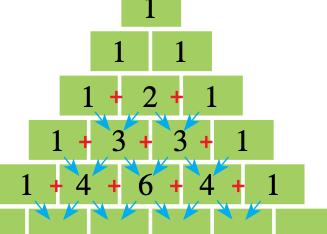
Picture: Mathematics Form 2 (DLP) textbook, p. 5.
- Method 1: the diagonal 1, 2, 3, 4, … adds 1 each time.
- Method 2: the diagonal 1, 3, 6, 10, … adds 2, 3, 4, … (the triangular numbers).
- Row 4 of the triangle is 1, 3, 3, 1; row 5 is 1, 4, 6, 4, 1; row 6 is 1, 5, 10, 10, 5, 1; row 7 is 1, 6, 15, 20, 15, 6, 1 (Example 4).
Fibonacci Numbers

Show answerHide answer
1.2Sequences
(b) 4, 5, −7, 10, −14, … : the changes are +1, −12, +17, −24, so there is no single pattern. It is not a sequence.
Completing a sequence
Find the rule from two terms that are next to each other, then check it on the others. Work forwards by applying the rule, and backwards by doing the opposite operation.
| Sequence | Rule | Missing terms |
|---|---|---|
| 7, 13, __, 25, __, … | +6 | 19, 31 |
| 88, __, 64, 52, __, __, … | −12 | 76, 40, 28 |
| __, 0.3, __, 0.027, 0.0081, __, … | ×0.3 | 1, 0.09, 0.00243 |
| __, __, ⅓, ⅔, __, … | +⅓ | −⅓, 0, 1 |
Example 7 (textbook p. 8). To find a missing term before the first number you are given, do the opposite operation: 0.3 ÷ 0.3 = 1, and ⅓ − ⅓ = 0.
Show answerHide answer
1.3Patterns and sequences
Numbers, words and algebraic expressions
Example 9 (textbook p. 10): the sequence 1, 9, 17, 25, 33, … can be described in three ways.
| Way | Description |
|---|---|
| Numbers | +8 each time |
| Words | Add 8 to the previous number |
| Algebraic expression | 1 + 8n, where n = 0, 1, 2, 3, … |
Check: n = 1 gives 3, n = 4 gives 12. ✓
If a sequence starts at another number, adjust: 5, 8, 11, 14, … is 3n + 2 (n = 1 gives 5, n = 4 gives 14).
Multiplying patterns use powers: 2, 4, 8, 16, … is 2n with n = 1, 2, 3, …, and 100, 50, 25, 12.5, … is 100 ÷ 2n with n = 0, 1, 2, 3, ….
Terms of a sequence
Show answerHide answer
Solving problems
| Step | Example 12 (textbook p. 12): fish feeder |
|---|---|
| Understand | Fish are fed 4 times a day, first at 7:35 a.m. When is the third feeding? |
| Plan | 1 day = 24 hours, so the gap is 24 ÷ 4 = 6 hours. The feeding times form a sequence that adds 6 hours. |
| Do | T1 = 7:35 a.m., T2 = 1:35 p.m., T3 = 7:35 p.m. |
| Conclude | The third feeding is at 7:35 p.m. |
Show answerHide answer
Summary
| Idea | Remember |
|---|---|
| Pattern | A rule for objects or numbers: +, −, ×, ÷ the previous term |
| Pascal's Triangle | Each number is the sum of the two above; rows start and end with 1 |
| Fibonacci Numbers | 0, 1, 1, 2, 3, 5, 8, … each term is the sum of the previous two |
| Sequence | Numbers or objects that follow one pattern |
| Describe a pattern | Numbers (+3), words (add 3), algebraic expression (3n) |
| Term | Tn is the term at position n |
| Problems | Understand, plan, do, conclude; check by listing terms |
Content and examples follow Mathematics Form 2 (DLP) textbook, Chapter 1, pp. 1–17.