Mathematics questions, chapter 1
Nama / NameKelas / ClassTarikh / Date
Patterns and Sequences
40 marks. Use Practice to check each answer as you go, or Exam to answer everything first. Show your working for Section B.
Section A: objective questions
12 marksChoose the correct answer. Each question carries 1 mark.
1
Question 1
What is the pattern of the numbers 17, 7, −3, −13, … ?
Show answerHide answer
C
17 → 7 → −3 → −13 goes down by 10 each time. The numbers get smaller, so the rule is subtract 10, not add 10.
2
Question 2
The numbers 28, 37, 46, 55, 64, … , 145 go up by 9 each time. What is the pattern of the even numbers in this list?
Show answerHide answer
A
28, 37, 46, 55, 64: odd and even terms take turns, so the even numbers are 28, 46, 64, … and go up by 9 + 9 = 18.
3
Question 3
The fifth row of Pascal's Triangle is 1, 4, 6, 4, 1. What is the sixth row?
Show answerHide answer
D
Each middle number is the sum of the two above it: 1 + 4 = 5, 4 + 6 = 10, 6 + 4 = 10, 4 + 1 = 5. The row starts and ends with 1.
4
Question 4
The Fibonacci Numbers are 0, 1, 1, 2, 3, 5, x, 13, 21, … . What is the value of x?
Show answerHide answer
B
Each term is the sum of the two before it, so x = 3 + 5 = 8. Check: 5 + 8 = 13.
5
Question 5
Which set of numbers is a sequence?
Show answerHide answer
B
A sequence follows one pattern. 9, 5, 1, −3 subtracts 4 every time. In the others the changes are different from one term to the next.
6
Question 6
Complete the sequence 80, 16, 3.2, __ , … .
Show answerHide answer
D
80 ÷ 5 = 16 and 16 ÷ 5 = 3.2, so the rule is divide by 5. 3.2 ÷ 5 = 0.64.
7
Question 7
In the sequence 13.3, 5.3, −2.7, __ , −18.7, … , what is the missing number?
Show answerHide answer
A
The rule is subtract 8: 5.3 − 8 = −2.7. So the missing term is −2.7 − 8 = −10.7, and −10.7 − 8 = −18.7 matches.
8
Question 8
Which algebraic expression gives the sequence 3, 6, 9, 12, … where n = 1, 2, 3, 4, … ?
Show answerHide answer
C
The terms are the multiples of 3, so the nth term is 3n. 3 + 3n would start at 6.
9
Question 9
Which expression gives 5, 8, 11, 14, … for n = 1, 2, 3, 4, … ?
Show answerHide answer
D
The terms go up by 3, so the expression has 3n. For n = 1 we need 5, so add 2: 3(1) + 2 = 5, 3(4) + 2 = 14.
10
Question 10
State the 7th term, T7, of the sequence 54, 50, 46, 42, … .
Show answerHide answer
B
The rule is subtract 4. From T1 to T7 there are 6 steps: 54 − 6 × 4 = 30. 34 is T6; 26 is T8.
11
Question 11
Which term of the sequence 100, 93, 86, 79, … is 51?
Show answerHide answer
C
The rule is subtract 7. 100 − 51 = 49 = 7 × 7, so 7 steps after T1, which is T8.
12
Question 12
A bus leaves every 25 minutes. The first bus leaves at 7:40 a.m. At what time does the 5th bus leave?
Show answerHide answer
A
The 5th bus leaves after 4 gaps: 4 × 25 = 100 minutes = 1 hour 40 minutes. 7:40 + 1:40 = 9:20 a.m. 9:45 counts 5 gaps.
Section B: structured questions
28 marksAnswer all questions. Show your working.
13
Question 13
State the pattern of each set of numbers in words.
[1 mark]
(a)12, 19, 26, 33, …
Show answerHide answer
Tick each point you got.
[1 mark]
(b)−2, −6, −18, −54, …
Show answerHide answer
−2 × 3 = −6, −6 × 3 = −18. Multiplying by 3 makes a negative number more negative.
Tick each point you got.
14
Question 14
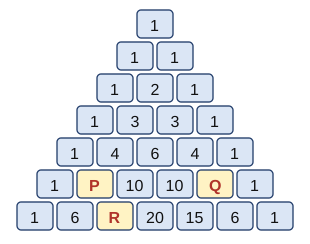
Diagram 1 shows seven rows of Pascal's Triangle. Three numbers, P, Q and R, are missing.
[3 marks]
(a)Find the values of P, Q and R.
Show answerHide answer
Each number is the sum of the two numbers above it. Row 6 is 1, 5, 10, 10, 5, 1 and row 7 is 1, 6, 15, 20, 15, 6, 1.
Tick each point you got.
15
Question 15
Determine whether each set of numbers is a sequence. Give a reason.
[1 mark]
(a)20, 14, 8, 2, −4, …
Show answerHide answer
Tick each point you got.
[1 mark]
(b)3, 5, 9, 10, 20, …
Show answerHide answer
Tick each point you got.
16
Question 16
A sequence is 6, 11, 16, 21, 26, … .
[1 mark]
(a)State the pattern using numbers.
Show answerHide answer
Tick each point you got.
[1 mark]
(b)State the pattern in words.
Show answerHide answer
Tick each point you got.
[2 marks]
(c)Write the pattern as an algebraic expression in n, where n = 1, 2, 3, … .
Show answerHide answer
The terms go up by 5, so the expression has 5n. n = 1 gives 5 but the first term is 6, so add 1.
Tick each point you got.
17
Question 17
The first four terms of a sequence are 22, x, 4, −5, … .
[1 mark]
(a)Find the value of x.
Show answerHide answer
Tick each point you got.
[2 marks]
(b)Calculate the 9th term, T9.
Show answerHide answer
From T1 to T9 there are 8 steps, not 9. 22 − 72 = −50.
Tick each point you got.
18
Question 18
A sequence is 5, 12, 19, 26, … .
[2 marks]
(a)Which term of the sequence is 145?
Show answerHide answer
Tick each point you got.
[2 marks]
(b)Is 200 a term of the sequence? Give a reason.
Show answerHide answer
A term is the first term plus a whole number of steps of 7.
Tick each point you got.
19
Question 19
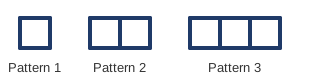
Diagram 2 shows patterns made of matchsticks.
[1 mark]
(a)How many matchsticks are needed for Pattern 4?
Show answerHide answer
Tick each point you got.
[1 mark]
(b)State the pattern of the number of matchsticks in words.
Show answerHide answer
Tick each point you got.
[2 marks]
(c)Calculate the number of matchsticks for Pattern 10.
Show answerHide answer
Pattern n needs 3n + 1 matchsticks, so Pattern 10 needs 3(10) + 1 = 31.
Tick each point you got.
20
Question 20
Encik Ravi takes a tablet every 8 hours. His first tablet is at 6:30 a.m.
[2 marks]
(a)At what time is the 3rd tablet?
Show answerHide answer
Tick each point you got.
21
Question 21
Make your own sequence of 5 terms. The first term is −6 and each term is found by multiplying the previous term by the same number.
[1 mark]
(a)Write your sequence.
Show answerHide answer
Tick each point you got.
[1 mark]
(b)State the pattern in words.
Show answerHide answer
Tick each point you got.
22
Question 22
Mei says that the pattern of 5, 10, 20, 40, … is add 5 to the previous number.
[1 mark]
(a)Is Mei correct? Give a reason.
Show answerHide answer
Tick each point you got.
[1 mark]
(b)State the correct pattern.
Show answerHide answer
Tick each point you got.