Factorisation and Algebraic Fractions
What this chapter covers
- Expand one or two algebraic expressions, simplify combined operations including expansion and solve problems (2.1)
- Relate expansion to factors and factorisation and list the factors of an algebraic product (2.2)
- Factorise expressions using the HCF, difference of squares, perfect squares, cross multiplication and grouping, and solve problems (2.2)
- Add and subtract algebraic fractions after expanding and factorising (2.3)
- Multiply and divide algebraic fractions and perform combined operations involving expansion and factorisation (2.3)
2.1Expansion
Expansion with one bracket
Use the Distributive Law: a(b + c) = ab + ac and a(b − c) = ab − ac. Watch the signs: (+)×(+) = +, (+)×(−) = −, (−)×(+) = −, (−)×(−) = +.
(b) 3r(r − 2s) = 3r2 − 6rs
(c) −5b(a + 3) = −5ab − 15b
(d) −2y3(9y − 3z + 6x) = −6y2 + 2yz − 4xy
Expansion with two brackets
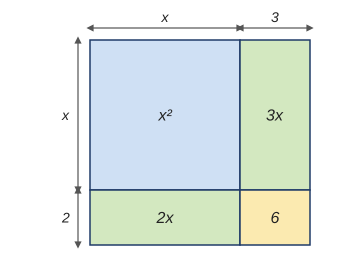
Multiply each term in the first bracket by each term in the second bracket, then collect the like terms. A rectangle shows why: the area of (x + 3) by (x + 2) is the sum of four smaller areas.
(b) (4 + 3r)(2 + r) = 8 + 4r + 6r + 3r2 = 3r2 + 10r + 8
(c) (3r + 4s)(r − 2s) = 3r2 − 6rs + 4rs − 8s2 = 3r2 − 2rs − 8s2
(d) (3p + 2)2 = (3p + 2)(3p + 2) = 9p2 + 6p + 6p + 4 = 9p2 + 12p + 4
Three results worth remembering
| Expansion | Result |
|---|---|
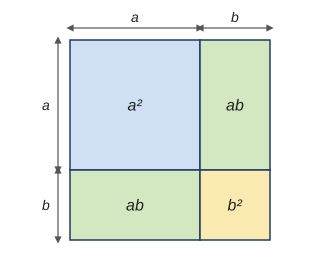
| (a + b)2 | a2 + 2ab + b2 |
| (a − b)2 | a2 − 2ab + b2 |
| (a + b)(a − b) | a2 − b2 |
Show answerHide answer
(b) x2 − 14x + 49
Combined operations including expansion
Follow BODMAS: brackets (expand them), then multiplication and division, then addition and subtraction. Collect like terms last.
(b) (r − 3t)2 + 4rt = r2 − 6rt + 9t2 + 4rt = r2 − 2rt + 9t2
(c) (x + y)(x − y) + x(x − 2y) = x2 − y2 + x2 − 2xy = 2x2 − 2xy − y2
Solving problems with expansion
2.2Factorisation
Factors and HCF
The factors of 3p are 1, 3, p and 3p. A common factor divides two or more terms exactly. The highest common factor (HCF) is the largest of them.
Choosing a method
| What you see | Method | Example |
|---|---|---|
| Every term shares a factor | Take out the HCF | 8x + 12x2 = 4x(2 + 3x) |
| Two perfect squares with a minus | Difference of squares: a2 − b2 = (a + b)(a − b) | 9m2 − 100 = (3m + 10)(3m − 10) |
| a2 ± 2ab + b2 | Perfect square | x2 − 6x + 9 = (x − 3)2 |
| Three terms ax2 + bx + c | Cross multiplication | m2 − 2m − 8 = (m + 2)(m − 4) |
| Four terms | Group in pairs | pq + qr + ps + rs = (q + s)(p + r) |
Common factor and difference of squares
(b) b2 − 1 = (b + 1)(b − 1)
(c) 3y2 − 147 = 3(y2 − 49) = 3(y + 7)(y − 7)
(d) 5k2 − 80 = 5(k2 − 16) = 5(k + 4)(k − 4)
Cross multiplication for ax2 + bx + c
For x2 + 6x + 8: find two numbers whose product is 8 (the constant) and whose sum is 6 (the coefficient of x). They are 2 and 4.
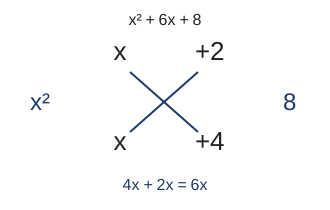
(b) 2m2 + 7m + 6: try (2m + 3)(m + 2). Cross products 4m + 3m = 7m. Correct.
(c) −2y2 − 9y + 5 = (2y − 1)(−y − 5)
Four terms: grouping
Show answerHide answer
(b) numbers with product −15 and sum 2 are 5 and −3: (x + 5)(x − 3)
(c) 2y(3x + 1) + 3(3x + 1) = (2y + 3)(3x + 1)
Solving problems with factorisation
2.3Algebraic expressions and laws of basic arithmetic operations
Expanding and factorising expressions
Before you add or subtract fractions, you may need to expand a bracket and then factorise the result.
(b) 4w(w − 2) − 5 = 4w2 − 8w − 5 = (2w − 5)(2w + 1)
Adding and subtracting
Make the denominators the same, using the LCM, then add or subtract the numerators.
(b) x+25w − x−55w = x + 2 − (x − 5)5w = 75w
(c) 14p + 46p: LCM = 12p, so 312p + 812p = 1112p
(d) 5m4r − m14rs: LCM = 28rs, so 35ms28rs − 2m28rs = 35ms − 2m28rs
Show answerHide answer
Multiplying and dividing
Factorise every numerator and denominator, change ÷ to × the upside-down fraction, then cancel the common factors.
(b) (h + k)2h2 − k2 × 6k − 3h2k − h = (h + k)(h + k)(h + k)(h − k) × 3(2k − h)2k − h = 3(h + k)h − k
(c) 5aa + 2b ÷ 2ab3a + 6b = 5aa + 2b × 3(a + 2b)2ab = 152b
Show answerHide answer
Combined operations
Expand and factorise as needed, then add, subtract, multiply or divide. Simplify each fraction before you combine them.
(b) 2x + 1 + x − 1x2 − 1 = 2x + 1 + x − 1(x + 1)(x − 1) = 2x + 1 + 1x + 1 = 3x + 1