Algebraic Formulae
What this chapter covers
- Write a formula based on a situation, using variables and the basic operations (3.1.1)
- Change the subject of a formula, including formulae with squares and square roots (3.1.2)
- Find the value of a variable when the values of the other variables are given (3.1.3)
- Solve problems involving algebraic formulae (3.1.4)
3.1Algebraic formulae
3.1.1 Forming a formula
A formula is built from the relationship between variables. Read the situation, give each unknown quantity a letter, then join the pieces with the correct operations.
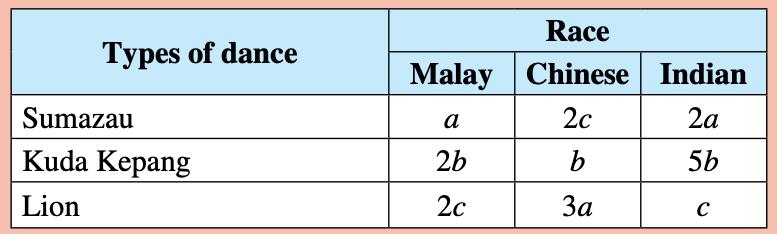
Table from Mathematics Form 2 (DLP) textbook, p. 45.
From the table, add across each race or down each dance:
- s, Chinese dancers: s = 2c + b + 3a
- d, Kuda Kepang dancers: d = 2b + b + 5b = 8b
- w, Indian and Malay dancers: w = (2a + 5b + c) + (a + 2b + 2c) = 3a + 7b + 3c
Cheese cake: 2 × RM3 = RM6 a slice
Before discount: 3m + 6n
After the 10% discount the price is 100% − 10% = 90% = 0.9 of the total
z = 0.9(3m + 6n) = 2.7m + 5.4n
Show answerHide answer
(b) C = 30(2) + 18(3) = 60 + 54 = RM114
3.1.2 Changing the subject of a formula
The perimeter of an isosceles triangle with base a and two equal sides b is P = a + 2b. Here P is the subject. We can rewrite it with a as the subject, a = P − 2b, or with b as the subject, b = P − a2.
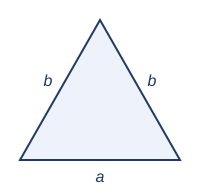
Treat the formula like a balance: do the same to both sides. To get the new subject alone, undo the operations in the reverse order.
| The letter has been | To undo it, do this to both sides |
|---|---|
| added to: + q | subtract q |
| subtracted: − q | add q |
| multiplied by q | divide by q |
| divided by q | multiply by q |
| squared: p² | take the square root |
| square root: √p | square both sides |
m + b = 2s (add m to both sides)
m = 2s − b
(d) t = m − n−3
t × (−3) = m − n, so −3t = m − n
m = −3t + n = n − 3t
(c) w = √(p3). Square both sides: w² = p3, so p = 3w²
(d) t = 1p². Then tp² = 1, p² = 1t, so p = √(1t)
Show answerHide answer
(b) T² = 2x, so x = T²2
3.1.3 Finding the value of a variable
If all the variables except one are known, substitute the numbers into the formula. To find a letter that is not the subject, either substitute first and solve the equation, or change the subject first.
(b) w = 15 and u = 4: 7t − 5(4) = 15, so 7t = 35 and t = 5
Take the positive square root: 3 − q = 8
q = −5
Show answerHide answer
(b) 7 = 3(3)² − 4y = 27 − 4y, so 4y = 20 and y = 5
3.1.4 Solving problems
Follow four steps: understand the problem, plan a strategy (choose letters, write an equation), carry out the plan, then write a conclusion and check.
Let a bun cost RMx and a chicken RM2x.
2x + 2x + 1 = 5, so 4x = 4 and x = 1. Bun RM1, chicken RM2.
Let y be the number of chickens: 2(1) + 2y = 12, so y = 5.
Azman can buy 5 pieces of fried chicken.
Show answerHide answer
Notebook RM3, pen RM2. Check: 9 + 4 = 13.
Quick summary
| Task | What to do |
|---|---|
| Form a formula | Name the quantities, join them with operations, use brackets for discounts |
| Change the subject | Undo operations in reverse order, same on both sides, coefficient 1 |
| Find a value | Substitute with brackets, then solve |
| Word problem | Understand, plan, carry out, conclude |