Circles
What this chapter covers
- Name the parts of a circle (centre, radius, diameter, chord, arc, sector, segment, circumference) and explain the properties of a circle (5.1)
- Construct a circle, a diameter through a point, a chord of given length and a sector of given angle using compasses, ruler and protractor (5.1)
- Explain that a diameter is an axis of symmetry, that a radius perpendicular to a chord bisects it, that perpendicular bisectors of chords meet at the centre, and that equal chords give equal arcs and are equidistant from the centre (5.2)
- Find the centre and radius of a circle by construction, and solve problems on the symmetrical properties of chords using Pythagoras' theorem (5.2)
- Define π as circumference ÷ diameter and use the circumference formulae C = πd = 2πr (5.3)
- Derive and use the area formula A = πr² (5.3)
- Find the length of an arc and the area of a sector, and work backwards to the radius or the angle at the centre (5.3)
- Solve problems involving circles, including combinations of shapes and the area of an annulus (5.3)
Wheels, coins, clock faces, round tables and satellite dishes are all circles. A circle is the path of a point that always stays the same distance from one fixed point. In this chapter you will name the parts of a circle, use its symmetry to find unknown lengths of chords, and calculate its circumference, area, arcs and sectors.
| English | Bahasa Melayu |
|---|---|
| circle, circumference | bulatan, lilitan |
| centre, radius, diameter | pusat, jejari, diameter |
| chord, arc | perentas, lengkok |
| sector, segment | sektor, tembereng |
| minor, major | minor, major |
| symmetry, axis of symmetry | simetri, paksi simetri |
| perpendicular bisector | pembahagi dua sama serenjang |
| area of a circle | luas bulatan |
5.1Properties of circles
Parts of a circle
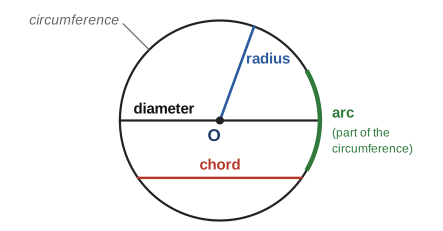
| Part | What it is |
|---|---|
| Centre | The fixed point; every point on the circumference is the same distance from it |
| Radius | A straight line from the centre to any point on the circumference |
| Diameter | A chord that passes through the centre (diameter = 2 × radius) |
| Chord | A straight line joining any two points on the circumference |
| Arc | Part of the circumference (a minor arc is shorter than a major arc) |
| Sector | The region enclosed by two radii and an arc |
| Segment | The region enclosed by a chord and an arc |
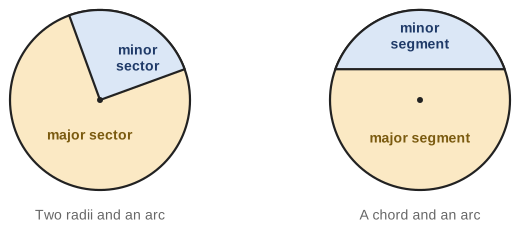
Example 1 (textbook p. 77)
Using the first figure above, name (a) the longest chord, (b) a line from the centre to the circumference, (c) the curved line that is one part of the circumference.
(a) Diameter (b) Radius (c) Arc
Show answerHide answer
(b) Segment
(c) Sector
Constructing a circle and its parts
Use a pair of compasses, a ruler and a protractor.
- Circle of given radius: mark the centre O, open the compasses to the radius on a ruler, put the sharp point on O and draw the circle.
- Diameter through a point Q on the circle: join Q to the centre O with a ruler and extend the line until it meets the circumference on the other side.
- Chord of given length from a point P: open the compasses to the length, put the sharp point on P and draw an arc that cuts the circle at A. Join P to A. (The chord can be at most one diameter long.)
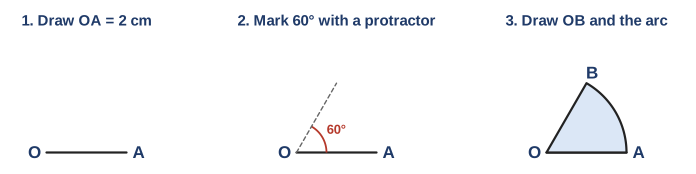
- Sector with a given angle: draw the circle and a radius OA. Use the protractor at O to mark the angle, draw the second radius OB. Sector AOB is the region between them.
Show answerHide answer
5.2Symmetrical properties of chords
Features in a circle
A circle looks the same after it is folded along any diameter, so a circle has infinitely many axes of symmetry. This one idea gives all the properties below.
2. A radius that is perpendicular to a chord bisects the chord (and a radius that bisects a chord is perpendicular to it).
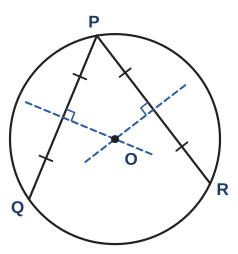
3. The perpendicular bisectors of two chords meet at the centre of the circle.
4. Chords that are equal in length cut off arcs of the same length (and the other way round).
5. Equal chords are the same distance from the centre (and the other way round).
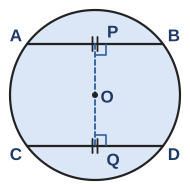
Two radii and a chord form an isosceles triangle, so the angles opposite the equal radii are equal. The perpendicular from the centre to the chord also splits that triangle into two right-angled triangles, where you can use Pythagoras' theorem: (half the chord)² + (distance from centre)² = radius².
Example 2 (textbook p. 83)
O is the centre of the circle and MN is a chord. K is the midpoint of MN and OK = 3 cm, NK = 4 cm. Find (a) ON, (b) an angle equal to ∠ONK.
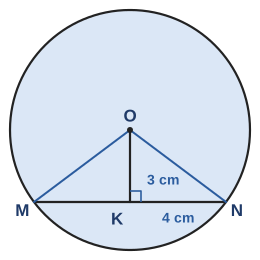
- OK ⊥ MN, so triangle OKN is right-angled at K.
- ON² = OK² + NK² = 3² + 4² = 9 + 16 = 25, so ON = 5 cm.
- OM = ON (radii), so triangle OMN is isosceles and ∠ONK = ∠OMK.
Example 3 (textbook p. 83)
Radius OP is perpendicular to chord MN at S. The radius is 10 cm and OS = 8 cm. Find MN.
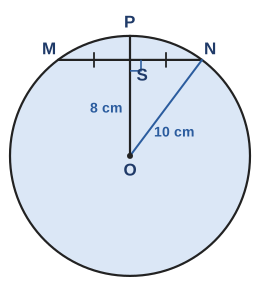
- OM is also a radius, so OM = 10 cm.
- MS² = OM² − OS² = 10² − 8² = 100 − 64 = 36, so MS = 6 cm.
- MS = SN (a radius perpendicular to a chord bisects it), so MN = 2 × 6 = 12 cm.
Centre and radius of a circle
To find the centre of a circle drawn on paper, draw two chords, for example PQ and PR, and construct the perpendicular bisector of each. They meet at the centre O. The distance from O to the circumference is the radius.
Solving problems using the symmetry of chords
Example 4 (textbook p. 84)
RS and TU are equal chords. POQ is a straight line through the centre O. OP = 5 cm and RS = 24 cm. Calculate (a) PR, (b) the radius.
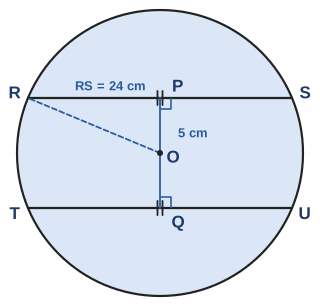
- OP ⊥ RS, so P is the midpoint: PR = 24 ÷ 2 = 12 cm.
- Radius OR² = PR² + OP² = 12² + 5² = 144 + 25 = 169, so OR = 13 cm.
- (Equal chords are the same distance from O, so OQ = 5 cm as well, and arcs RS and TU are equal.)
Example 5 (textbook p. 85)
A round window has a diameter of 50 cm. Two parallel iron rods US = 48 cm and PR are on opposite sides of the centre. The distance QT between them is 31 cm. Find the length of PR.
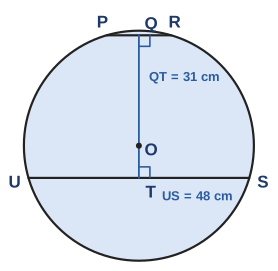
- Radius = 50 ÷ 2 = 25 cm. Half of US = 24 cm.
- OT = √(25² − 24²) = √(625 − 576) = √49 = 7 cm.
- OQ = QT − OT = 31 − 7 = 24 cm.
- PQ = √(25² − 24²) = √49 = 7 cm, so PR = 2 × 7 = 14 cm.
Show answerHide answer
Chord = 2 × 5 = 10 cm
5.3Circumference and area of a circle
Circumference and diameter: the number π
If you measure the circumference and the diameter of any circular object (a pail, a tyre, a stopwatch) and divide, you always get about 3.14.
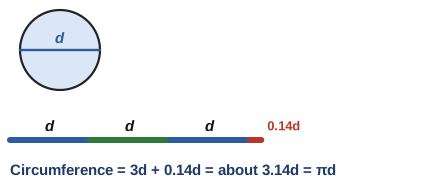
Circumference = πd = 2πr
Area of a circle
Cut a circle into many thin sectors and arrange them side by side. The shape becomes nearly a rectangle with height r and base = half the circumference = πr.
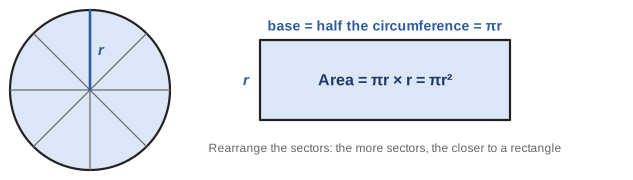
Circumference and area problems
| You know | You want | Method |
|---|---|---|
| radius or diameter | circumference | C = 2πr or πd |
| circumference | radius | r = C ÷ 2π, then area if needed |
| area | radius | r² = A ÷ π, then take the square root |
Example 6 (textbook p. 88)
Calculate the circumference of a circle with (a) diameter 14 cm (π = 227), (b) radius 21.3 cm (π = 3.142).
(a) C = πd = 227 × 14 = 44 cm
(b) C = 2πr = 2 × 3.142 × 21.3 = 133.85 cm (2 d.p.)
Example 7 (textbook p. 88)
The circumference of a circle is 88 cm. Find its diameter (π = 227).
πd = 88, so 227 × d = 88 and d = 88 × 722 = 28 cm
Example 9 (textbook p. 89)
The area of a circle is 616 cm². Find its radius and diameter (π = 227).
πr² = 616, so r² = 616 × 722 = 196 and r = √196 = 14 cm. Diameter = 2 × 14 = 28 cm.
Example 10 (textbook p. 89)
The circumference is 66 cm. Find the area (π = 227).
- 2πr = 66, so 2 × 227 × r = 66 and r = 66 × 744 = 10.5 cm
- Area = πr² = 227 × 10.5² = 346.5 cm²
Show answerHide answer
(b) r = 7 cm, area = 227 × 7² = 154 cm²
Length of an arc and area of a sector
An arc is part of the circumference, and a sector is part of the circle. Each is in the same proportion to the whole as its angle at the centre is to 360°.
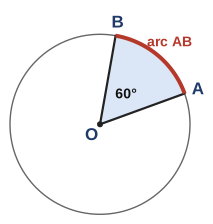
Area of sector = θ360° × πr²
where θ is the angle at the centre.
Example 12 (textbook p. 90)
Radius 14 cm, centre O. Calculate the length of minor arc PQ with a 60° angle at the centre. Give the answer to 2 d.p. (π = 227)
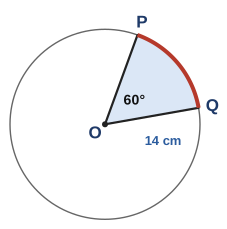
Length = 60°360° × 2 × 227 × 14 = 16 × 88 = 14.67 cm
Example 13 (textbook p. 90)
Radius 21 cm and ∠ROS = 72°. Calculate the length of the major arc RS. (π = 227)
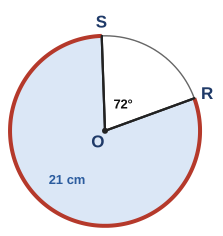
- Angle at the centre for the major arc = 360° − 72° = 288°
- Length = 288°360° × 2 × 227 × 21 = 105.6 cm
Example 14 (textbook p. 91)
An arc is 11 cm long and its angle at the centre is 45°. Find the radius. (π = 227)
45°360° × 2 × 227 × r = 11, so 18 × 447 × r = 11, 1114 r = 11 and r = 14 cm
Example 15 (textbook p. 91)
Radius 21 mm, ∠MON = 100°. Calculate the area of the minor sector MON. (π = 227)
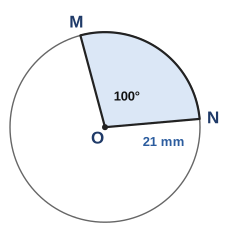
Area = 100°360° × 227 × 21² = 385 mm²
Example 16 (textbook p. 92)
The area of sector QOP is 18.48 cm² and the radius is 12 cm. Find the angle θ at the centre. (π = 227)
θ360° × 227 × 12² = 18.48, so θ = 18.48 × 360° ÷ (227 × 144) = 14.7°
Show answerHide answer
(b) 135°360° × 227 × 8² = 75.43 cm²
Solving problems involving circles
Most problems combine shapes. Break the figure into rectangles, triangles and parts of circles, find each area (or length), then add or subtract.
Example 17 (textbook p. 92)
A park is a rectangle 63 m by 58 m. A quadrant of radius 7 m is planted with flowers at each corner. A circular fish pond of diameter 28 m is in the middle. The rest is grass. Find the area of grass. (π = 227)
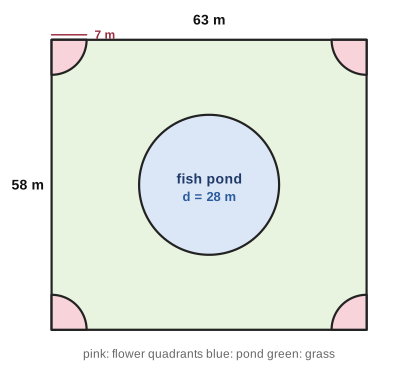
- Park = 63 × 58 = 3 654 m²
- Four quadrants make one whole circle of radius 7 m: 227 × 7² = 154 m²
- Pond: radius 14 m, area = 227 × 14² = 616 m²
- Grass = 3 654 − 154 − 616 = 2 884 m²
An annulus
The region between two circles with the same centre is an annulus. Its area is the big circle minus the small circle.
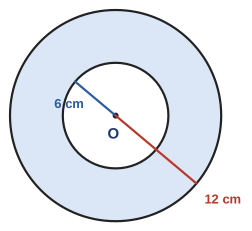
With R = 12 cm and r = 6 cm: area = π(144 − 36) = 108π cm² (about 339.43 cm² using 227).
Show answerHide answer
64 × 227 = 201.14 cm²
Summary
| Idea | Key fact | Example |
|---|---|---|
| Parts | Diameter is the longest chord; sector has two radii and an arc; segment has a chord and an arc | Diameter = 2 × radius |
| Symmetry | A radius perpendicular to a chord bisects it; equal chords are equidistant from the centre and cut equal arcs | r = 10, OS = 8: MN = 12 |
| Chord problems | Right-angled triangle: r² = (half chord)² + (distance)² | 5² + 12² = 13² |
| Circumference | C = πd = 2πr | r = 21.3: 133.85 cm |
| Area | A = πr² | r = 14: 616 cm² |
| Arc and sector | θ360° of 2πr and of πr² | 60°, r = 14: 14.67 cm |
| Annulus | π(R² − r²) | R = 12, r = 6: 108π |