Polygon
What this chapter covers
- Describe the geometric properties of regular polygons (equal sides, equal interior angles, n axes of symmetry) and tell regular from irregular polygons (4.1.1)
- Construct regular polygons (equilateral triangle, square, hexagon and others) with a ruler and compasses or by dividing the angle at the centre, and explain the steps (4.1.2)
- Derive and use the formula (n − 2) × 180° for the sum of the interior angles of a polygon (4.2.1)
- Make and verify the conjecture that the exterior angles of a polygon add up to 360° (4.2.2)
- Find the interior angle, the exterior angle and the number of sides of a regular polygon, and unknown angles in other polygons (4.2.3)
- Solve problems involving polygons, including combinations of polygons (4.2.4)
Polygons are everywhere in buildings and in art: the floating mosque at Tanjung Bungah in Penang uses a geometric pattern of polygons. In Form 1 you met triangles and quadrilaterals. In this chapter you look at regular polygons with any number of sides, how to construct them, and the rules for their interior and exterior angles. The word "polygon" comes from poly (many) and gon (angle).
| English | Bahasa Melayu |
|---|---|
| regular polygon, irregular polygon | poligon sekata, poligon tak sekata |
| axis of symmetry | paksi simetri |
| side, vertex | sisi, bucu |
| interior angle, exterior angle | sudut pedalaman, sudut peluaran |
| supplementary angle | sudut penggenap |
| conjecture | konjektur |
4.1Regular polygons
Geometric properties of regular polygons
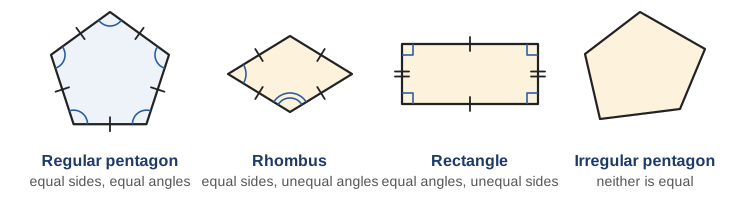
The textbook (p. 57) also sorts polygons by shape. A convex polygon has no interior angle more than 180°. A concave polygon has at least one interior angle more than 180°.
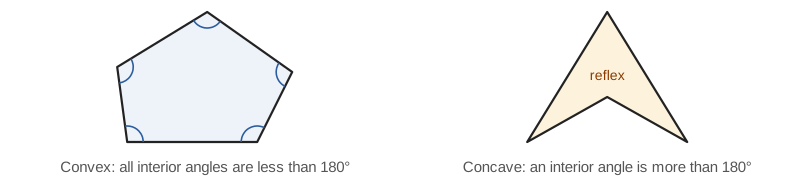
Based on the textbook, Mathematics Form 2 (DLP), p. 57.
Axes of symmetry
An axis of symmetry is a fold line: the two halves match exactly. The activity on p. 58 shows the rule for regular polygons.
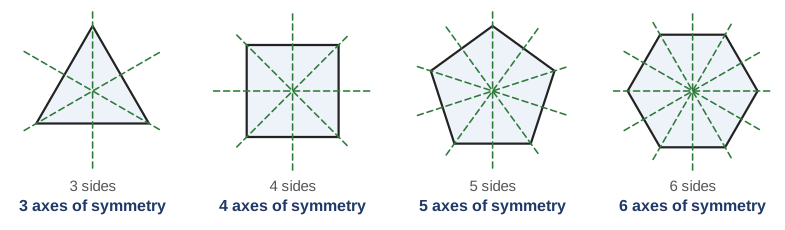
| Regular polygon | Sides | Vertices | Axes of symmetry |
|---|---|---|---|
| equilateral triangle | 3 | 3 | 3 |
| square | 4 | 4 | 4 |
| regular pentagon | 5 | 5 | 5 |
| regular hexagon | 6 | 6 | 6 |
| regular octagon | 8 | 8 | 8 |
Show answerHide answer
b) 2 (a rhombus is irregular: its axes are its two diagonals)
c) 15
Constructing regular polygons
The textbook (pp. 59-61) builds regular polygons with a ruler and compasses. The idea is always that the compasses keep the same radius, so the sides come out equal.
Method: regular hexagon with side 3.5 cm (textbook p. 60)
- Draw a circle of radius 3.5 cm and mark a point A on it.
- With the compasses still at 3.5 cm and the point on A, mark B on the circle.
- Move to B and mark C, then D, E and F in the same way.
- Join AB, BC, CD, DE, EF and FA.
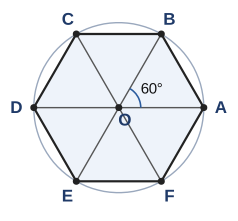
Why it works: the radius of the circle equals the side, so each triangle such as OAB has three equal sides. It is equilateral, so ∠AOB = 60°, and 6 × 60° = 360° fills the centre exactly.
Show answerHide answer
b) 360° ÷ 9 = 40°
4.2Interior angles and exterior angles of polygons
Interior and exterior angles
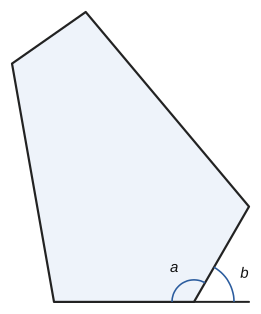
Sum of the interior angles
Choose one vertex and draw diagonals to the other vertices. This cuts an n-sided polygon into (n − 2) triangles. Each triangle has angles totalling 180°.
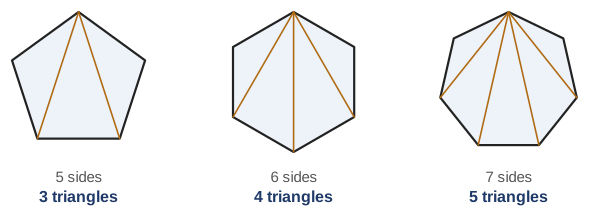
| Polygon | Sides n | Triangles | Sum of interior angles |
|---|---|---|---|
| triangle | 3 | 1 | 1 × 180° = 180° |
| quadrilateral | 4 | 2 | 2 × 180° = 360° |
| pentagon | 5 | 3 | 3 × 180° = 540° |
| hexagon | 6 | 4 | 4 × 180° = 720° |
| octagon | 8 | 6 | 6 × 180° = 1 080° |
| n-sided polygon | n | n − 2 | (n − 2) × 180° |
Example 1 (textbook p. 63)
Find the number of triangles and the sum of the interior angles of a polygon with a) 13 sides, b) 18 sides.
- a) Triangles = 13 − 2 = 11. Sum = 11 × 180° = 1 980°
- b) Triangles = 18 − 2 = 16. Sum = 16 × 180° = 2 880°
Example 2 (based on textbook p. 64)
Find the value of x in each polygon.
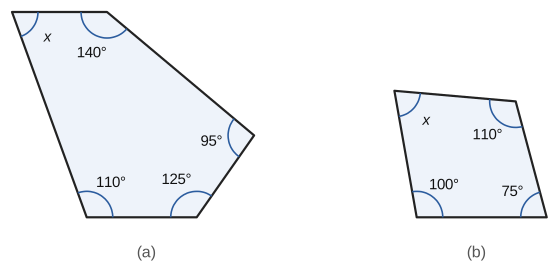
- (a) Sum for a pentagon = (5 − 2) × 180° = 540°
- x + 110° + 125° + 95° + 140° = 540°, so x + 470° = 540° and x = 70°
- (b) Sum for a quadrilateral = (4 − 2) × 180° = 360°
- x + 100° + 75° + 110° = 360°, so x = 360° − 285° = 75°
Show answerHide answer
b) 540° − (120° + 100° + 130° + 70°) = 540° − 420° = 120°
Sum of the exterior angles
Walk once round a polygon: at every vertex you turn through its exterior angle, and after one complete round you have turned a full circle. The textbook confirms this by exploring polygons with different n.
Example 3 (based on textbook p. 65)
The exterior angles of a pentagon are 85°, 100°, 70°, x and 2x. Find x and the interior angle at the vertex with exterior angle 2x.
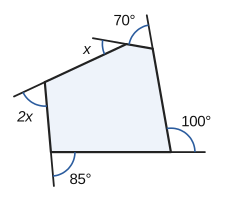
- Sum of exterior angles = 360°
- 85° + 100° + 70° + x + 2x = 360°, so 255° + 3x = 360°
- 3x = 105°, so x = 35° and 2x = 70°
- Interior angle = 180° − 70° = 110°
Regular polygons: finding angles and sides
Exterior angle = 360°n
Interior angle = (n − 2) × 180°n or 180° − exterior angle
Number of sides n = 360°exterior angle
Example 4 (based on textbook pp. 65-66)
For a regular decagon (10 sides), find a) the exterior angle, b) the interior angle.
- a) Exterior angle = 360° ÷ 10 = 36°
- b) Interior angle = 180° − 36° = 144°
- Check with the sum: (10 − 2) × 180° = 1 440°, and 1 440° ÷ 10 = 144°.
Example 5 (based on textbook p. 66)
Find the number of sides of a regular polygon when an interior angle is a) 156°, b) 140°.
- a) Exterior angle = 180° − 156° = 24°, so n = 360° ÷ 24 = 15
- b) Exterior angle = 180° − 140° = 40°, so n = 360° ÷ 40 = 9
Example 6
The sum of the interior angles of a polygon is 2 340°. How many sides has it?
- (n − 2) × 180° = 2 340°
- n − 2 = 2 340 ÷ 180 = 13
- n = 15
Example 7
In a regular polygon the interior angle is (4y + 20)° and the exterior angle is (y + 10)°. Find the number of sides.
- Interior + exterior = 180°: 4y + 20° + y + 10° = 180°, so 5y = 150° and y = 30°
- Exterior angle = 30° + 10° = 40°
- n = 360° ÷ 40 = 9 sides (a nonagon). The interior angle is 4(30°) + 20° = 140°.
Show answerHide answer
b) n = 360° ÷ 18 = 20
c) Exterior angle = 50° and 360 ÷ 50 = 7.2, which is not a whole number, so no.
Solving problems involving polygons
The textbook (p. 66) uses four steps: understand the problem, plan the strategy, carry out the strategy, and conclude (check). Draw the figure, mark what you know, and give a reason for each angle.
Example 8 (based on textbook p. 64)
ABCDE is a regular pentagon. BC and ED are extended to meet at F. Find x = ∠CFD.
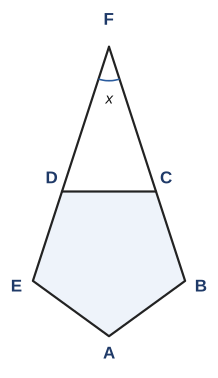
- Exterior angle of a regular pentagon = 360° ÷ 5 = 72°
- ∠FCD = ∠FDC = 72° (exterior angles at C and D)
- In triangle CFD: x = 180° − 72° − 72° = 36°
Summary
| Idea | Key fact | Example |
|---|---|---|
| Regular polygon | All sides equal and all interior angles equal | A rhombus is not regular |
| Axes of symmetry | Regular n-gon has n axes | Regular hexagon: 6 |
| Construction | Compasses keep the side equal; angle at the centre = 360° ÷ n | Hexagon: 6 triangles of 60° |
| Interior angle + exterior angle | 180° at the same vertex | 120° + 60° |
| Sum of interior angles | (n − 2) × 180° | Octagon: 1 080° |
| Sum of exterior angles | 360° for every polygon | Always 360° |
| Regular polygon | Exterior = 360° ÷ n; interior = 180° − exterior | n = 9: 40° and 140° |
| Number of sides | n = 360° ÷ exterior angle | Exterior 24°: n = 15 |