Three-Dimensional Geometrical Shapes
What this chapter covers
- Compare, contrast and classify prisms, pyramids, cylinders, cones and spheres, and describe their geometric properties (6.1)
- Analyse nets of pyramids, prisms, cylinders and cones, and draw nets and build models (6.2)
- Derive and use the formulae for the surface area of cubes, cuboids, pyramids, prisms, cylinders, cones and spheres (6.3)
- Solve problems involving the surface area of three-dimensional shapes, including combined solids (6.3)
- Derive the formulae for the volume of prisms, cylinders, pyramids and cones, and use the volume formulae including the sphere (6.4)
- Solve problems involving the volume of three-dimensional shapes, including converting units (6.4)
Look at a tin of milk, a cone-shaped party hat, a football and a triangular gift box. They are all three-dimensional (3D) shapes: they have length, width and height, so they take up space. In this chapter you will describe their properties, draw their nets, and calculate their surface areas and volumes. In the Form 2 textbook, the Tun Mustapha Tower in Sabah (a cylinder) is the opening example.
| English | Bahasa Melayu |
|---|---|
| two-dimensional shape, three-dimensional shape | bentuk dua dimensi, bentuk tiga dimensi |
| geometrical characteristic | sifat geometri |
| net | bentangan |
| surface area | luas permukaan |
| volume | isi padu |
| subject of formula | perkara rumus |
| cross section | keratan rentas |
6.1Geometric properties of three-dimensional shapes
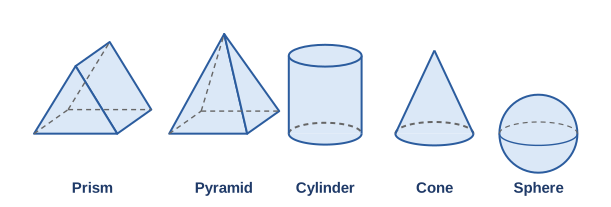
| Shape | Geometrical characteristics |
|---|---|
| Prism | Two bases that are congruent, parallel polygons; flat rectangular side faces; the same (uniform) cross section all along its length. |
| Pyramid | One flat base that is a polygon; the other faces are triangles that meet at one point, the apex. |
| Cylinder | Two circular bases that are congruent and parallel; one curved surface. |
| Cone | One circular base; one apex; one curved surface joining the base and the apex. |
| Sphere | One curved surface; every point on the surface is the same distance from the centre. |
Faces, edges and vertices
A polyhedron is a solid whose surfaces are all flat polygons. A cylinder, a cone and a sphere are non-polyhedra because they have curved surfaces. Count the parts of a polyhedron:
| Solid | Faces (F) | Edges (E) | Vertices (V) |
|---|---|---|---|
| Cuboid | 6 | 12 | 8 |
| Triangular prism | 5 | 9 | 6 |
| Hexagonal prism | 8 | 18 | 12 |
| Square-based pyramid | 5 | 8 | 5 |
| Tetrahedron (triangular-based pyramid) | 4 | 6 | 4 |
Example 1: name the solid
Which solid has one vertex, one circular base and one curved surface?
- One apex (vertex) and one circular base: this is a cone.
- A pyramid also has one vertex, but its base is a polygon and it has no curved surface.
Show answerHide answer
6.2Nets of three-dimensional shapes
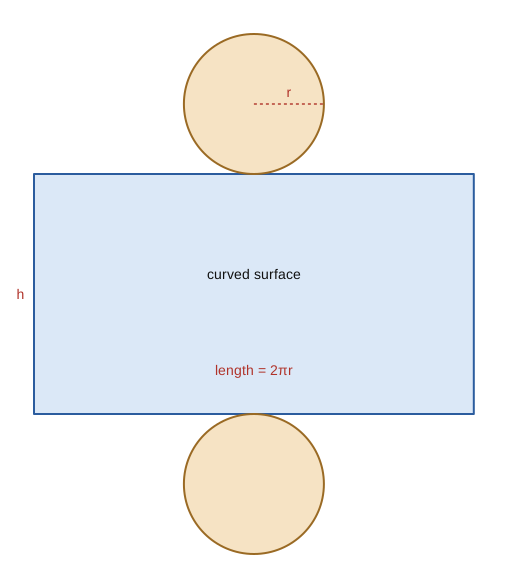
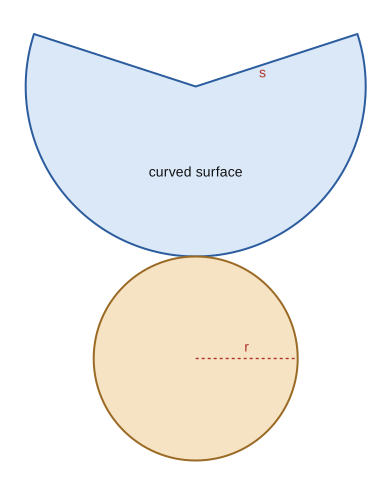
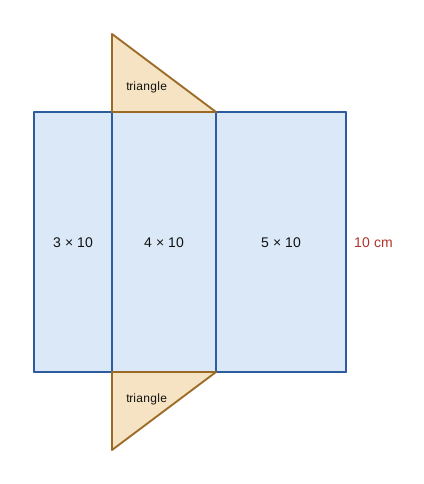
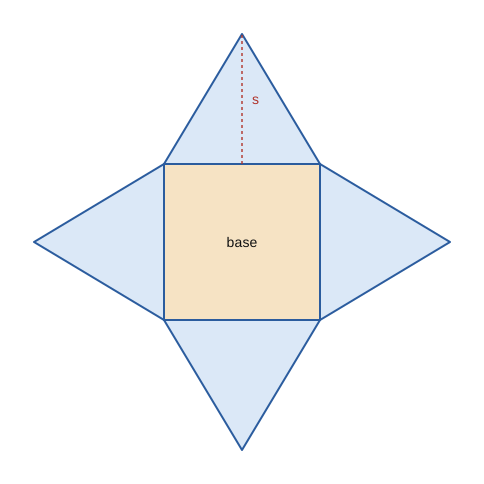
One solid can have more than one net (a cube has 11 different nets), but all of its nets contain the same pieces.
| Solid | Surfaces in the net |
|---|---|
| Cube | 6 squares |
| Cuboid | 6 rectangles (opposite faces are equal) |
| Triangular prism | 2 triangles + 3 rectangles |
| Square-based pyramid | 1 square + 4 triangles |
| Cylinder | 2 circles + 1 rectangle |
| Cone | 1 circle + 1 sector (curved surface) |
Show answerHide answer
6.3Surface area of three-dimensional shapes
| Solid | Surface area |
|---|---|
| Cube, side a | 6 × a² |
| Cuboid, l × w × h | 2(lw + lh + wh) |
| Prism | (2 × area of cross section) + (perimeter of cross section × length) |
| Pyramid with square base | area of base + 4 × area of a triangle |
| Closed cylinder | 2πr² + 2πrh |
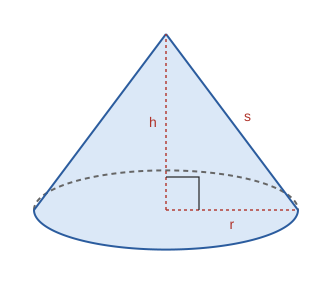
| Cone | πr² + πrs |
| Sphere | 4πr² |
Where the cylinder and cone formulae come from
Cylinder. The net is two circles and a rectangle. The rectangle is 2πr long (the circumference) and h wide (the height). So surface area = 2 × πr² + 2πr × h.
Cone. Cut the curved surface into many thin sectors and arrange them side by side. They almost form a rectangle with length πr (half the circumference) and width s (the slant height). So the curved surface area is πr × s = πrs, and the whole surface is πr² + πrs.
Example 2 (like textbook p. 107): cube, cuboid and pyramid
- Cube of side 4 cm: 6 × (4 × 4) = 96 cm².
- Cuboid 7 cm × 4 cm × 4 cm: (4 × 7 × 4) + (2 × 4 × 4) = 112 + 32 = 144 cm².
- Pyramid, square base 8 cm, each triangle has base 8 cm and slant height 5 cm: (8 × 8) + 4 × (½ × 8 × 5) = 64 + 80 = 144 cm².
Example 3 (textbook p. 108): cylinder and cone
Use π = 227.
- Closed cylinder, r = 7 cm, h = 9 cm:
2πr² + 2πrh = 2 × 227 × 7² + 2 × 227 × 7 × 9 = 308 + 396 = 704 cm². - Cone, r = 3 cm, s = 5 cm:
πr² + πrs = 227 × 3² + 227 × 3 × 5 = 28.29 + 47.14 = 75.43 cm².
Surface area of a sphere
Example 4 (textbook p. 109)
A sphere has radius 14 cm. Surface area = 4 × 227 × 14² = 2 464 cm².
Solving problems: combined shapes
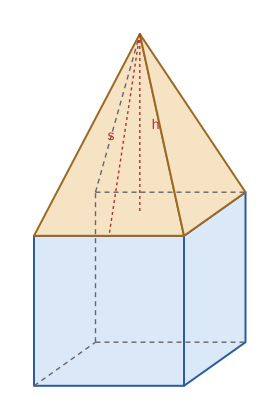
Example 5 (textbook p. 109): cube and pyramid
A cube of side 5 cm has a pyramid on top. The height of the whole object is 11 cm. Find the surface area in m².
- Understand: the pyramid sits on the top face of the cube, so that face is not on the surface. The object has 5 square faces and 4 triangles.
- Height of pyramid = 11 − 5 = 6 cm. Half of the base = 2.5 cm.
- Slant height s = √(6² + 2.5²) = √42.25 = 6.5 cm.
- Surface area = 5 × (5 × 5) + 4 × (½ × 5 × 6.5) = 125 + 65 = 190 cm².
- Convert: 1 m² = 10 000 cm², so 190 ÷ 10 000 = 0.019 m².
Show answerHide answer
6.4Volume of three-dimensional shapes
Prisms and cylinders
A prism has the same cross section from one end to the other, so its volume is the area of the cross section multiplied by the length (or height). A cylinder is a prism-like solid with a circular cross section.
Volume of a cylinder = area of base × height = πr²h
A cuboid is a prism with a rectangle as cross section: V = l × w × h. If you cut a cuboid along a diagonal of its cross section you get two equal triangular prisms, so the volume of one triangular prism is ½ × l × w × h.
Pyramids and cones
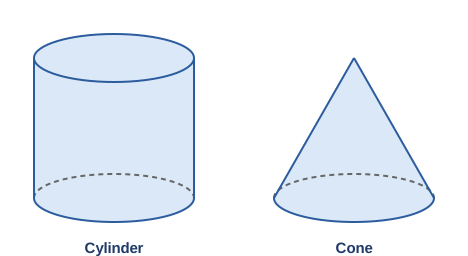
Six identical pyramids fit exactly inside a cube whose base is the base of one pyramid and whose height is twice the height of the pyramid. So one pyramid is 16 of that cube, and since the cube is twice as tall as the pyramid, one pyramid is 13 of a prism with the same base and height. In the same way, three cones of sago fill a cylinder with the same base and height (textbook p. 112).
| Solid | Volume |
|---|---|
| Prism | area of cross section × height |
| Cuboid | l × w × h |
| Cylinder | πr²h |
| Pyramid | 13 × area of base × height |
| Cone | 13πr²h |
| Sphere | 43πr³ |
Example 6 (like textbook pp. 112-113): prism, cylinder, cone and pyramid
- Triangular prism: the cross section is a triangle with base 8 cm and height 3 cm, and the prism is 12 cm long. V = (½ × 8 × 3) × 12 = 144 cm³.
- Cylinder: r = 3.5 cm, h = 12 cm. V = 227 × 3.5² × 12 = 462 cm³.
- Cone: r = 7 cm, h = 12 cm. V = 13 × 227 × 7² × 12 = 616 cm³.
- Pyramid: square base 4 cm × 4 cm, height 3 cm. V = 13 × 16 × 3 = 16 cm³.
Volume of a sphere and a hemisphere
Example 7 (textbook p. 114)
- Sphere, r = 7 cm: V = 43 × 227 × 7³ = 1 437.33 cm³.
- Hemisphere, r = 5 cm: V = 23 × 227 × 5³ = 261.90 cm³.
Solving problems
Example 8: a cylinder with a hemisphere on top
A water container is a cylinder of radius 7 cm and height 10 cm with a hemisphere of the same radius on top. How many litres does the whole container hold? (π = 227)
- Cylinder: 227 × 7² × 10 = 1 540 cm³.
- Hemisphere: 23 × 227 × 7³ = 718.67 cm³.
- Total = 1 540 + 718.67 = 2 258.67 cm³.
- Litres: 2 258.67 ÷ 1 000 = 2.26 litres (2 decimal places).
Example 9 (like textbook p. 116): cone inside a cylinder
A cylinder of radius 7 cm and height 15 cm is full of water. A solid cone of the same radius and height is lowered into it so the cone is fully under water. How much water remains?
- Volume of cylinder = 227 × 7² × 15 = 2 310 cm³.
- Volume of cone = 13 × 2 310 = 770 cm³.
- Water left = 2 310 − 770 = 1 540 cm³, which is 23 of the cylinder.
Show answerHide answer
Summary
| Solid | Surface area | Volume |
|---|---|---|
| Prism | 2 × cross section + perimeter × length | cross section × height |
| Pyramid | base + triangles | 13 × base × height |
| Cylinder | 2πr² + 2πrh | πr²h |
| Cone | πr² + πrs | 13πr²h |
| Sphere | 4πr² | 43πr³ |