Mathematics questions, chapter 11
Nama / NameKelas / ClassTarikh / Date
Isometric Transformations
42 marks. Use Practice to check each answer as you go, or Exam to answer everything first. Show your working for Section B.
Section A: objective questions
12 marksChoose the correct answer. Each question carries 1 mark.
1
Question 1
Which of the following can change when an object undergoes a translation, a reflection or a rotation?
Show answerHide answer
C
An isometric transformation moves the object, so its position changes. The shape, size and lengths stay the same, so the image is congruent to the object.
2
Question 2
Two figures are congruent if they have
Show answerHide answer
A
Congruent figures have the same shape and size. Position and orientation may be different. Figures with the same shape but different sizes are similar.
3
Question 3
What does the translation −32 mean?
Show answerHide answer
D
The top number is the movement along the x-axis: −3 is 3 units to the left. The bottom number is along the y-axis: 2 is 2 units upwards.
4
Question 4
Find the image of the point (5, −3) under the translation −24.
Show answerHide answer
B
(5 + (−2), −3 + 4) = (3, 1). (7, 1) adds −2 as +2. (3, −7) subtracts the 4 instead of adding.
5
Question 5
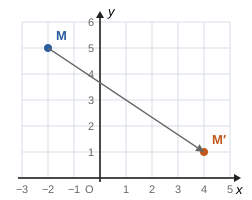
Diagram 1 shows the point M and its image M′ under a translation. What is the translation?
Show answerHide answer
A
Vector = image − object = (4 − (−2), 1 − 5) = (6, −4). The image is 6 units to the right and 4 units down. −64 is the reverse translation.
6
Question 6
Which statement about a reflection is not true?
Show answerHide answer
D
In a reflection the orientation is reversed (a mirror image). It is a translation or a rotation that keeps the orientation.
7
Question 7
What is the image of the point (4, −7) under a reflection in the y-axis?
Show answerHide answer
D
Reflection in the y-axis changes the sign of x only: (x, y) becomes (−x, y), so (4, −7) becomes (−4, −7). (4, 7) is the reflection in the x-axis.
8
Question 8
The point L(4, 1) is mapped to L′(4, 5) under a reflection. What is the equation of the axis of reflection?
Show answerHide answer
B
The x-coordinate does not change, so the axis is horizontal. It passes through the midpoint of 1 and 5, which is (1 + 5) ÷ 2 = 3. The axis is y = 3.
9
Question 9
A complete description of a rotation must state
Show answerHide answer
C
A rotation is described by its centre of rotation, the angle and the direction (clockwise or anticlockwise).
10
Question 10
What is the image of the point (3, 2) under a rotation of 90° anticlockwise about the origin?
Show answerHide answer
A
For 90° anticlockwise about the origin, (x, y) becomes (−y, x), so (3, 2) becomes (−2, 3). (2, −3) is the 90° clockwise image and (−3, −2) is the 180° image.
11
Question 11
Which statement describes an isometry?
Show answerHide answer
B
An isometry keeps the distance between any two points, so the image is congruent to the object. Changing the size or shape is not an isometry.
12
Question 12
Diagram 2 shows a propeller with three identical blades. What is the order of rotational symmetry of the propeller about its centre?

Show answerHide answer
C
The three blades are 120° apart, so the propeller fits itself after 120°, 240° and 360°. The order is 360° ÷ 120° = 3.
Section B: structured questions
30 marksAnswer all questions. Show your working.
13
Question 13
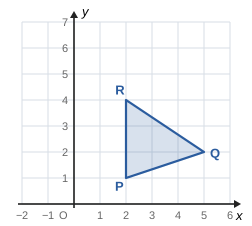
Diagram 3 shows triangle PQR on a Cartesian plane. The triangle is translated by −32.
[2 marks]
(a)State the coordinates of the images P′, Q′ and R′.
Show answerHide answer
Tick each point you got.
[1 mark]
(b)Point S′(4, 1) is the image of S under the translation −52. Find the coordinates of S.
Show answerHide answer
Tick each point you got.
14
Question 14
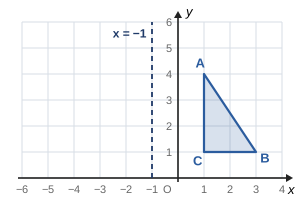
Diagram 4 shows triangle ABC and the line x = −1. Triangle ABC is reflected in the line x = −1.
[2 marks]
(a)State the coordinates of A′, B′ and C′.
Show answerHide answer
x′ = 2 × (−1) − x. For B: −2 − 3 = −5.
Tick each point you got.
[1 mark]
(b)State the image of the point (−1, 6).
Show answerHide answer
The point is on the axis of reflection, so it does not move.
Tick each point you got.
15
Question 15
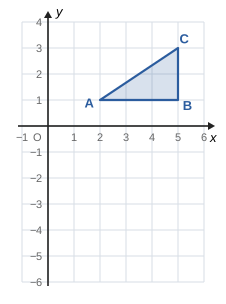
Diagram 5 shows triangle ABC. It is rotated through 90° clockwise about the origin O.
[3 marks]
(a)State the coordinates of A′, B′ and C′.
Show answerHide answer
Tick each point you got.
[2 marks]
(b)The image of a point T is (−2, −3) under a rotation of 90° anticlockwise about the origin. Find the coordinates of T.
Show answerHide answer
Check: rotating (−3, 2) 90° anticlockwise gives (−2, −3).
Tick each point you got.
16
Question 16
In each part the centre of rotation is not the origin O.
[2 marks]
(a)Find the image of M(2, 5) under a rotation of 90° anticlockwise about N(1, 2).
Show answerHide answer
Tick each point you got.
[2 marks]
(b)K′(3, −1) is the image of K under a rotation of 90° clockwise about (1, 1). Find K.
Show answerHide answer
Tick each point you got.
17
Question 17
In Diagram 6, triangles A, B and C are images of triangle P under three different isometries.
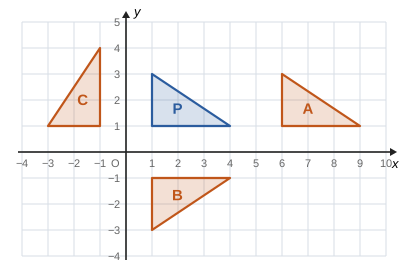
[3 marks]
(a)State the isometry that maps P to A, to B and to C.
Show answerHide answer
Tick each point you got.
[1 mark]
(b)Explain why P, A, B and C are all congruent.
Show answerHide answer
Tick each point you got.
18
Question 18
State the order of rotational symmetry of each shape.
[1 mark]
(a)A square
Show answerHide answer
Tick each point you got.
[1 mark]
(b)A rectangle that is not a square
Show answerHide answer
Tick each point you got.
[1 mark]
(c)A triangle with three sides of different lengths
Show answerHide answer
Order 1 means no rotational symmetry.
Tick each point you got.
19
Question 19
Diagram 7 shows triangle P and its image P′.
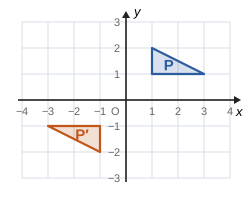
[1 mark]
(a)Describe one single transformation that maps P onto P′.
Show answerHide answer
Tick each point you got.
[2 marks]
(b)Describe a different pair of transformations, one after the other, that also maps P onto P′.
Show answerHide answer
Reflect P in the x-axis, then reflect the result in the y-axis.
Any other correct pair is also accepted, for example two rotations of 90° about the origin in the same direction.
Tick each point you got.
20
Question 20
The point P(2, 1) is mapped in this order: first a translation 3−2, then a reflection in the y-axis, then a rotation of 90° anticlockwise about the origin.
[3 marks]
(a)Find the final image of P.
Show answerHide answer
Tick each point you got.
[2 marks]
(b)Aini says the final image is the same if the reflection is done first. Is she correct? Show your working.
Show answerHide answer
Tick each point you got.