Isometric Transformations
What this chapter covers
- Recognise a transformation and describe the change in position, direction and orientation; explain one-to-one correspondence between object and image (11.1.1)
- Explain congruence and identify congruent figures and corresponding sides and angles (11.1.2)
- Recognise a translation, describe it as a column vector, and find the image or the object, including problems with two moves (11.2.1 to 11.2.4)
- Recognise a reflection, describe it by its axis, find the image or object and the axis, and solve problems (11.3.1 to 11.3.4)
- Recognise a rotation, describe it by centre, angle and direction, find the image or object and the centre, and solve problems (11.4.1 to 11.4.3)
- Explain that translation, reflection and rotation are isometries and that an isometry gives a congruent image; solve problems on isometry and congruence (11.5.1 to 11.5.3)
- Explain rotational symmetry and find the order of rotational symmetry of a shape (11.6.1, 11.6.2)
Look at your reflection in a mirror, a ceiling fan turning and a person walking along a road. Each one is a transformation: the same shape is moved from one place to another. In this chapter you will learn three transformations, translation, reflection and rotation, and see why they give images that are congruent to the object.
| English | Bahasa Melayu |
|---|---|
| transformation, object, image | penjelmaan, objek, imej |
| translation, vector | translasi, vektor |
| reflection, axis of reflection | pantulan, paksi pantulan |
| rotation, centre of rotation | putaran, pusat putaran |
| clockwise, anticlockwise | ikut arah jam, lawan arah jam |
| isometry, congruence, orientation | isometri, kekongruenan, orientasi |
| rotational symmetry, order of rotational symmetry | simetri putaran, peringkat simetri putaran |
11.1Transformations and congruence
A transformation can change the position, direction or orientation of a figure. In this chapter the shape and size stay the same, so the image is congruent to the object.
| Everyday action | Type of transformation |
|---|---|
| Akmal walks from his home to the bus stop | Translation (slides in a straight line) |
| Akmal sees himself in the mirror | Reflection (flips over a line) |
| A ceiling fan turns | Rotation (turns about a fixed point) |
The image of point C is T. The image of line AB is the line RS, with the same length. The image of ∠BCD is ∠STU, with the same size.
Show answerHide answer
11.2Translation
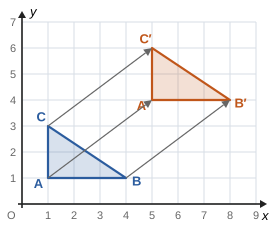
Vector of translation
A translation is written as a column vector ab:
- a is the movement parallel to the x-axis: positive to the right, negative to the left.
- b is the movement parallel to the y-axis: positive upwards, negative downwards.
| Description | Vector |
|---|---|
| 2 units to the left and 3 units downwards | −2−3 |
| 5 units to the right and 5 units downwards | 5−5 |
| 6 units downwards | 0−6 |
| 3 units to the right | 30 |
Finding the image or the object
To go back from the image to the object, subtract: object = (x′ − a, y′ − b).
Q′ = (3 + (−5), 1 + 2) = (−2, 3)
A = (−6 − 3, 1 − (−2)) = (−9, 3)
Vector = 3 − 26 − 9 = 1−3
Show answerHide answer
(b) 4 − (−2)1 − 5 = 6−4
Problems with two moves
For two translations one after the other, add the vectors. If a piece moves −40 then 3−2, the single translation is −4 + 30 + (−2) = −1−2.
11.3Reflection
Properties of a reflection
- The object and image are on opposite sides of the axis.
- Each point and its image are the same perpendicular distance from the axis, so the axis is the perpendicular bisector of the line joining them.
- The shape and size are the same, but the orientation is reversed.
- A point on the axis is its own image (it does not move).
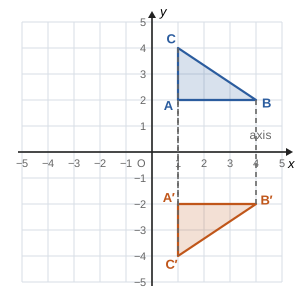
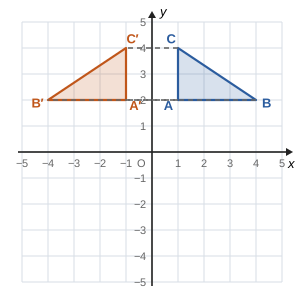
| Reflection of (x, y) | Image | Example: (4, −7) |
|---|---|---|
| in the x-axis | (x, −y) | (4, 7) |
| in the y-axis | (−x, y) | (−4, −7) |
For L(4, 1) mapped to L′(4, 5): midpoint of 1 and 5 is 3, so the axis is y = 3.
Drawing the image in a line
- From each vertex, draw a line perpendicular to the axis and extend it beyond the axis.
- Measure the distance from the vertex to the axis and mark the same distance on the other side.
- Join the image points in the same order.
Show answerHide answer
(b) Midpoint of −1 and 5 is (−1 + 5) ÷ 2 = 2, so the axis is x = 2.
11.4Rotation
To describe a rotation you must give three things: the centre, the angle and the direction.
- The image has the same shape, size and orientation as the object.
- The centre of rotation does not move.
- Each point of the image is the same distance from the centre as the object point.
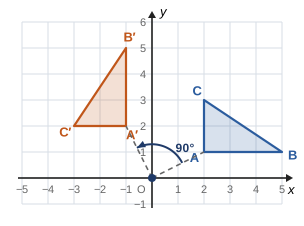
| Rotation about the origin | (x, y) maps to | Example (3, 2) |
|---|---|---|
| 90° anticlockwise | (−y, x) | (−2, 3) |
| 180° (either direction) | (−x, −y) | (−3, −2) |
| 270° anticlockwise (= 90° clockwise) | (y, −x) | (2, −3) |
Finding the image or the object
- Tracing paper: trace the object, hold the centre with the tip of a pencil, turn the paper through the angle.
- Protractor and ruler: join a point to the centre, measure the angle in the given direction and mark an equal length.
- Object from image: rotate the image the opposite way by the same angle.
- Centre: draw the perpendicular bisectors of two lines joining object and image points. They meet at the centre.
Vector from N to M = (2 − 1, 5 − 2) = (1, 3). Rotating gives (−3, 1).
Image = N + (−3, 1) = (1 − 3, 2 + 1) = (−2, 3)
Rotate K′ 90° anticlockwise about (1, 1): vector (2, −2) becomes (2, 2). K = (1 + 2, 1 + 2) = (3, 3).
Show answerHide answer
90° anticlockwise: (−y, x) = (−2, 3).
11.5Translation, reflection and rotation as an isometry
| Transformation | Shape and size | Orientation | What is needed to describe it |
|---|---|---|---|
| Translation | Same | Same | Vector |
| Reflection | Same | Reversed | Axis of reflection |
| Rotation | Same | Same | Centre, angle, direction |
Because the image is congruent to the object under an isometry, corresponding lengths and angles are equal. A figure that is bigger or smaller (different size) or has a different shape is not an isometric image.
Image with vertices (6, 1), (9, 1), (6, 3): translation 50.
Image with vertices (1, −1), (4, −1), (1, −3): reflection in the x-axis.
Image with vertices (−1, 1), (−1, 4), (−3, 1): rotation of 90° anticlockwise about the origin.
PQ = AB = 7 cm. ∠R = ∠C = 180° − 52° − 64° = 64°.
One transformation after another
When a figure is transformed more than once, do the transformations in the order given, using the image of each step as the object of the next. Changing the order can give a different final image.
After the translation: (3 + 1, 1 + 2) = (4, 3). After the reflection: (4, −3).
Reflecting first gives (3, −1), then translating gives (4, 1). This is different, so the order matters.
Show answerHide answer
11.6Rotational symmetry
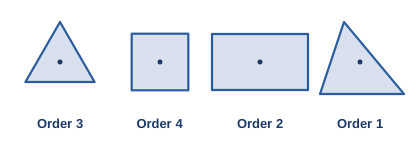
| Shape | Order of rotational symmetry | Smallest turn |
|---|---|---|
| Equilateral triangle | 3 | 120° |
| Square | 4 | 90° |
| Rectangle (not a square) | 2 | 180° |
| Regular hexagon | 6 | 60° |
Show answerHide answer
(b) 8 (smallest turn 45°)