Mathematics notes, chapter 10
Gradient of a Straight Line
Textbook Mathematics Form 2 (DLP), pages 188–205
What this chapter covers
- Describe gradient and the direction of inclination in real-life situations, and explain gradient as the ratio of vertical distance to horizontal distance (10.1.1)
- Derive and use the formulae for the gradient of a straight line on the Cartesian plane, m = (y₂ − y₁) ÷ (x₂ − x₁) and m = −(y-intercept) ÷ (x-intercept) (10.1.2)
- Generalise the gradient of a line, including positive, negative, zero and undefined gradients and the link between gradient and steepness (10.1.3)
- Determine the gradient of a straight line from a diagram, from two points and from the intercepts (10.1.4)
- Solve problems involving the gradient of a straight line, including missing intercepts and parallel sides (10.1.5)
10.1Gradient
Steepness and direction of inclination
Gradient is the degree of steepness of a line. The steeper the line, the greater the gradient. The sign of the gradient tells the direction of the slant.
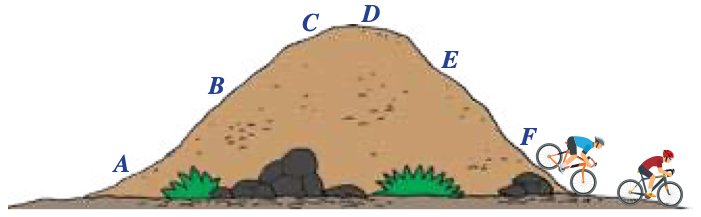
Textbook p. 190.
- A line that makes a larger angle with the x-axis is steeper and has a greater gradient. The angle is always measured from the x-axis.
- A line that goes up to the right has a positive gradient. A line that goes down to the right (inclined to the left) has a negative gradient.
Example 1 (textbook p. 191): stairs and escalator
A staircase rises at 30° and an escalator at 45°. The 45° line is more inclined, so the escalator is steeper and has the greater gradient.Gradient as a ratio
Gradient, m = vertical distancehorizontal distance
Vertical distance is how far the line rises (change in y). Horizontal distance is how far it runs (change in x).
Vertical distance is how far the line rises (change in y). Horizontal distance is how far it runs (change in x).
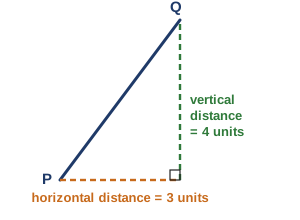
Vertical comes first, horizontal second. "Rise over run." Both distances are lengths, so they are written as positive numbers when drawn on a plain diagram.
Writing horizontal ÷ vertical. A steeper line must give a bigger number, so the vertical distance goes on top.
Example 3(b) (textbook p. 192): vertical distance 2 units, horizontal distance 3 units
Gradient = 23. Line BC is less steep than PQ, because 23 < 43.Gradient on a Cartesian plane
A straight line through A (x₁, y₁) and B (x₂, y₂) has
m = y₂ − y₁x₂ − x₁ = change in y ÷ change in x
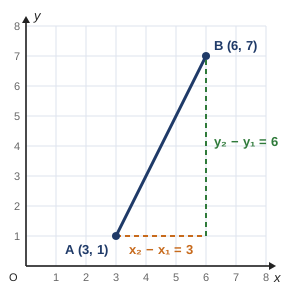
Example 4(b) (textbook p. 194): P (4, −1) and Q (3, 5)
m = (5 − (−1)) ÷ (3 − 4) = 6 ÷ (−1) = −6The line goes down to the right, so a negative gradient is correct.
Mixing the order. If you start the top with y₂ you must start the bottom with x₂. Do not write (y₂ − y₁) ÷ (x₁ − x₂). Be careful with minus signs: 5 − (−1) = 6, not 4.
Gradient from the intercepts
The x-intercept is where the line crosses the x-axis, at (x, 0). The y-intercept is where it crosses the y-axis, at (0, y).
m = −y-interceptx-intercept
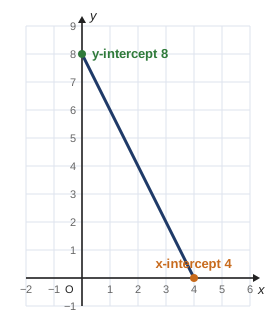
| Line | x-intercept | y-intercept | Gradient |
|---|---|---|---|
| Example 5(a) | −5 | 8 | −8 ÷ (−5) = 85 |
| Example 5(b) | 3 | 4 | −43 |
| Example 6(b) | −3 | 9 | −9 ÷ (−3) = 3 |
The intercept formula is the same as (y₂ − y₁) ÷ (x₂ − x₁) with the points (x-intercept, 0) and (0, y-intercept): m = (y-int − 0) ÷ (0 − x-int) = −y-int ÷ x-int. Do not forget the minus sign in front.
Find the gradient of the line with x-intercept −4 and y-intercept 10, and of the line through (1, 7) and (4, 1).
Show answerHide answer
First line: m = −10 ÷ (−4) = 52.
Second line: m = (1 − 7) ÷ (4 − 1) = −6 ÷ 3 = −2.
Second line: m = (1 − 7) ÷ (4 − 1) = −6 ÷ 3 = −2.
Four kinds of gradient
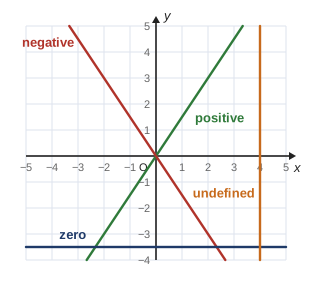
| Line | Gradient | Why |
|---|---|---|
| Rises to the right | Positive | y increases as x increases |
| Falls to the right | Negative | y decreases as x increases |
| Parallel to the x-axis | Zero | Both points have the same y, so y₂ − y₁ = 0 |
| Parallel to the y-axis | Undefined | Both points have the same x, so x₂ − x₁ = 0 and you cannot divide by 0 |
- The closer a line is to the y-axis, the greater its gradient. A greater absolute value of the gradient means a steeper line.
- To compare steepness, ignore the sign and compare the absolute values. A line with m = −4 is steeper than a line with m = 2, because 4 is greater than 2.
Example 8 (textbook p. 196): what kind of gradient?
Lines inclined to the right (up to the right) have positive gradients. Lines inclined to the left have negative gradients. A line parallel to the x-axis has zero gradient. A line parallel to the y-axis has an undefined gradient.Zero gradient and undefined gradient are not the same. A flat floor has gradient 0. A vertical wall has no gradient at all.
Calculating gradient from real situations
Example 10 (textbook p. 198): Jamali's walk
From his house to the forest, the vertical distance is 50 − 20 = 30 m and the horizontal distance is 10 m. Gradient = 30 ÷ 10 = 3.From the river bank to his house, the vertical distance is 20 m and the horizontal distance is 40 m. Gradient = 2040 = 12.
Always use the same unit for both distances. If the stairs are 15 cm high and 25 cm deep, use cm for both: m = 1525 = 35.
Solving problems
Rearrange m = −y-intercept ÷ x-intercept to find a missing intercept:
| Find | Formula |
|---|---|
| x-intercept | −(y-intercept) ÷ m |
| y-intercept | −m × (x-intercept) |
Example 11 (textbook p. 198 and 199): missing intercepts
(a) A line passes through P (0, −4) with m = −2. x-intercept = −(−4) ÷ (−2) = −2, so it crosses the x-axis at (−2, 0).(b) A line passes through Q (6, 0) with m = 13. y-intercept = −13 × 6 = −2, so it crosses the y-axis at (0, −2).
Missing coordinate (textbook p. 203, Generating Excellence question 5): find k
The line through M (1, k) and N (−2, 3) has gradient −2.(3 − k) ÷ (−2 − 1) = −2, so 3 − k = −2 × (−3) = 6 and k = −3.
Check: M (1, −3) and N (−2, 3) give (3 + 3) ÷ (−2 − 1) = 6 ÷ (−3) = −2.
Example 13 (textbook p. 199 and 200): what type of quadrilateral?
A (−9, −2), B (−7, 2), C (−4, 3), D (−6, −1).
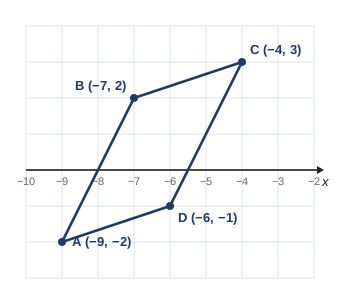
mAB = (2 + 2) ÷ (−7 + 9) = 2 and mDC = (3 + 1) ÷ (−4 + 6) = 2
Both pairs of opposite sides have equal gradients, so they are parallel. ABCD is a parallelogram.
Parallel lines have equal gradients. Use this to show that sides of a shape are parallel.
A line passes through (−4, 0) and has gradient 32. Find where it crosses the y-axis.
Show answerHide answer
y-intercept = −32 × (−4) = 6, so it crosses at (0, 6).