Mathematics questions, chapter 10
Nama / NameKelas / ClassTarikh / Date
Gradient of a Straight Line
43 marks. Use Practice to check each answer as you go, or Exam to answer everything first. Show your working for Section B.
Section A: objective questions
12 marksChoose the correct answer. Each question carries 1 mark.
1
Question 1
The gradient of a straight line is the ratio of
Show answerHide answer
B
Gradient = vertical distance ÷ horizontal distance (rise over run). Option A is upside down, so a steeper line would give a smaller number.
2
Question 2
Line KL makes an angle of 45° with the x-axis and line MN makes an angle of 30° with the x-axis. Both lines rise to the right. Which statement is true?
Show answerHide answer
A
The larger the angle from the x-axis, the steeper the line and the greater the gradient. 45° is larger than 30°, so KL is steeper.
3
Question 3
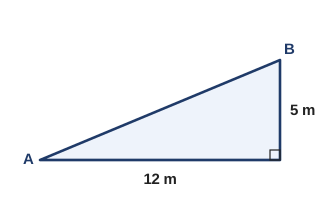
Diagram 1 shows a ramp AB. What is the gradient of AB?
Show answerHide answer
C
Gradient = vertical ÷ horizontal = 5 ÷ 12. Option A is horizontal ÷ vertical. 17 comes from adding 5 + 12.
4
Question 4
What is the gradient of the straight line passing through A (2, 3) and B (6, 11)?
Show answerHide answer
D
m = (11 − 3) ÷ (6 − 2) = 8 ÷ 4 = 2. Option A is the inverse (4 ÷ 8).
5
Question 5
Find the gradient of the straight line passing through P (2, 3) and Q (8, 5).
Show answerHide answer
A
m = (5 − 3) ÷ (8 − 2) = 2 ÷ 6 = 1/3. Option B divides change in x by change in y. Option C adds the coordinates instead of subtracting.
6
Question 6
A straight line has x-intercept −6 and y-intercept 9. Its gradient is
Show answerHide answer
C
m = −(y-intercept) ÷ (x-intercept) = −9 ÷ (−6) = 3/2. The two minus signs make a positive gradient. Option A forgets the minus sign in the formula.
7
Question 7
Which straight line has an undefined gradient?
Show answerHide answer
B
Both points have x = 2, so the line is parallel to the y-axis and x₂ − x₁ = 0, which cannot be a divisor. Option A is parallel to the x-axis, so its gradient is 0.
8
Question 8
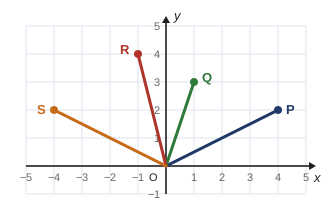
Diagram 2 shows four straight lines P, Q, R and S drawn from the origin. Which line is the steepest?
Show answerHide answer
D
Steepness depends on the absolute value of the gradient. P has m = 1/2, Q has m = 3, R has m = −4 and S has m = −1/2. The greatest absolute value is |−4| = 4, so R is the steepest. Q has the greatest gradient value, but its line is less steep than R.
9
Question 9
Each step of a staircase is 18 cm high and 24 cm deep. The gradient of the staircase is
Show answerHide answer
B
Vertical ÷ horizontal = 18 ÷ 24 = 3/4. Option A is upside down. Option D adds the two distances.
10
Question 10
A straight line passes through the point (0, −6) and has a gradient of 3. Its x-intercept is
Show answerHide answer
A
x-intercept = −(y-intercept) ÷ m = −(−6) ÷ 3 = 2. Option B forgets the minus sign in the formula.
11
Question 11
A straight line passes through the point (6, 0) and has a gradient of −32. Its y-intercept is
Show answerHide answer
D
y-intercept = −m × (x-intercept) = −(−3/2) × 6 = 9. Option A drops the minus sign in the formula. Options B and C use 6 ÷ (3/2) = 4, which is the wrong rearrangement.
12
Question 12
The gradient of the straight line passing through P (2, k) and Q (6, 10) is 32. Find the value of k.
Show answerHide answer
C
(10 − k) ÷ (6 − 2) = 3/2, so 10 − k = 6 and k = 4. Option B adds 6 instead of subtracting.
Section B: structured questions
31 marksAnswer all questions. Show your working.
13
Question 13
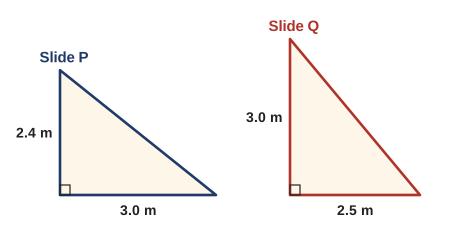
Diagram 3 shows two playground slides, P and Q.
[1 mark]
(a)Calculate the gradient of slide P.
Show answerHide answer
Tick each point you got.
[1 mark]
(b)Calculate the gradient of slide Q.
Show answerHide answer
Tick each point you got.
[1 mark]
(c)Which slide is steeper? Give a reason.
Show answerHide answer
Tick each point you got.
14
Question 14
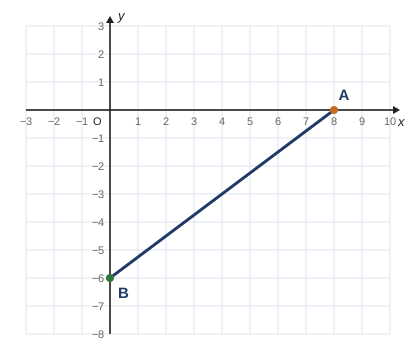
Diagram 4 shows a straight line AB. It cuts the x-axis at A and the y-axis at B.
[2 marks]
(a)State the x-intercept and the y-intercept of AB.
Show answerHide answer
Tick each point you got.
[2 marks]
(b)Calculate the gradient of AB.
Show answerHide answer
Tick each point you got.
[1 mark]
(c)State whether the gradient is positive or negative, and how you can tell from Diagram 4.
Show answerHide answer
Tick each point you got.
15
Question 15
Four straight lines are given by two points each: AB through A (1, 2) and B (5, 2), CD through C (3, −1) and D (3, 6), EF through E (0, 0) and F (2, 6), and GH through G (1, 5) and H (4, −1).
[2 marks]
(a)Find the gradient of AB and of CD.
Show answerHide answer
Tick each point you got.
[2 marks]
(b)Find the gradient of EF and of GH.
Show answerHide answer
Tick each point you got.
[1 mark]
(c)Arrange the gradients of AB, EF and GH in descending order.
Show answerHide answer
Tick each point you got.
16
Question 16
A straight line passes through P (0, 6) and has a gradient of −32.
[2 marks]
(a)Find the x-intercept of the line.
Show answerHide answer
Tick each point you got.
[2 marks]
(b)The line also passes through Q (8, k). Find the value of k.
Show answerHide answer
Check with the intercepts: the line crosses the x-axis at (4, 0), and going 4 more along x drops y by 6, so y = −6.
Tick each point you got.
17
Question 17
The vertices of a quadrilateral ABCD are A (−2, 1), B (1, 4), C (5, 2) and D (2, −1).
[2 marks]
(a)Calculate the gradients of AB, BC, CD and DA.
Show answerHide answer
Tick each point you got.
[2 marks]
(b)Name the type of quadrilateral and give a reason.
Show answerHide answer
Tick each point you got.
18
Question 18
Amir wants the gradient of the line through P (2, 5) and Q (6, −3). His working is: m = (6 − 2) ÷ (−3 − 5) = 4 ÷ (−8) = −1/2.
[1 mark]
(a)Is Amir's answer correct? State his mistake.
Show answerHide answer
Tick each point you got.
[2 marks]
(b)Show the correct working and answer.
Show answerHide answer
Tick each point you got.
19
Question 19
A is the point (2, 3). Write the coordinates of a point B, different from A, so that the line AB has
[1 mark]
(a)a gradient of 2.
Show answerHide answer
(3, 5): m = (5 − 3) ÷ (3 − 2) = 2
Tick each point you got.
[1 mark]
(b)a gradient of zero.
Show answerHide answer
(7, 3): the line is parallel to the x-axis
Tick each point you got.
[1 mark]
(c)an undefined gradient.
Show answerHide answer
(2, 8): the line is parallel to the y-axis
Tick each point you got.
20
Question 20
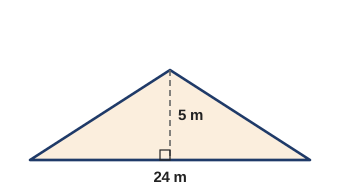
Diagram 5 shows the roof of a house. The roof is an isosceles triangle with a width of 24 m and a height of 5 m.
[2 marks]
(a)Calculate the gradient of the roof.
Show answerHide answer
Tick each point you got.
[2 marks]
(b)Calculate the length of one slanting side of the roof.
Show answerHide answer
Pythagoras' theorem: slant² = vertical² + horizontal². 5, 12 and 13 form a Pythagorean triple.
Tick each point you got.