Speed and Acceleration
What this chapter covers
- Explain the meaning of speed as a rate involving distance and time (9.1.1)
- Describe the differences between uniform and non-uniform speed (9.1.2)
- Calculate speed and average speed, including unit conversion (9.1.3)
- Solve problems involving speed (9.1.4)
- Explain the meaning of acceleration and deceleration as a rate involving speed and time (9.2.1)
- Perform calculations involving acceleration, including unit conversion (9.2.2)
- Solve problems involving acceleration (9.2.3)
How fast is a car, a runner or a MotoGP rider? Speed tells you how much distance something covers in a fixed time, and acceleration tells you how quickly that speed is changing. In this chapter you will calculate speed and average speed, convert between units, read distance-time and speed-time graphs, and solve problems about acceleration and deceleration.
| English | Bahasa Melayu |
|---|---|
| speed, distance, time | laju, jarak, masa |
| unit | unit |
| average speed | laju purata |
| uniform speed, non-uniform speed | laju seragam, laju tak seragam |
| stationary | pegun |
| acceleration, deceleration | pecutan, nyahpecutan |
9.1Speed
Speed as a rate
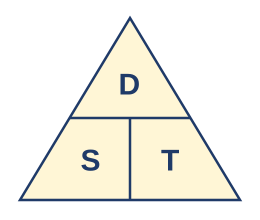
| To find | Formula | Unit |
|---|---|---|
| speed | speed = distance ÷ time | km/h, m/s, m/min |
| distance | distance = speed × time | km, m |
| time | time = distance ÷ speed | h, min, s |
Example 1 (like textbook p. 171)
Aida walks 100 m to a shop in 5 minutes. Find her speed.
- Speed = 100 m5 min = 20 m/min
Aida walks 20 metres every minute. The unit m/min is read "metre per minute".
Example 2 (like textbook p. 171)
In a 100 m race, Khairul finished in 10.18 s and Badrul in 10.25 s. Find the speed of each runner, correct to 2 decimal places.
- Khairul: 100 m10.18 s = 9.82 m/s
- Badrul: 100 m10.25 s = 9.76 m/s
The runner who takes the shorter time over the same distance has the greater speed.
Example 3: finding distance and time
A bus travels from Tanjung Malim to Muar, a distance of 272 km, at an average speed of 80 km/h. It leaves at 0830. At what time does it arrive? (24-hour system)
- Time = 272 km80 km/h = 3.4 h
- 0.4 h = 0.4 × 60 = 24 min, so 3.4 h = 3 h 24 min
- Arrival time = 0830 + 3 h 24 min = 1154
Show answerHide answer
b) 15 × 5 = 75 km
Uniform and non-uniform speed
Marble A and marble B are rolled along a table. A photograph is taken every second and the distance from the start is read off a ruler.

Textbook figure, Mathematics Form 2 (DLP), p. 172.
| Time (s) | 0 | 1 | 2 | 3 | 4 |
|---|---|---|---|---|---|
| Marble A: distance (cm) | 0 | 2 | 4 | 6 | 8 |
| Marble B: distance (cm) | 0 | 2 | 3 | 5 | 8 |
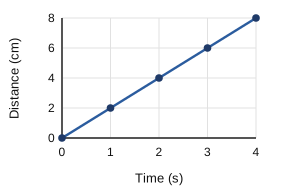
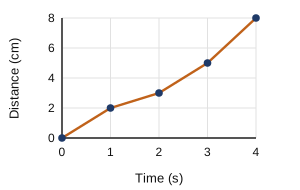
Non-uniform speed: unequal distances are covered in equal intervals of time. Its distance-time graph is not a straight line.
Example 4 (like textbook p. 172)
Farid drives a trailer 170 km in the first 2 hours and 190 km in the next 4 hours. Is the speed uniform?
- First 2 hours: 170 km2 h = 85 km/h
- Next 4 hours: 190 km4 h = 47.5 km/h
- The two speeds are different, so the speed is non-uniform.
Example 5 (like textbook p. 173)
A golf ball is hit from P through Q and R to S. P to Q is 40 m in 2 s, Q to R is 70 m in 3.5 s and R to S is 60 m in 3 s. Is its speed uniform?
- P to Q: 40 ÷ 2 = 20 m/s
- Q to R: 70 ÷ 3.5 = 20 m/s
- R to S: 60 ÷ 3 = 20 m/s
- All three speeds are equal, so the speed is uniform.
Average speed
Example 6 (like textbook p. 174)
Amir cycles from his house to town A, a distance of 35 km. He leaves at 9:00 a.m., rests at a pizzeria on the way and arrives at 12:15 p.m. Find his average speed.
- Total time = 12:15 − 9:00 = 3 h 15 min = 3.25 h
- Average speed = 35 km3.25 h = 10.77 km/h
Example 7 (like textbook p. 174)
A bus leaves Puchong at 0825 and reaches Perai at 1345. The distance is 354 km. Find the average speed.
- Total time = 1345 − 0825 = 5 h 20 min = 5 13 h
- Average speed = 354 ÷ 5 13 = 66.38 km/h (2 decimal places)
If you round 5 h 20 min to 5.33 h first, you get 66.42 km/h. Keep the exact fraction (or more decimals) in your calculator and round only at the end.
Example 8: different units in one journey (like textbook p. 175)
Karmila won a triathlon: a 10 km run, a 1 500 m swim and a 40 km cycle, in 1 hour 56 minutes. Find the average speed in km/h.
- Total distance = 10 km + 1.5 km + 40 km = 51.5 km
- Total time = 1 h 56 min = 1 5660 h = 1.933 h
- Average speed = 51.5 km1.933 h = 26.64 km/h
Example 9: reading a distance-time graph (like textbook p. 176)
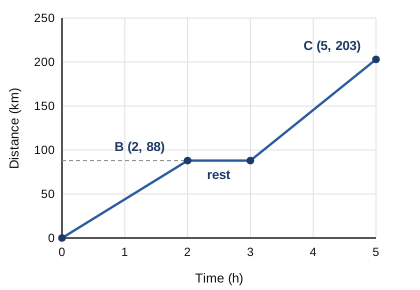
A school bus travels from school (O) to Kuala Lumpur (C) and stops for a rest from B. Find (a) the speed in the first 2 hours, (b) the average speed for the whole trip.
- (a) Speed = gradient = 88 km2 h = 44 km/h
- (b) Total distance = 203 km, total time = 5 h (the rest is included)
- Average speed = 203 km5 h = 40.6 km/h
Changing units of speed
| 1 km = 1 000 m | 1 m = 100 cm | 1 h = 60 min | 1 min = 60 s | 1 h = 3 600 s |
|---|
To convert a speed, convert the distance unit and the time unit separately.
Example 10 (like textbook p. 175)
The speed limit on a road is 90 km/h. Convert it to (a) m/s, (b) km/min.
- (a) 90 km/h = 90 × 1 000 m3 600 s = 25 m/s
- (b) 90 km/h = 90 km60 min = 1.5 km/min
Example 11 (like textbook p. 175)
Convert 120 m/s to km/min.
- 120 m in 1 s means 120 × 60 = 7 200 m in 1 min
- 7 200 m = 7 200 ÷ 1 000 = 7.2 km/min
The textbook shows 7.06 km/min because it rounds 1 ÷ 60 to 0.017 too early. The exact answer is 7.2 km/min.
Show answerHide answer
b) 0.8 × 3.6 = 2.88 km/h
c) 25.9 × 3.6 = 93.24 km/h
Solving problems involving speed
Use four steps: understand the problem, plan the strategy, carry it out, and write a conclusion.
Example 12 (like textbook p. 176)
Khairul Idham Pawi won the Moto3 race at the German Grand Prix. The track is 40.38 km and he took 47 minutes 8 seconds. Find (a) his average speed in km/h; (b) the difference in time between him and the second place rider, whose speed was 0.85 km/min.
- (a) 47 min 8 s = 47 860 min = 2 8283 600 h = 0.7856 h
- Speed = 40.380.7856 = 51.40 km/h
- (b) Second place time = 40.38 km0.85 km/min = 47.51 min, which is about 47 min 30 s
- Difference = 47 min 30 s − 47 min 8 s = about 22 s
Example 13 (like textbook p. 177)
Mr Tan drove from Kuala Lumpur to Skudai in 3 hours 7 minutes at an average speed of 103 km/h. On the way back he took 34 of an hour longer. Find his average speed for the return journey.
- Time to Skudai = 3 h 7 min = 3 760 h = 3.1167 h
- Distance = 103 × 3.1167 = 321.02 km
- Return time = 3.1167 + 0.75 = 3.8667 h
- Return speed = 321.023.8667 = 83.02 km/h
Example 14: finding a missing stage
A taxi drives 60 km from Ipoh to Tapah at 100 km/h. The whole trip from Ipoh to Kuala Lumpur is 220 km at an average speed of 110 km/h. Find the average speed from Tapah to Kuala Lumpur.
- Total time = 220 ÷ 110 = 2 h. Time Ipoh to Tapah = 60 ÷ 100 = 0.6 h
- Tapah to Kuala Lumpur: distance = 220 − 60 = 160 km, time = 2 − 0.6 = 1.4 h
- Speed = 160 ÷ 1.4 = 114.29 km/h
9.2Acceleration
Acceleration and deceleration
If speed increases there is acceleration. If speed decreases the acceleration is negative, which is called deceleration. An object with uniform speed has zero acceleration.
| Speed unit | Time unit | Acceleration unit |
|---|---|---|
| m/s | second | m/s² (m/s per second) |
| km/h | hour | km/h² (km/h per hour) |
| km/h | second | km/h per second |
Example 15 (like textbook p. 180)
A motorcycle starts from rest and accelerates uniformly to 20 m/s in 5 s. Find its acceleration.
- Acceleration = (20 − 0) m/s5 s = 4 m/s²
Every second the speed goes up by 4 m/s.
Example 16 (like textbook p. 181)
The rider brakes and the motorcycle slows down uniformly from 20 m/s to a stop in 4 s. Find its acceleration.
- Acceleration = (0 − 20) m/s4 s = −5 m/s²
The deceleration is 5 m/s². Write either "acceleration = −5 m/s²" or "deceleration = 5 m/s²", but not "deceleration = −5 m/s²".
Example 17 (like textbook p. 180)
A racing car accelerates from rest to 120 km/h in 6 s. Find the acceleration in km/h per second.
- Change of speed = 120 − 0 = 120 km/h
- Acceleration = 120 km/h6 s = 20 km/h per second
In m/s² this is 20 ÷ 3.6 = 5.56 m/s² (see Example 19 for the conversion).
Speed-time graph
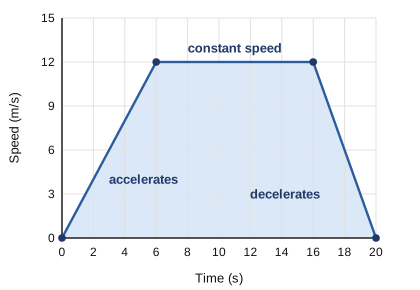
| Stage | Time | Acceleration | Distance (area) |
|---|---|---|---|
| speeding up | 0 s to 6 s | 12 ÷ 6 = 2 m/s² | ½ × 6 × 12 = 36 m |
| constant speed | 6 s to 16 s | 0 | 10 × 12 = 120 m |
| slowing down | 16 s to 20 s | (0 − 12) ÷ 4 = −3 m/s² | ½ × 4 × 12 = 24 m |
| whole journey | 20 s | 36 + 120 + 24 = 180 m |
Unit conversion for acceleration
Convert the distance unit and each time unit one at a time. An acceleration has the time unit twice.
Example 18 (like textbook p. 181)
Convert 420 m/min per minute to km/min².
- 420 m/min² = 420 ÷ 1 000 kmmin² = 0.42 km/min²
Example 19: m/s² and km/h per second
Convert 5 m/s² to km/h per second.
- Speed gain each second = 5 m/s = 5 × 3.6 = 18 km/h
- So 5 m/s² = 18 km/h per second
In the same way 1 m/s² = 3.6 km/h per second.
Example 20 (like textbook p. 182)
Samy increases his speed from 70 km/h to 100 km/h in 30 minutes. Find the acceleration in (a) km/h per hour, (b) km/h per second.
- Change of speed = 100 − 70 = 30 km/h
- (a) 30 min = 0.5 h, acceleration = 30 ÷ 0.5 = 60 km/h²
- (b) 30 min = 1 800 s, acceleration = 30 ÷ 1 800 = 0.0167 km/h per second
Show answerHide answer
b) (10 − 8) ÷ 4 = 0.5 m/s²
Solving problems involving acceleration
Example 21 (like textbook p. 183)
Lisnah drives at 100 km/h and then accelerates at 4 km/h per second while overtaking. Find her speed after 5 s.
- Increase in speed = 4 × 5 = 20 km/h
- Speed after 5 s = 100 + 20 = 120 km/h
Example 22 (like textbook p. 183)
A motorcycle at 40 km/h reduces its speed by 20% of its beginning speed within 40 s. Find the acceleration.
- End speed = 80% × 40 = 32 km/h
- Acceleration = (32 − 40) km/h40 s = −0.2 km/h per second (deceleration 0.2 km/h per second)
Example 23: two trips (like textbook p. 182)
Rani cycles for 34 of an hour with a speed change of 18 km/h. The return trip takes 40% less time at the same speed change. Find the difference in the two accelerations.
- Trip 1: 18 ÷ 0.75 = 24 km/h²
- Trip 2 time = 0.75 × 0.6 = 0.45 h, acceleration = 18 ÷ 0.45 = 40 km/h²
- Difference = 40 − 24 = 16 km/h²
Example 24: braking distance
A car travelling at 72 km/h brakes uniformly and stops in 8 s. Find (a) the deceleration in m/s², (b) the distance covered while braking.
- 72 km/h = 72 ÷ 3.6 = 20 m/s
- (a) Acceleration = 0 − 208 = −2.5 m/s², so the deceleration is 2.5 m/s²
- (b) The speed-time graph is a triangle: distance = ½ × 8 × 20 = 80 m
Summary
| Idea | Formula or rule |
|---|---|
| Speed | distance ÷ time |
| Distance, time | distance = speed × time; time = distance ÷ speed |
| Average speed | total distance ÷ total time (include rests) |
| Uniform speed | equal distances in equal times; straight line on a distance-time graph |
| Acceleration | (final speed − initial speed) ÷ time |
| Deceleration | negative acceleration; the speed decreases |
| Graphs | distance-time: gradient = speed. Speed-time: gradient = acceleration, area = distance |
| Units | m/s × 3.6 = km/h; 1 m/s² = 3.6 km/h per second |
- Make the units agree before you calculate. Change minutes to hours by dividing by 60.
- Average speed is total distance over total time, not the mean of the speeds.
- Acceleration needs the final speed minus the initial speed, then divide by the time taken.