Mathematics questions, chapter 9
Nama / NameKelas / ClassTarikh / Date
Speed and Acceleration
40 marks. Use Practice to check each answer as you go, or Exam to answer everything first. You may use a calculator. Show your working for Section B.
Section A: objective questions
12 marksChoose the correct answer.
1
Question 1
Which statement describes speed?
Show answerHide answer
A
Speed is a rate: distance divided by time, so it is the distance covered in each unit of time. The time taken for one unit of distance is the inverse of speed, and the total distance of a journey is not a rate at all.
2
Question 2
A sprinter runs 100 m in 12.5 s. What is her speed?
Show answerHide answer
C
Speed = 100 ÷ 12.5 = 8 m/s. 12.5 m/s is just the time, 0.125 m/s divides the other way round (12.5 ÷ 100), and 1 250 multiplies.
3
Question 3
The table shows the distance of a toy car from its starting point.
Which statement is correct?
| Time (s) | 0 | 1 | 2 | 3 | 4 |
|---|---|---|---|---|---|
| Distance (m) | 0 | 4 | 8 | 12 | 16 |
Show answerHide answer
B
Equal distances (4 m) are covered in equal intervals of time (1 s), which is uniform speed. A growing distance alone does not make the speed non-uniform.
4
Question 4
The speed of a motorcycle is 72 km/h. What is this speed in m/s?
Show answerHide answer
D
72 km/h = 72 × 1 000 ÷ 3 600 = 20 m/s (or 72 ÷ 3.6). 259.2 multiplies by 3.6 instead of dividing, and 1.2 is 72 ÷ 60 (km/min).
5
Question 5
A car travels 90 km in the first 1.5 hours and then 120 km in the next 2.5 hours. What is its average speed for the whole journey?
Show answerHide answer
B
Average speed = total distance ÷ total time = (90 + 120) ÷ (1.5 + 2.5) = 210 ÷ 4 = 52.5 km/h. 54 km/h is the mean of the two speeds (60 and 48), which is not the average speed. 48 km/h is the second speed only.
6
Question 6
A bus leaves Seremban at 0945 and travels 255 km at an average speed of 75 km/h. At what time does it arrive?
Show answerHide answer
A
Time = 255 ÷ 75 = 3.4 h = 3 h 24 min (0.4 × 60 = 24). 0945 + 3 h 24 min = 1309. 1325 reads 0.4 h as 40 minutes.
7
Question 7
A cyclist's speed changes from 6 m/s to 2 m/s in 4 s. Which statement is correct?
Show answerHide answer
D
Acceleration = (2 − 6) ÷ 4 = −1 m/s². The speed decreases, so it is a deceleration of 1 m/s². 2 m/s² comes from dividing the speed change (4 m/s) by 2 instead of by the 4 s taken.
8
Question 8
A car accelerates uniformly from rest to 90 km/h in 10 s. What is its acceleration?
Show answerHide answer
C
Acceleration = (90 − 0) ÷ 10 = 9 km/h per second. 90 forgets to divide by the time and 900 multiplies by 10.
9
Question 9
An acceleration is 5 m/s². What is this in km/h per second?
Show answerHide answer
B
Each second the speed rises by 5 m/s = 5 × 3.6 = 18 km/h, so the acceleration is 18 km/h per second. 1.39 divides by 3.6 instead of multiplying.
10
Question 10
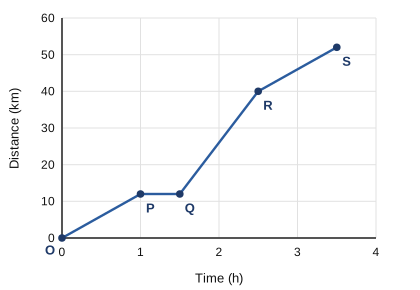
Diagram 1 shows the distance-time graph of a cyclist's journey. In which part of the journey is the cyclist travelling the fastest?
Show answerHide answer
A
The fastest part has the steepest line. OP: 12 ÷ 1 = 12 km/h. PQ: 0 (at rest). QR: (40 − 12) ÷ 1 = 28 km/h. RS: (52 − 40) ÷ 1 = 12 km/h.
11
Question 11
A car is travelling at 36 km/h. It accelerates uniformly at 0.5 m/s² for 8 s. What is its final speed?
Show answerHide answer
C
Speed gained = 0.5 × 8 = 4 m/s = 4 × 3.6 = 14.4 km/h. Final speed = 36 + 14.4 = 50.4 km/h. 40 km/h adds 4 without changing the unit, 14.4 km/h is only the gain, and 14 km/h is the final speed in m/s (10 + 4 = 14) with the wrong unit.
12
Question 12
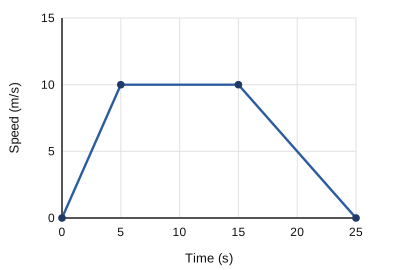
Diagram 2 shows the speed-time graph of an object. The statements are:
I. The acceleration in the first 5 s is 2 m/s².
II. The object moves at a constant speed for 10 s.
III. The deceleration in the last 10 s is 2 m/s².
IV. The total distance travelled is 175 m.
Which statements are correct?
I. The acceleration in the first 5 s is 2 m/s².
II. The object moves at a constant speed for 10 s.
III. The deceleration in the last 10 s is 2 m/s².
IV. The total distance travelled is 175 m.
Which statements are correct?
Show answerHide answer
D
I: 10 ÷ 5 = 2 m/s², correct. II: constant from 5 s to 15 s, which is 10 s, correct. III: the deceleration is 10 ÷ 10 = 1 m/s², so III is wrong. IV: area = ½ × (10 + 25) × 10 = 175 m, correct.
Section B: structured questions
28 marksAnswer all questions. Show your working.
13
Question 13
Use the formula for speed, distance and time to answer the following.
[1 mark]
(a)Hafiz cycles 45 km in 3 hours. Find his speed in km/h.
Show answerHide answer
Tick each point you got.
[1 mark]
(b)A cheetah runs at 14 m/s for 25 s. How far does it run?
Show answerHide answer
Tick each point you got.
[1 mark]
(c)Sara runs 400 m at a speed of 8 m/s. How long does she take?
Show answerHide answer
Tick each point you got.
14
Question 14
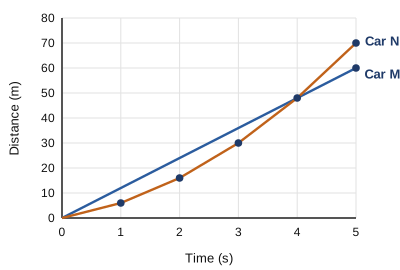
Diagram 3 shows the distance-time graphs of two toy cars, M and N, over 5 seconds.
[1 mark]
(a)Which car moves at a uniform speed? Give a reason.
Show answerHide answer
Tick each point you got.
[1 mark]
(b)Find the speed of car M in m/s.
Show answerHide answer
Tick each point you got.
15
Question 15
Convert speeds between units.
[1 mark]
(a)Convert 108 km/h to m/s.
Show answerHide answer
Tick each point you got.
[1 mark]
(b)Convert 15 m/s to km/min.
Show answerHide answer
Tick each point you got.
[2 marks]
(c)An aircraft flies at 900 km/h. How far does it fly in 20 seconds? Give your answer in metres.
Show answerHide answer
Tick each point you got.
16
Question 16
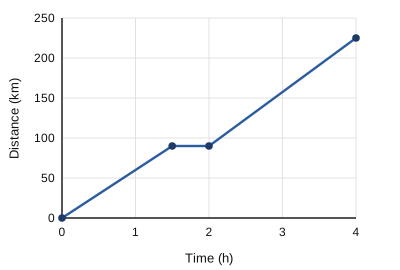
Diagram 4 shows Ali's car journey from town P. He left at 8:00 a.m. and stopped for a rest after driving the first part of the journey.
[1 mark]
(a)Find his speed in the first part of the journey, in km/h.
Show answerHide answer
Tick each point you got.
[1 mark]
(b)For how many minutes did he rest?
Show answerHide answer
Tick each point you got.
[2 marks]
(c)Calculate the average speed for the whole journey.
Show answerHide answer
Tick each point you got.
17
Question 17
Puan Salmah drove 168 km from town A to town B at an average speed of 84 km/h. She returned along the same road at an average speed of 70 km/h.
[2 marks]
(a)Calculate the total time of the two journeys.
Show answerHide answer
Tick each point you got.
[2 marks]
(b)Calculate the average speed for the whole round trip.
Show answerHide answer
This is not (84 + 70) ÷ 2 = 77 km/h, because more time is spent at the slower speed.
Tick each point you got.
18
Question 18
A motorcycle starts from rest and reaches a speed of 18 m/s in 6 seconds. It then brakes uniformly and stops in 4.5 seconds.
[1 mark]
(a)Calculate its acceleration while it speeds up.
Show answerHide answer
Tick each point you got.
[2 marks]
(b)Calculate its acceleration while it brakes. State the deceleration.
Show answerHide answer
Tick each point you got.
19
Question 19
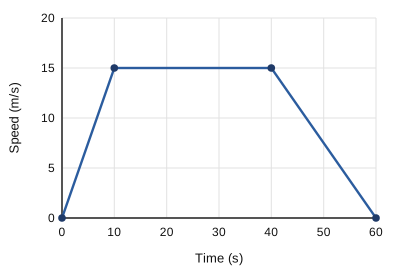
Diagram 5 shows the speed-time graph of a train between two stations.
[1 mark]
(a)Calculate the acceleration of the train in the first 10 seconds.
Show answerHide answer
Tick each point you got.
[1 mark]
(b)Calculate the deceleration of the train in the last 20 seconds.
Show answerHide answer
Tick each point you got.
[2 marks]
(c)Calculate the distance between the two stations.
Show answerHide answer
The distance is the area of the trapezium under the graph.
Tick each point you got.
20
Question 20
A delivery van must travel 90 km and be at the customer within 2 hours. It must also stop for 15 minutes to unload goods at a depot on the way. The driver is planning the speeds for the journey.
[2 marks]
(a)Calculate the minimum average speed, in km/h, that the van must keep while it is driving.
Show answerHide answer
Tick each point you got.
[2 marks]
(b)The first 40 km is a town road and the remaining 50 km is a highway. Choose a speed for each part, in km/h, so that the van reaches the customer on time. Show that your plan works.
Show answerHide answer
Tick each point you got.