Mathematics questions, chapter 13
Nama / NameKelas / ClassTarikh / Date
Simple Probability
40 marks. Use Practice to check each answer as you go, or Exam to answer everything first. A calculator is not needed. Give probabilities as fractions in simplest form unless told otherwise.
Section A: objective questions
12 marksChoose the correct answer.
1
Question 1
Which gives the experimental probability of an event?
Show answerHide answer
B
Experimental probability is the ratio of how often the event happened (its frequency) to how many times the experiment was done (the number of trials). Option A is the same ratio upside down.
2
Question 2
A fair coin is flipped many times. What happens to the experimental probability of getting a head as the number of flips becomes very large?
Show answerHide answer
A
With more trials the ratio settles towards a fixed value, which is 0.5 for a fair coin. It changes a lot only when there are few trials.
3
Question 3
A coin is flipped 50 times and shows heads 28 times. What is the experimental probability of heads?
Show answerHide answer
C
28 ÷ 50 = 1425. 1125 is the probability of tails (22 ÷ 50), and 12 is the theoretical value, not the one found in this experiment.
4
Question 4
What is the sample space when a fair dice is thrown once?
Show answerHide answer
D
The sample space lists all possible outcomes: 1, 2, 3, 4, 5 and 6. {2, 4, 6} and {1, 3, 5} are events (even and odd numbers), not the sample space.
5
Question 5
A number is chosen at random from the prime numbers between 30 and 50. What is n(S)?
Show answerHide answer
C
The primes between 30 and 50 are 31, 37, 41, 43 and 47, so n(S) = 5. 33, 39, 49 and the even numbers are not prime.
6
Question 6
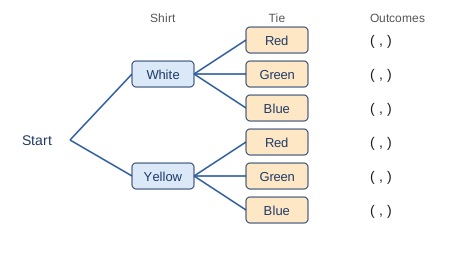
Diagram 1 shows a tree diagram for choosing one shirt and one tie. How many outcomes are there in the sample space?
Show answerHide answer
D
Each of the 2 shirts goes with each of the 3 ties, giving 2 × 3 = 6 pairs. 5 comes from adding 2 + 3.
7
Question 7
A box has 14 blue, 21 yellow and 15 red pencils. One pencil is taken at random. What is the probability that it is yellow?
Show answerHide answer
A
n(S) = 14 + 21 + 15 = 50 and n(yellow) = 21, so P = 2150. 2129 compares yellow with the other colours only (21 : 29). 725 is P(blue) and 310 is P(red).
8
Question 8
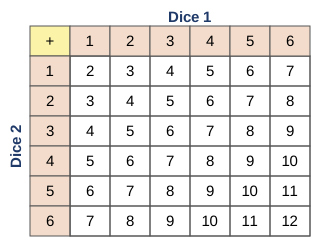
Diagram 2 shows the sums when two fair dice are thrown. What is the probability that the sum is greater than 10?
Show answerHide answer
B
A sum greater than 10 means 11 or 12. The sum 11 appears twice and 12 once, so 3 outcomes out of 36: 336 = 112. 118 counts only the sum 11.
9
Question 9
A fair dice is thrown. A is the event of getting a number greater than 4. Which set shows A', the complement of A?
Show answerHide answer
A
A = {5, 6}. The complement holds every other outcome in S = {1, 2, 3, 4, 5, 6}, which is {1, 2, 3, 4}. {5, 6} is A itself, and 4 is not greater than 4 so it belongs in A'.
10
Question 10
The probability that it will rain tomorrow is 0.35. What is the probability that it will not rain tomorrow?
Show answerHide answer
D
P(not rain) = 1 − P(rain) = 1 − 0.35 = 0.65. A probability can never exceed 1, so 1.35 is impossible.
11
Question 11
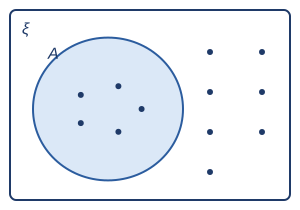
Diagram 3 shows a Venn diagram. The universal set has 12 elements and set A has 5 elements. Find P(A').
Show answerHide answer
C
n(A') = 12 − 5 = 7 and n(S) = 12, so P(A') = 712. 512 is P(A). 57 and 75 compare inside with outside instead of with the whole set.
12
Question 12
A bag has 16 red marbles and some blue marbles. The probability of taking a red marble is 25. After 10 more blue marbles are added, what is the probability of taking a blue marble?
Show answerHide answer
B
Total marbles = 16 ÷ 25 = 40, so there are 24 blue. After adding 10: blue = 34, total = 50, P(blue) = 3450 = 1725. 35 is P(blue) before the 10 were added.
Section B: structured questions
28 marksAnswer all questions. Show your working.
13
Question 13
Aina flips a coin and records the number of heads. Table 1 shows her results.
Table 1
| Number of flips | 20 | 50 | 100 | 500 |
|---|---|---|---|---|
| Number of heads | 13 | 27 | 52 | 251 |
[1 mark]
(a)Find the experimental probability of a head after 20 flips, as a decimal.
Show answerHide answer
Tick each point you got.
[1 mark]
(b)Find the experimental probability of a head after 500 flips.
Show answerHide answer
Tick each point you got.
[2 marks]
(c)What value do the results move towards? Explain why the ratio changes less as the number of flips increases.
Show answerHide answer
Tick each point you got.
14
Question 14
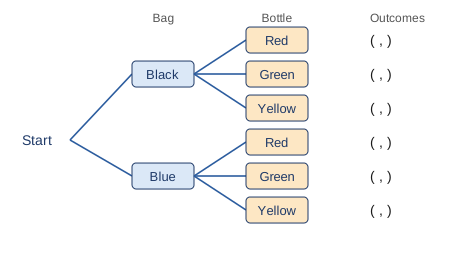
Faris chooses one bag and one bottle. The bags are black and blue. The bottles are red, green and yellow. Diagram 4 shows the tree diagram.
[2 marks]
(a)List the sample space S.
Show answerHide answer
Tick each point you got.
[1 mark]
(b)List the elements of the event that Faris chooses a green bottle.
Show answerHide answer
Tick each point you got.
[1 mark]
(c)Find the probability that Faris chooses a green bottle.
Show answerHide answer
Tick each point you got.
15
Question 15
Two fair dice are thrown and the two numbers are added. Use the table in Diagram 5.
[1 mark]
(a)How many outcomes give a sum of 8?
Show answerHide answer
Tick each point you got.
[1 mark]
(b)Find the probability of a sum of 8.
Show answerHide answer
Tick each point you got.
[2 marks]
(c)Find the probability that the sum is greater than 9.
Show answerHide answer
Tick each point you got.
16
Question 16
Sara receives pocket money every Monday and every Friday. A day is chosen at random from 3 weeks.
[1 mark]
(a)How many days in the 3 weeks does Sara receive pocket money, and how many days are there in total?
Show answerHide answer
Tick each point you got.
[1 mark]
(b)Find the probability that Sara receives pocket money on the chosen day.
Show answerHide answer
Tick each point you got.
[1 mark]
(c)Find the probability that Sara does not receive pocket money on the chosen day.
Show answerHide answer
Tick each point you got.
[1 mark]
(d)In 12 weeks, on how many days will Sara receive no pocket money?
Show answerHide answer
Tick each point you got.
17
Question 17
A factory makes 250 light bulbs in one day. The probability that a bulb is faulty is 350. Faulty bulbs are thrown away and every good bulb is sold for RM4.
[1 mark]
(a)How many bulbs are faulty?
Show answerHide answer
Tick each point you got.
[1 mark]
(b)Find the probability that a bulb chosen at random is not faulty.
Show answerHide answer
Tick each point you got.
[2 marks]
(c)Calculate the money collected in one day from selling all the good bulbs.
Show answerHide answer
Tick each point you got.
18
Question 18
In a netball competition the records show that the pink team scored 12 goals from 18 attempts and the blue team scored 18 goals from 30 attempts.
[1 mark]
(a)Find the probability that the pink team scores from one attempt.
Show answerHide answer
Tick each point you got.
[1 mark]
(b)Find the probability that the blue team scores from one attempt.
Show answerHide answer
Tick each point you got.
[1 mark]
(c)Which team has the better scoring record? Show how you compare the two values.
Show answerHide answer
Tick each point you got.
[1 mark]
(d)Ali says, "The pink team will certainly win." Is he right? Give a reason.
Show answerHide answer
Tick each point you got.
19
Question 19
Zara fills a lucky-dip bag with 20 marbles that are red, blue or green. She wants the probability of taking a red marble to be 14 and the probability of taking a blue marble to be 25.
[1 mark]
(a)How many red marbles should she put in the bag?
Show answerHide answer
Tick each point you got.
[1 mark]
(b)How many blue marbles should she put in the bag?
Show answerHide answer
Tick each point you got.
[1 mark]
(c)How many green marbles are there?
Show answerHide answer
Tick each point you got.
[1 mark]
(d)Find the probability of taking a green marble.
Show answerHide answer
Tick each point you got.