Mathematics notes, chapter 13
Simple Probability
Textbook Mathematics Form 2 (DLP), pages 276–293
What this chapter covers
- Carry out simple probability experiments and write the ratio frequency of an event ÷ number of trials as the experimental probability (13.1)
- Explain that the experimental probability settles towards one value when the number of trials is large (13.1)
- List the sample space and events of an experiment, using lists and tree diagrams, and compute theoretical probability P(A) = n(A) ÷ n(S) (13.2)
- Describe the complement of an event in words and in set notation, and use P(A') = 1 − P(A) (13.3)
- Solve problems involving the probability of an event and its complement (13.4)
13.1Experimental probability
Probability measures how likely an event is to happen. It is a number from 0 (cannot happen) to 1 (sure to happen), written as a fraction, a decimal or a percentage (textbook p. 278).
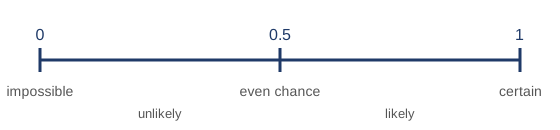
Experimental probability comes from doing an experiment:
experimental probability of an event = frequency of the event ÷ number of trials
experimental probability of an event = frequency of the event ÷ number of trials
Example: flipping a coin (textbook p. 278)
A coin is flipped 50 times and lands on heads 27 times.Experimental probability of heads = 2750 = 0.54
Flip it 100 times and heads might come up 52 times: 52100 = 0.52. The ratio changes from one experiment to the next.
What happens when there are many trials?
In the textbook activity (p. 279) a coin is flipped up to 1 200 times and the ratio heads ÷ flips is graphed. The graph wobbles a lot at the start and then settles close to 0.5.
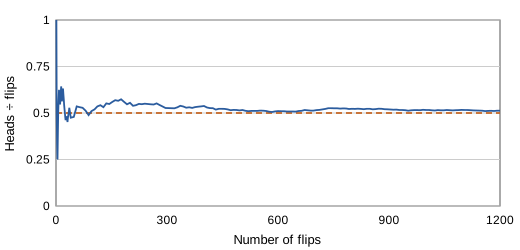
When the number of trials is large enough, the experimental probability moves towards one fixed value. For a fair coin, that value is 0.5.
Thinking a small experiment proves the probability. 3 heads in 4 flips gives 34, but that does not mean a fair coin has probability 34 of heads. Use many trials.
A fair dice is thrown 40 times and a 6 appears 9 times. (a) Find the experimental probability of a 6. (b) What value should it move towards if the dice is thrown many more times?
Show answerHide answer
(a) 940 = 0.225
(b) It moves towards 16 (about 0.167), the theoretical probability of a 6.
(b) It moves towards 16 (about 0.167), the theoretical probability of a 6.
13.2Theoretical probability with equally likely outcomes
Sample space and events
Outcome: one possible result of an experiment. Sample space, S: the set of all possible outcomes, written with { }. Event: a set of outcomes that satisfy a condition; it is a subset of S (textbook pp. 280-282).
| Experiment | Sample space | n(S) |
|---|---|---|
| Flip a coin | S = {head, tail} | 2 |
| Throw a fair dice | S = {1, 2, 3, 4, 5, 6} | 6 |
| Choose a letter from KASUT | S = {K, A, S, U, T} | 5 |
Example 2 (textbook p. 283): a prime number between 20 and 40
The primes are 23, 29, 31, 37. S = {23, 29, 31, 37} and n(S) = 4.Example 5 (textbook p. 284): events from a sample space
A card is taken from K, A, S, U, T.Event "consonant" = {K, S, T}. Event "vowel" = {A, U}.
Example 6 (textbook p. 284): events with a condition
Jar A has one card, I. Jar B has four cards, I, K, A and N. One card is taken from each jar.S = {(I, I), (I, K), (I, A), (I, N)}.
Event "the two letters are the same" = {(I, I)}.
Event "at least one consonant" = {(I, K), (I, N)}, because I and A are vowels.
Tree diagrams
When an experiment has two stages, a tree diagram helps you list every pair without missing any (textbook pp. 281, 283-284).
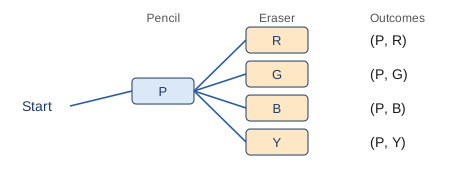
Example 3 (textbook p. 283): pencil and eraser
Palin buys one pencil P and one eraser, which is red (R), green (G), blue (B) or yellow (Y).
Two flips of a coin
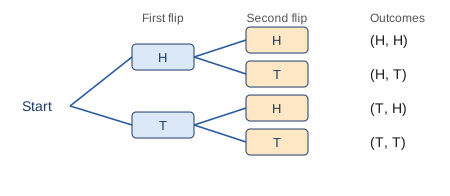
Event "both flips the same" = {(H, H), (T, T)}.
Leaving out (T, H) because "it is the same as (H, T)". The order of the flips matters, so (H, T) and (T, H) are two different outcomes.
Probability of an event
P(A) = n(A) ÷ n(S) when every outcome is equally likely. n(A) is the number of outcomes in the event; n(S) is the number of outcomes in the sample space.
Example 7 (textbook p. 286): apples
A box has 25 green apples and 35 red apples. n(S) = 60.P(green) = 2560 = 512
Two dice (textbook p. 285)
The table shows every sum when two fair dice are thrown: 36 equally likely outcomes. The sum 5 appears 4 times (highlighted).
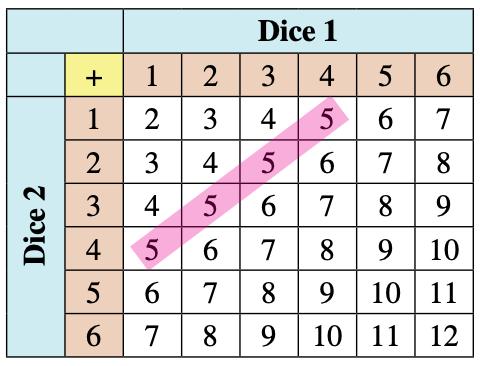
Textbook p. 285, Mathematics Form 2 (DLP).
Theoretical probability of a sum of 5 = 436 = 19.If the dice are thrown 36 times and a sum of 5 comes up 12 times, the experimental probability is 1236 = 13. With many more throws the experimental value moves towards 19.
Always give the answer as a fraction in its simplest form, or as a decimal. Check that it lies between 0 and 1.
A bag has 12 blue, 18 yellow and 10 red marbles. One is taken at random. Find P(red) and P(not blue).
Show answerHide answer
n(S) = 12 + 18 + 10 = 40
P(red) = 1040 = 14
Not blue means yellow or red: 28 marbles, so 2840 = 710
P(red) = 1040 = 14
Not blue means yellow or red: 28 marbles, so 2840 = 710
13.3Probability of the complement of an event
The complement of an event A, written A', contains all the outcomes in the sample space that are not in A (textbook pp. 287-288).
Example (textbook p. 287): multiples of 3
The first nine multiples of 3 are 3, 6, 9, 12, 15, 18, 21, 24, 27. A is the event "an even number is picked".
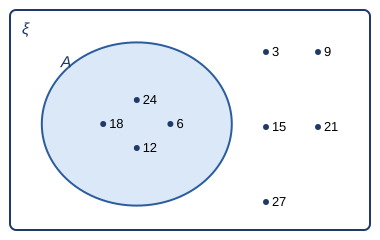
P(A) = 49, P(A') = 59, and 49 + 59 = 1.
P(A) + P(A') = 1, so P(A') = 1 − P(A) and 0 ≤ P(A) ≤ 1.
If P(A) = 0, A cannot happen. If P(A) = 1, A is certain.
If P(A) = 0, A cannot happen. If P(A) = 1, A is certain.
Example 10 (textbook p. 288): primes up to 20
A number is chosen from 1 to 20. A = prime numbers = {2, 3, 5, 7, 11, 13, 17, 19}.P(A) = 820 = 25
P(A') = 1 − 25 = 35 (check: 12 numbers that are not prime, 1220 = 35)
"Not", "none of" and "other than" are clues to use the complement. Often 1 − P(A) is quicker than counting everything else.
Writing the complement as a number instead of a set. A' = {3, 9, 15, 21, 27} lists outcomes; P(A') = 59 is the probability.
A shop sells 25 cups, 30 picture frames and 15 other souvenirs. Z is the event "a cup is sold". Find P(Z') and say what Z' means.
Show answerHide answer
n(S) = 25 + 30 + 15 = 70
P(Z) = 2570 = 514, so P(Z') = 1 − 514 = 914
Z' means "a picture frame or other souvenir is sold" (not a cup).
P(Z) = 2570 = 514, so P(Z') = 1 − 514 = 914
Z' means "a picture frame or other souvenir is sold" (not a cup).
13.4Simple probability: solving problems
Follow the steps in the textbook (p. 290): understand the problem, plan (find n(S) and n(A)), carry out the calculation, then write a conclusion with units.
Example 12 (textbook p. 290): shirts
A manufacturer makes 80 shirts a month and sells 60 of them. Profit on 15 shirts is RM135.(a) P(sold) = 6080 = 34
(b) In two months he sells 2 × 60 = 120 shirts. Profit = 120 ÷ 15 × RM135 = 8 × RM135 = RM1 080
(c) P(not sold) = 1 − 34 = 14, which is 20 shirts a month.
Working backwards
The probability of picking a red pen is 25. There are 30 pens in the container.Number of red pens = 25 × 30 = 12. Blue pens: P(blue) = 1 − 25 = 35, so 18 pens.
If you know P(A) and the total n(S), then n(A) = P(A) × n(S). If you know n(A) and P(A), then n(S) = n(A) ÷ P(A).
When items are added or removed, both n(A) and n(S) can change. Adding 8 red marbles raises the red count and the total.
Bag P has 24 red marbles and some blue marbles, and nothing else. The probability of taking a red marble is 38. (a) How many marbles are there altogether? (b) How many are not red? (c) 16 blue marbles are added; find P(blue).
Show answerHide answer
(a) 24 ÷ 38 = 24 × 83 = 64
(b) 64 − 24 = 40
(c) Blue = 40 + 16 = 56, total = 64 + 16 = 80, P(blue) = 5680 = 710
(b) 64 − 24 = 40
(c) Blue = 40 + 16 = 56, total = 64 + 16 = 80, P(blue) = 5680 = 710
Summary
| Idea | Rule |
|---|---|
| Experimental probability | frequency of event ÷ number of trials; settles towards one value as trials increase |
| Sample space | S = set of all outcomes; n(S) = how many |
| Theoretical probability | P(A) = n(A) ÷ n(S), equally likely outcomes |
| Range | 0 ≤ P(A) ≤ 1 |
| Complement | P(A) + P(A') = 1, so P(A') = 1 − P(A) |