Biodiversity
What this chapter covers
- Explain what biodiversity is and why it is important (1.1.1)
- Justify the need for effective biodiversity management and name ways to conserve it (1.1.2)
- Characterise the major groups of animals and plants (1.2.2)
- Use and construct a dichotomous key to identify organisms (1.2.1)
1.1Diversity of organisms
Malaysia is one of the 12 megabiodiversity countries in the world. Its equatorial climate makes it an ideal habitat for a huge variety of organisms. Biodiversity also exists at the genetic level: genetic diversity is the variation in the genes within a species.
Importance of biodiversity
| Importance | Example |
|---|---|
| Source of food | Animals and plants supply food to humans |
| Balance in nature | Cycle of nutrients, pollination and interaction between organisms |
| Recreational places | Areas rich in biodiversity can be developed for recreation |
| Medicine | Herbs are used to make medicines and cosmetics |
| Raw materials for industries | Timber, bamboo and rattan for furniture, musical instruments and buildings |
| Education | Research on microorganisms, animals and plants increases knowledge and creates new technology |
The International Day for Biological Diversity is celebrated on 22 May every year.
Managing biodiversity effectively
We need raw materials such as timber for development, but deforestation must be controlled. Animals lose their habitat and food sources, and species can become extinct. Biodiversity is maintained and conserved by:
- Laws that ban the killing or trade of endemic and endangered species (Wildlife Protection Act 1972).
- Protecting habitats: national parks, marine parks, forest reserves and wildlife sanctuaries.
- Reproductive programmes: seedling nurseries for reforestation and turtle hatcheries.
| In situ conservation | Ex situ conservation | |
|---|---|---|
| Where | Within the species' natural habitat | Outside the natural habitat |
| Examples | National parks, permanent forest reserves, marine parks | Zoos, botanical parks |
Show answerHide answer
1.2Classification of organisms
The two main groups of organisms are animals and plants. Each group is divided into smaller groups using common and different characteristics.
Invertebrates (no backbone)
| Group | Characteristics | Examples |
|---|---|---|
| No legs, body not segmented | Body not divided into segments | Sponge, sea anemone, coral, planaria, snail |
| No legs, segmented body | Body divided into several segments | Earthworm, leech, tapeworm |
| Three pairs of legs | Segmented body, exoskeleton (hard outer shell) | Ant, butterfly, cockroach |
| More than three pairs of legs | Segmented body, exoskeleton | Spider, horseshoe crab, prawn, centipede, scorpion |
Vertebrates (with a backbone)
A poikilotherm has a body temperature that changes with its surroundings. A homeotherm keeps a constant body temperature, free from the surroundings.
| Group | Body temperature | Covering | Breathing | Eggs and fertilisation | Examples |
|---|---|---|---|---|---|
| Fish | Poikilothermic | Hard, slimy scales; fins and tail | Gills | Lay eggs; external | Grouper, clown fish, eel |
| Amphibians | Poikilothermic | Moist skin | Young: gills. Adult: lungs and moist skin | Jelly-like eggs (spawn) without shell; external | Frog, toad, salamander |
| Reptiles | Poikilothermic | Scales and hard skin | Lungs | Eggs with shell; internal | Turtle, snake, crocodile, iguana |
| Birds | Homeothermic | Feathers; wings; scaly feet | Lungs | Hard-shelled eggs; internal | Owl, kingfisher, duck |
| Mammals | Homeothermic | Fur or hair | Lungs | Give birth and nurse young; internal | Bat, giraffe, elephant, lion |
Show answerHide answer
Plants
Plants are classified as non-flowering and flowering. Vascular plants have a vascular system that carries water and food and have true roots, stems and leaves; non-vascular plants are small and simple and have none.
| Group | Reproduction | Vascular system |
|---|---|---|
| Moss | Spores | Non-vascular |
| Fern | Spores | Vascular |
| Conifer | Bears cones | Vascular |
Flowering plants make flowers, which become fruits with seeds. A seed contains a cotyledon (stored food for germination). One cotyledon makes a monocotyledon; a pair makes a dicotyledon.
| Monocotyledon | Dicotyledon | |
|---|---|---|
| Cotyledons in the seed | One | Two |
| Root | Fibrous root | Tap root |
| Leaf veins | Parallel | Network-like |
| Stem | Most are non-woody | Woody |
| Examples | Paddy, maize | Tomato, durian |
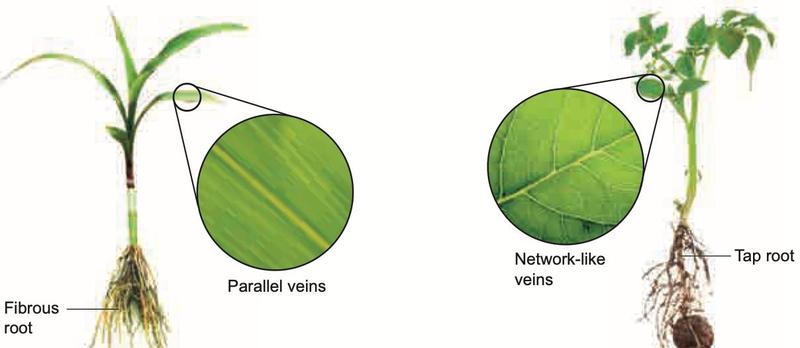
Plant photographs: textbook Figure 1.5, p. 13.
Dichotomous key
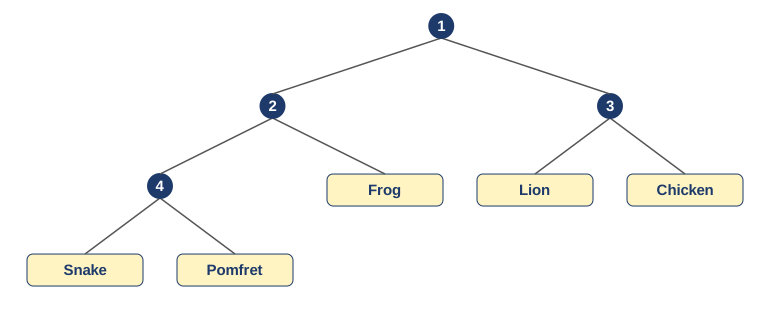
Couplet 2: scaly skin, go to 4.
Couplet 4: does not have fins, so it is the snake.
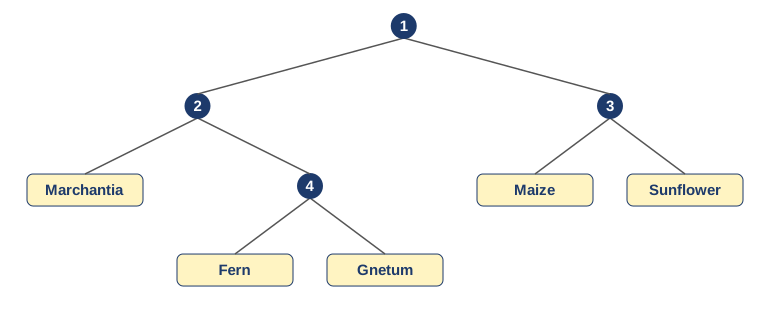
Show answerHide answer
Summary
| Remember | Key fact |
|---|---|
| Biodiversity | Variety of microorganisms, animals and plants, including genetic diversity |
| Conservation | Laws, protected habitats (in situ), reproductive programmes and zoos (ex situ) |
| Invertebrate groups | No legs (segmented or not); three pairs of legs; more than three pairs |
| Vertebrates | Fish, amphibians, reptiles, birds, mammals |
| Homeothermic vertebrates | Birds and mammals only |
| Flowering plants | Monocotyledon (one cotyledon) or dicotyledon (two) |
| Dichotomous key | Series of two-statement couplets that leads to a name |