Science questions, chapter 1
Nama / NameKelas / ClassTarikh / Date
Biodiversity
43 marks. Use Practice to check each answer as you go, or Exam to answer everything against the clock first.
Section A: objective questions
12 marksChoose the best answer for each question.
1
Question 1
Which statement describes biodiversity?
Show answerHide answer
B
Biodiversity is the diversity of organisms: microorganisms, animals and plants (textbook p. 4).
2
Question 2
Timber, bamboo and rattan are used to make furniture and musical instruments. This shows that biodiversity is important as
Show answerHide answer
C
Forest products such as timber, bamboo and rattan are raw materials for industries.
3
Question 3
Which is an example of in situ conservation?
Show answerHide answer
D
In situ conservation preserves species within their natural habitat, such as national parks, permanent forest reserves and marine parks. Zoos and botanical parks are ex situ.
4
Question 4
Which of the following is an endemic species of Malaysia?
Show answerHide answer
A
The pitcher plant Nepenthes rajah lives only in a restricted habitat in Malaysia. Other endemic examples: rafflesia, leatherback turtle, Malayan tiger.
5
Question 5
Which invertebrate has no legs but has a segmented body?
Show answerHide answer
A
An earthworm has no legs and its body is divided into segments. Snails and sea anemones have no legs and no segments; a spider has legs.
6
Question 6
Which pair of animals both have more than three pairs of legs?
Show answerHide answer
D
Scorpion and prawn have more than three pairs of legs. Ant, cockroach and butterfly have three pairs; an earthworm has no legs.
7
Question 7
Which characteristic is shared by fish and amphibians?
Show answerHide answer
C
Both are poikilothermic and undergo external fertilisation. Only young amphibians have gills, amphibians have moist skin, and their eggs have no shell.
8
Question 8
An animal is poikilothermic, has scales and hard skin, breathes through lungs and lays eggs with a shell. To which group does it belong?
Show answerHide answer
B
These are the characteristics of reptiles, with internal fertilisation. Amphibians have moist skin; birds are homeothermic; fish breathe through gills.
9
Question 9
A bat can fly like a bird but it is classified as a mammal. Which characteristic is the reason?
Show answerHide answer
C
Mammals give birth and nurse their young. Birds are also homeothermic, have wings and breathe through lungs, so these do not separate a bat from a bird.
10
Question 10
Which characteristics are found in a dicotyledon?
Show answerHide answer
B
Dicotyledons have two cotyledons, a tap root, leaves with network-like veins and a woody stem. Options A and D describe monocotyledons; plants that reproduce by spores do not make seeds.
11
Question 11
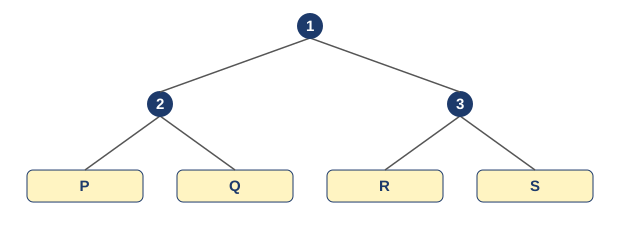
Diagram 1 shows a dichotomous key for four animals, P, Q, R and S. Which animal is most likely to be Q?
Show answerHide answer
D
Q has a backbone, so it is a vertebrate, and has moist skin without scales. That describes an amphibian, a frog. P (feathers) would be the eagle and R (three pairs of legs) the ant.
12
Question 12
A student wants the first couplet of a dichotomous key to divide eagle, frog, snake and whale into two groups of two. Which pair of statements is the best?
Show answerHide answer
A
Poikilothermic: frog and snake. Homeothermic: eagle and whale. That is 2 and 2. All four have lungs and a backbone, so those statements do not divide them. Laying eggs divides them 3 and 1 (only the whale gives birth).
Section B: structured questions
31 marksAnswer all questions. Write your answers in the spaces provided.
13
Question 13
Choose the importance of biodiversity shown by each situation.
[1 mark]
(a)Rattan is used to make chairs and tables.
Show answerHide answer
Raw materials for industries
[1 mark]
(b)Bees carry pollen from flower to flower and plants make fruits.
Show answerHide answer
Balance in nature
[1 mark]
(c)Scientists study microorganisms to create new technology.
Show answerHide answer
Education
14
Question 14
A conservation officer works to protect the leatherback turtle, an endemic species of Malaysia.
[1 mark]
(a)What is an endemic species?
Show answerHide answer
Tick each point you got.
[2 marks]
(b)State two ways to maintain and conserve endemic species.
Show answerHide answer
Any 2 points
Tick each point you got.
[1 mark]
(c)Zoos preserve species outside their natural habitat. State the type of conservation.
Show answerHide answer
Ex situ conservation
Ex situ means outside the natural habitat, for example zoos and botanical parks.
15
Question 15
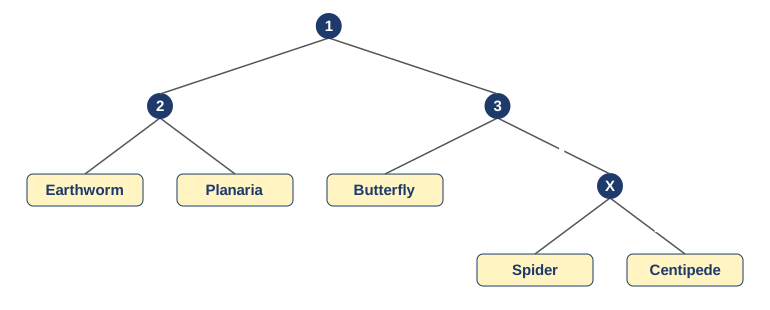
Diagram 2 shows a dichotomous key for five invertebrates.
[1 mark]
(a)Which animal has no legs and a body that is not segmented?
Show answerHide answer
Tick each point you got.
[1 mark]
(b)A cockroach has three pairs of legs. Which animal in the key is it grouped with?
Show answerHide answer
Tick each point you got.
[2 marks]
(c)Spider and centipede are separated at couplet X. State one similarity and one difference between them.
Show answerHide answer
Tick each point you got.
[1 mark]
(d)Earthworm and planaria both have no legs. State the characteristic used to separate them.
Show answerHide answer
Tick each point you got.
16
Question 16
Table 1 shows the characteristics of four vertebrates, P, Q, R and S.
| Animal | Characteristics |
|---|---|
| P | Poikilothermic, scales and hard skin, lungs, eggs with shell, internal fertilisation |
| Q | Poikilothermic, fins and tail, gills, scales, external fertilisation |
| R | Homeothermic, feathers, lungs, wings, eggs with hard shell |
| S | Homeothermic, hair, lungs, gives birth and nurses its young |
[1 mark]
(a)Name the group of animal P.
Show answerHide answer
Tick each point you got.
[1 mark]
(b)Name the group of animal Q.
Show answerHide answer
Tick each point you got.
[1 mark]
(c)Name the group of animal R.
Show answerHide answer
Tick each point you got.
[2 marks]
(d)Name the group of animal S and state one feature that makes it different from R.
Show answerHide answer
Tick each point you got.
17
Question 17
Table 2 shows the characteristics of three plants.
| Plant | Characteristics |
|---|---|
| X | Produces flowers; seed has one cotyledon; fibrous roots; leaves with parallel veins |
| Y | Produces flowers; seed has two cotyledons; tap root; woody stem |
| Z | No flowers; reproduces by spores; has vascular system; true roots, stems and leaves |
[1 mark]
(a)State the group of plant X.
Show answerHide answer
Tick each point you got.
[2 marks]
(b)State two differences between plant X and plant Y.
Show answerHide answer
Any 2 points
Tick each point you got.
[1 mark]
(c)Name one example of plant Z.
Show answerHide answer
Tick each point you got.
[1 mark]
(d)Moss is also non-flowering and reproduces by spores. State one way in which moss is different from Z.
Show answerHide answer
Tick each point you got.
18
Question 18
A company wants to clear part of a forest to obtain timber and to build a factory.
[2 marks]
(a)State two effects of clearing the forest on biodiversity.
Show answerHide answer
Any 2 points
Tick each point you got.
[1 mark]
(b)Suggest one action the company can take to reduce the effect.
Show answerHide answer
Any 1 points
Tick each point you got.
[2 marks]
(c)Deforestation helps the development of a country, yet it must be controlled. Justify.
Show answerHide answer
Tick each point you got.
19
Question 19
Construct a dichotomous key to identify these four animals: eagle, bat, crocodile and frog. Write your key as numbered couplets, each with two statements.
[4 marks]
(a)Write your dichotomous key.
Show answerHide answer
Tick each point you got.