Science questions, chapter 2
Nama / NameKelas / ClassTarikh / Date
Ecosystem
44 marks. Use Practice to check each answer as you go, or Exam to answer everything against the clock first.
Section A: objective questions
12 marksChoose the best answer for each question.
1
Question 1
Which organism is a producer?
Show answerHide answer
B
A producer makes its own food by photosynthesis. Cabbage is a green plant. The caterpillar and fox are consumers and the mushroom is a decomposer.
2
Question 2
What is the role of a decomposer in an ecosystem?
Show answerHide answer
D
Decomposers such as bacteria and fungi break down dead organisms into simple materials and nutrients (saprophytism).
3
Question 3
Why does the amount of energy decrease along a food chain?
Show answerHide answer
A
Organisms use energy to move and respire, and lose energy as heat and in undigested food or faeces, so less is passed to the next level.
4
Question 4
Which food chain is written correctly?
Show answerHide answer
C
A food chain starts with the producer and the arrows point towards the organism that eats, in the direction of energy flow.
5
Question 5
Which process releases oxygen into the atmosphere?
Show answerHide answer
B
Photosynthesis absorbs carbon dioxide and releases oxygen. The other three processes use oxygen and release carbon dioxide.
6
Question 6
How do the roots of plants help in the water cycle?
Show answerHide answer
D
Roots absorb water that is later released by transpiration, and they hold the soil tightly so that water flows more slowly and soil erosion is prevented.
7
Question 7
A pond has dragonflies, fish, tadpoles and water snails. All the tadpoles in the pond are called a ______.
Show answerHide answer
A
A population is a group of organisms of the same species living in the same habitat. A community is made up of populations of different organisms.
8
Question 8
A remora fish attaches to a shark and feeds on scraps of the shark's food. The shark is not harmed. What type of interaction is this?
Show answerHide answer
C
Only the remora benefits and the shark is neither harmed nor helped, so this is commensalism.
9
Question 9
In an experiment, most woodlice moved to the partition that contained water and few went to the partition with anhydrous calcium chloride. What does this show?
Show answerHide answer
B
Anhydrous calcium chloride keeps the air dry, so the woodlice that gathered over the water chose the damp (humid) place.
10
Question 10
Which is a weakness of biological control?
Show answerHide answer
D
Biological control is slow, and a newly introduced species may upset the balance of the ecosystem. It does not use chemicals and usually costs less.
11
Question 11
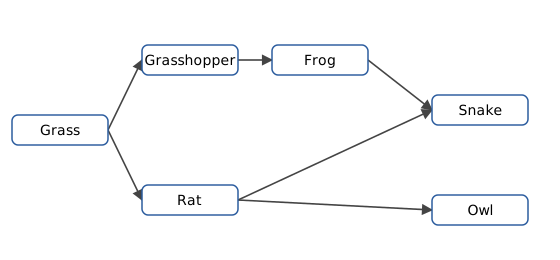
Diagram 1 shows a food web. All the rats are removed by a disease. Which organism will be most affected?
Show answerHide answer
C
The owl eats only rats in this web, so it loses its only food source. The snake can still eat frogs. Grass would increase, and the grasshopper and frog are not directly affected.
12
Question 12
An oil palm plantation has too many rats. Which method is best for a sustainable plantation?
Show answerHide answer
A
Owls are natural predators of rats, so this is biological control that avoids pollution. Pesticides, burning and poison pollute air, soil and water.
Section B: structured questions
32 marksAnswer all questions. Write your answers in the spaces provided.
13
Question 13
A food chain in a forest is: Grass → Grasshopper → Frog → Snake. State the role of each organism.
[1 mark]
(a)Grass
Show answerHide answer
Producer
[1 mark]
(b)Grasshopper
Show answerHide answer
Primary consumer
[1 mark]
(c)Frog
Show answerHide answer
Secondary consumer
[1 mark]
(d)Snake
Show answerHide answer
Tertiary consumer
14
Question 14
Diagram 2 shows a food web in a grass field.
[1 mark]
(a)Write the longest food chain in the web.
Show answerHide answer
Tick each point you got.
[1 mark]
(b)Why is grass a producer?
Show answerHide answer
Tick each point you got.
[2 marks]
(c)Predict what will happen to the number of grasshoppers if all the frogs die. Give a reason.
Show answerHide answer
Tick each point you got.
15
Question 15
State the type of interaction in each situation.
[1 mark]
(a)A tapeworm lives in the intestine of a human and absorbs digested food.
Show answerHide answer
Parasitism
[1 mark]
(b)The fungi in a lichen supply water and minerals to the algae, and the algae supply food to the fungi.
Show answerHide answer
Mutualism
[1 mark]
(c)Two plants in a forest grow close together and fight for sunlight and space.
Show answerHide answer
Competition
[1 mark]
(d)A bird's nest fern grows on the branch of a tree to get sunlight. The tree is not harmed.
Show answerHide answer
Commensalism
16
Question 16
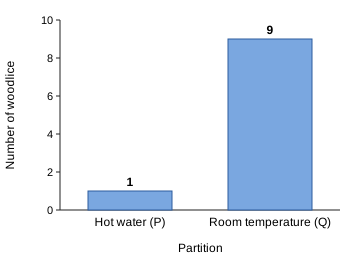
A pupil put 10 woodlice on a wire gauze over a Petri dish with two partitions. Partition P had hot water (50 °C) and partition Q had room-temperature water (26 °C to 30 °C). After five minutes the number of woodlice above each partition was counted. Diagram 3 shows the results.
[1 mark]
(a)State the manipulated variable.
Show answerHide answer
Tick each point you got.
[1 mark]
(b)State the responding variable.
Show answerHide answer
Tick each point you got.
[1 mark]
(c)State a conclusion for this experiment.
Show answerHide answer
Any 1 points
Tick each point you got.
[1 mark]
(d)State one variable that must be kept constant.
Show answerHide answer
Any 1 points
Tick each point you got.
17
Question 17
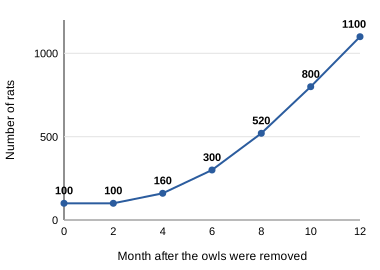
A farmer kept owls to catch rats on his farm. He then removed all the owls. Diagram 4 shows the number of rats on the farm after the owls were removed.
[1 mark]
(a)How many rats are there at month 6?
Show answerHide answer
Tick each point you got.
[1 mark]
(b)By how many did the rat population increase from month 0 to month 12?
Show answerHide answer
Tick each point you got.
[2 marks]
(c)Explain why the number of rats increased.
Show answerHide answer
Tick each point you got.
[1 mark]
(d)Suggest one effect of the large rat population on the farm.
Show answerHide answer
Any 1 points
Tick each point you got.
18
Question 18
Burning of fossil fuels and unrestricted logging affect the carbon cycle and the oxygen cycle.
[2 marks]
(a)State two processes in which living things release carbon dioxide.
Show answerHide answer
Tick each point you got.
[2 marks]
(b)Explain how unrestricted logging upsets the balance of oxygen and carbon dioxide in the air.
Show answerHide answer
Tick each point you got.
[1 mark]
(c)Suggest one step to solve the problem caused by burning fossil fuels.
Show answerHide answer
Any 1 points
Tick each point you got.
19
Question 19
Hana and Mei have different opinions about decomposers. Hana: "Producers can live without decomposers because they make their own food." Mei: "Without decomposers, producers will not get enough nutrients and may die."
[1 mark]
(a)Whose opinion is correct?
Show answerHide answer
Tick each point you got.
[2 marks]
(b)Justify your answer.
Show answerHide answer
Tick each point you got.
20
Question 20
A town council plans to plant a city forest, which is an area with many trees, in the middle of the city.
[2 marks]
(a)State two benefits of the city forest in maintaining a balanced ecosystem.
Show answerHide answer
Any 2 points
Tick each point you got.
[1 mark]
(b)Suggest one way the council can make sure the forest is not destroyed.
Show answerHide answer
Any 1 points
Tick each point you got.