Ecosystem
What this chapter covers
- Classify organisms as producers, consumers and decomposers, and interpret food chains and food webs, including energy flow and loss (2.1)
- Explain the role of living things in the water, carbon and oxygen cycles, and suggest solutions when human activities interfere with them (2.2)
- Use the terms habitat, species, population, community and ecosystem, and explain how a balanced ecosystem depends on interdependence (2.3)
- Describe how temperature, light and humidity affect the distribution of organisms, and why adaptation matters in tropical, desert and tundra areas (2.3)
- Identify mutualism, commensalism, parasitism, prey-predator and competition, and explain biological control (2.3)
- Name the factors that change population size and predict how changes in an ecosystem upset the balance (2.3)
- Explain how human activities affect the balance of nature and what humans can do to maintain it (2.4)
2.1Energy flow in an ecosystem
| Group | What it does | Examples |
|---|---|---|
| Producer | Makes its own food by photosynthesis | Most plants, cabbage, grass |
| Primary consumer | Herbivore or omnivore that eats producers | Caterpillar, snail, grasshopper |
| Secondary consumer | Omnivore or carnivore that eats primary consumers | Himalayan bluetail (omnivore), kingfisher (primary carnivore) |
| Tertiary consumer | Secondary carnivore that eats secondary consumers; usually larger than the consumers below it | Fox |
| Decomposer | Breaks down dead plants and animals into simpler materials and nutrients (saprophytism) | Mushroom, mould, bacteria |
Roles of organisms: textbook Figure 2.1, pp. 22–23.
Food chains and food webs
A food chain shows the feeding relationship between organisms in one line. A food web is several food chains that are interconnected.
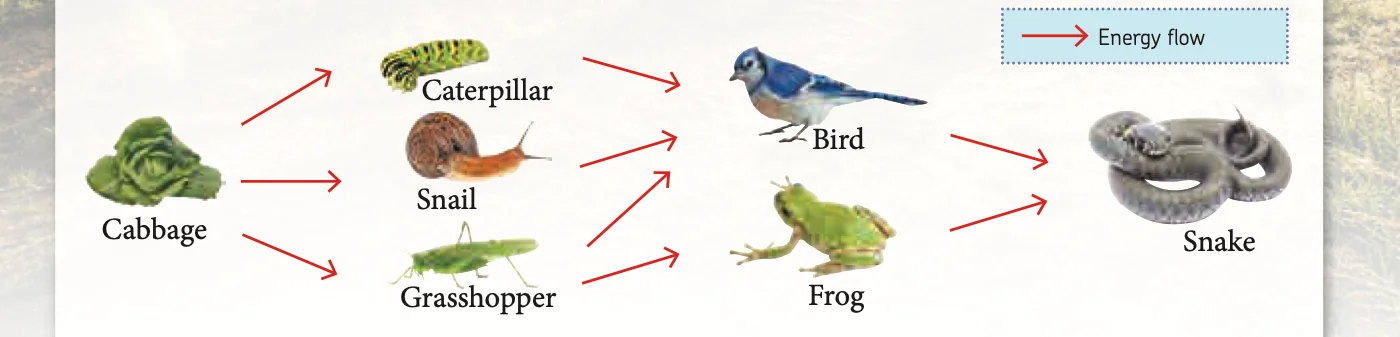
Cabbage → Snail → Bird → Snake
Cabbage → Grasshopper → Bird → Snake
Cabbage → Grasshopper → Frog → Snake
Energy loss
Energy is not passed on in full. At each step some energy is lost because the organism uses it to move and for respiration, and some is lost as heat or as chemical energy in undigested food and faeces. This is why there are fewer organisms at the top of a food chain.
Show answerHide answer
2.2Nutrient cycle in an ecosystem
Role of living things in the water cycle
- Roots absorb water from the ground; plants release water vapour into the air by transpiration.
- Animals add water to the air through respiration, defecation and excretion (sweating and urination).
- Roots hold soil together and slow down the flow of water, which prevents soil erosion.
- Fallen leaves cover the ground, reduce evaporation and keep the soil from drying out.
Two processes that change the state of matter in the water cycle: evaporation (liquid to gas) and condensation (gas to liquid).
Carbon cycle and oxygen cycle
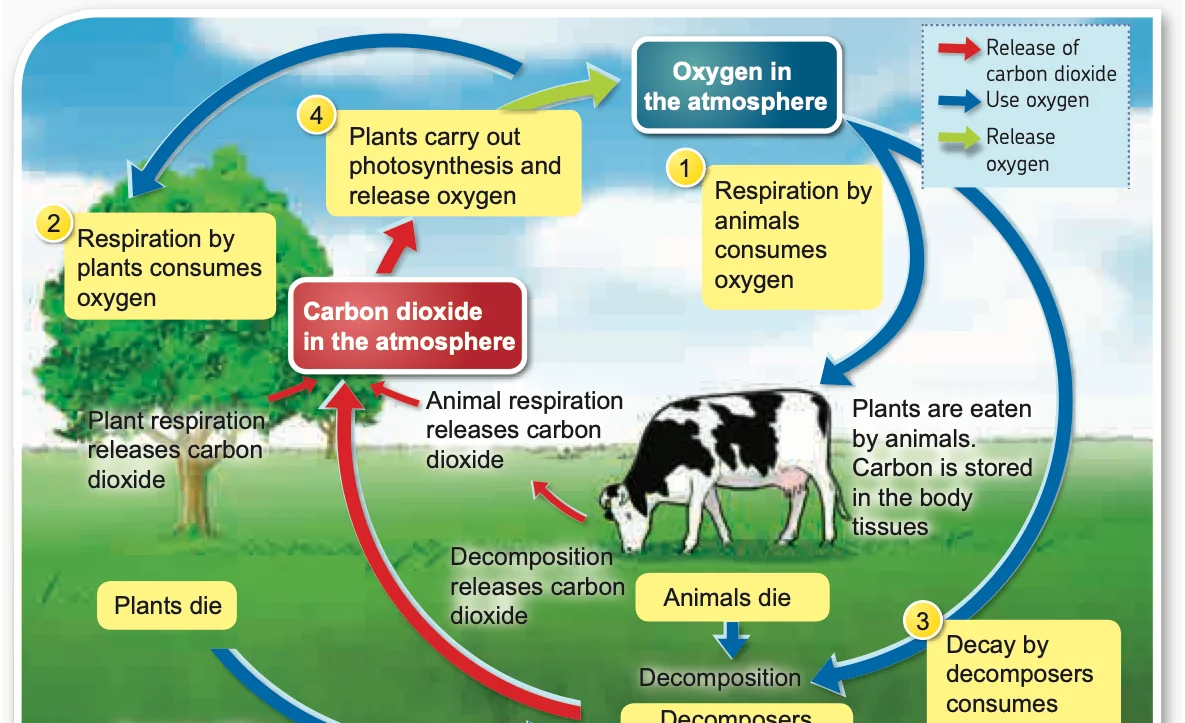
| Process | Oxygen | Carbon dioxide |
|---|---|---|
| Respiration by plants and animals | Used | Released |
| Decay by bacteria and fungi | Used | Released |
| Photosynthesis by green plants | Released | Absorbed |
Carbon is also stored in the body tissues when animals eat plants. Green plants keep the amounts of oxygen and carbon dioxide in the air in balance.
When humans interfere
| Human activity | Step to solve it |
|---|---|
| Unrestricted logging | Create planned agricultural systems; replant trees; tighten laws |
| Burning of fossil fuels | Use public transport |
| Overconsumption of water resources | Store rain water for daily use |
Show answerHide answer
2.3Interdependence and interaction
Levels of organisation
| Term | Meaning | Example |
|---|---|---|
| Habitat | Natural surroundings or home of an organism | A pond |
| Species | Group of organisms with common characteristics that can reproduce to breed offspring | Dragonfly |
| Population | Organisms of the same species living in the same habitat | All the dragonflies in the pond |
| Community | Populations of different organisms living together in one habitat and interacting | Dragonflies, fish, snails and tadpoles in the pond |
| Ecosystem | Communities that interact with one another and the non-living components (water, air, soil) | The whole pond |
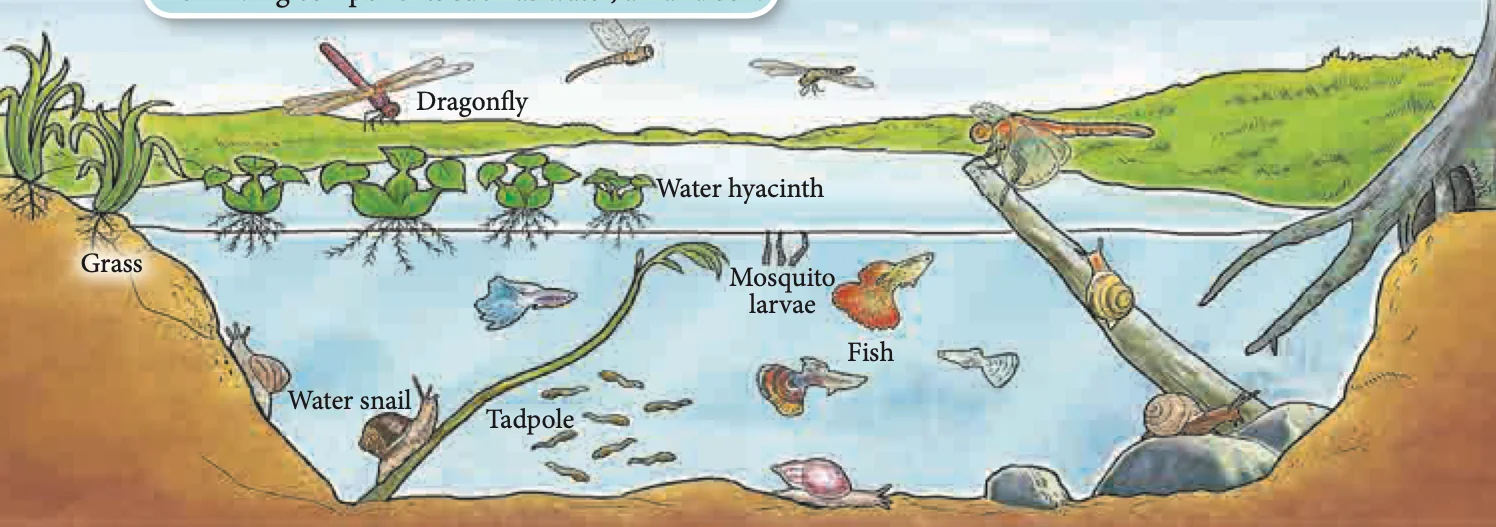
A balanced ecosystem
Organisms depend on one another and on non-living components such as water, light, air and soil. An ecosystem is balanced when its living and non-living components are in harmony without external interference. Cutting down the trees of a forest makes it unbalanced.
How non-living factors affect distribution (Experiment 2.1)
| Factor tested | Manipulated variable | Result with woodlice |
|---|---|---|
| Temperature | Hot water (50 °C) against room-temperature water | Gather at a medium temperature |
| Light | Covered (dark) against uncovered partition | Gather in the dark |
| Humidity | Water (damp) against anhydrous calcium chloride (dry) | Gather in a damp place |
In every part the responding variable is the distribution of woodlice, and the number of woodlice and the other two factors are kept constant.
Adaptation to the environment
Organisms must adapt to the climate of their habitat to survive. The tropics have high rainfall and sunlight all year, deserts are extremely hot and dry, and tundra has long winters and short summers.
Interaction between organisms
| Type | Meaning | Examples |
|---|---|---|
| Mutualism | Both organisms benefit | Sea anemone and clown fish; fungi and algae in lichens; mynah and buffalo |
| Commensalism | One benefits (commensal); the other is neither harmed nor helped | Remora fish on a shark; bird's nest fern on a tree |
| Parasitism | Parasite benefits; host is harmed | Tapeworm in the intestine; lice on humans and animals |
| Prey-predator | Predator hunts and eats the prey | Lion and zebra; owl and rat |
| Competition | Organisms in one habitat compete for limited light, space, water, food or mates | Two roosters fighting for a mate |
Biological control
Examples in Malaysia: owls kept in oil palm plantations to control rats; Bacillus thuringiensis against the rhinoceros beetle; guppies eating mosquito larvae; ladybird beetles eating aphids; ducks eating snails and insects in paddy fields.
| Advantages | Disadvantages |
|---|---|
| No pesticides or chemicals, so it is more environmentally friendly; usually cheaper; does not affect human health | Takes a long time before the effect is seen; a new species may disturb the balance of the ecosystem |
Factors that change population size
- Disease: avian flu in poultry, tobacco mosaic virus in tobacco crops.
- Predators: the number of zebras falls when lions are present.
- Source of food: pandas decline when bamboo forests are cleared; crows increase where food scraps are plentiful.
- Change of weather: drought makes soil dry and infertile and increases the risk of forest fires.
Changes in the ecosystem
- Limited water supply reduces producers such as paddy, which affects the whole food web.
- Migration: cattle egrets that arrive in Kuala Gula from September to April lower the number of insects there.
- Change in population size: more pests such as caterpillars means fewer plants.
Show answerHide answer
2.4Role of humans in maintaining a balanced nature
| Human activity | Effects on the environment |
|---|---|
| Forest logging | Extinction of plant and animal species; soil erosion; greenhouse effect |
| Industrialisation | Air, water and soil pollution; acid rain; greenhouse effect |
| Agriculture | Water pollution from too many pesticides and fertilisers; soil loses minerals |
| Waste disposal | Pollution of water and ground; flash floods; foul odour from decaying waste |
What can be done
- Enforce laws, for example forest patrols and road blocks to monitor timber lorries.
- Increase public awareness through schools and the mass media.
- Practise 5R: refuse, reduce, reuse, recycle, repurpose.
- Use biological control in agriculture instead of pesticides.