Science questions, chapter 3
Nama / NameKelas / ClassTarikh / Date
Nutrition
44 marks. Use Practice to check each answer as you go, or Exam to answer everything against the clock first.
Section A: objective questions
12 marksChoose the best answer for each question.
1
Question 1
Which food class supplies the most energy per gramme?
Show answerHide answer
C
Fat gives 37 kJ (9 kcal) per gramme, about twice the energy of carbohydrate or protein (17 kJ, 4 kcal per gramme). Vitamins give no energy.
2
Question 2
Bleeding gums are a sign of a deficiency of which vitamin?
Show answerHide answer
B
Lack of vitamin C causes scurvy, with bleeding gums. Vitamin A deficiency causes night blindness and vitamin D deficiency causes rickets.
3
Question 3
Why is a water bath used to heat the mixture in Benedict's test?
Show answerHide answer
D
A water bath gives gentle, even heating, so the liquid does not spurt out of the test tube.
4
Question 4
A food sample is tested with Millon's reagent and heated in a water bath. A red colour is seen. Which food class is present?
Show answerHide answer
A
Millon's test is the test for protein. Starch is tested with iodine, reducing sugar with Benedict's solution and fat with the alcohol-emulsion test.
5
Question 5
A snack contains 15 g of carbohydrate and 10 g of fat. What is its calorific value? (Carbohydrate 4 kcal/g, fat 9 kcal/g)
Show answerHide answer
B
Carbohydrate: 15 × 4 = 60 kcal. Fat: 10 × 9 = 90 kcal. Total = 60 + 90 = 150 kcal.
6
Question 6
Which person needs the most energy each day?
Show answerHide answer
D
Heavy work, a bigger body frame and being male increase the calorific requirement. A construction worker needs more energy than an office worker.
7
Question 7
Which organ produces bile?
Show answerHide answer
A
Bile is produced by the liver and stored in the gall bladder. It flows into the duodenum.
8
Question 8
What is the function of bile in the duodenum?
Show answerHide answer
C
Bile has no enzyme. It breaks fat into small droplets (emulsifies) and neutralises the acid. Lipase from the pancreas digests the fat.
9
Question 9
Diagram 1 shows the human digestive system. At which part does the digestion of protein begin?
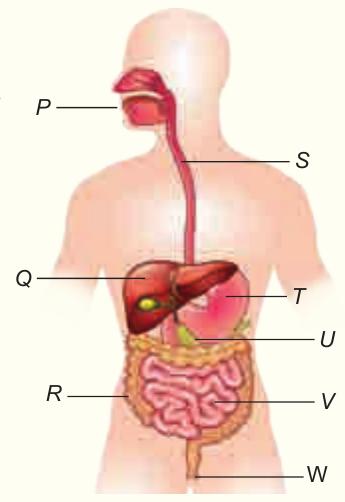
Show answerHide answer
B
T is the stomach, where protease and hydrochloric acid begin the digestion of protein. P is the mouth (starch digestion begins), V is the small intestine and W is the rectum.
10
Question 10
Starch suspension is mixed with saliva and left in a 37 °C water bath for 30 minutes. Which results are obtained?
Show answerHide answer
A
Amylase in saliva digests starch to maltose, a reducing sugar. So starch is no longer present (iodine stays brown) and Benedict's solution gives a brick-red precipitate.
11
Question 11
Which structure increases the surface area of the small intestine for absorption?
Show answerHide answer
C
The wall of the small intestine has millions of villi, which give a large surface area for absorption.
12
Question 12
Hakim eats mostly rice, fried chicken and sweet drinks, and never eats fruit or vegetables. Which is the most likely result for his body?
Show answerHide answer
D
Fruit and vegetables supply fibre and vitamins. Without fibre peristalsis is weak and faeces move slowly, causing constipation; vitamins are also lacking.
Section B: structured questions
32 marksAnswer all questions. Write your answers in the spaces provided.
13
Question 13
Table 1 shows the results of food tests on three foods, P, Q and R.
Table 1
| Food | Iodine test | Benedict's test | Millon's test |
|---|---|---|---|
| P | Dark blue | Blue | No change |
| Q | Brown | Brick-red precipitate | No change |
| R | Brown | Blue | Red |
[1 mark]
(a)Which food contains starch?
Show answerHide answer
P
Iodine solution turns dark blue only with starch.
[1 mark]
(b)Which food contains a reducing sugar such as glucose?
Show answerHide answer
Q
Benedict's solution gives a brick-red precipitate with reducing sugar.
[1 mark]
(c)Which food contains protein?
Show answerHide answer
R
Millon's reagent turns red with protein.
14
Question 14
Suraya is a long-distance runner. Diagram 2 shows the calorific value of each food in her breakfast before a practice session.
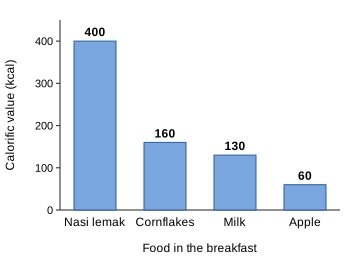
[1 mark]
(a)Calculate the total calorific value of Suraya's breakfast in kcal.
Show answerHide answer
Tick each point you got.
[1 mark]
(b)Convert your answer in (a) to kJ. (1 kcal = 4.2 kJ)
Show answerHide answer
Tick each point you got.
[1 mark]
(c)Which food in her breakfast supplies the most energy?
Show answerHide answer
Nasi lemak
Nasi lemak has the tallest bar, 400 kcal.
[2 marks]
(d)Suraya's breakfast has no vegetables. State the food class and one health benefit that she lacks.
Show answerHide answer
Tick each point you got.
15
Question 15
A snack bar has 10 g protein, 5 g fat and 30 g carbohydrate. Use these values: protein 4 kcal/g, fat 9 kcal/g, carbohydrate 4 kcal/g. 1 kcal = 4.2 kJ.
[1 mark]
(a)Calculate the energy from the fat in kcal.
Show answerHide answer
Tick each point you got.
[1 mark]
(b)Calculate the total calorific value of the snack bar in kcal.
Show answerHide answer
Tick each point you got.
[2 marks]
(c)Nadia's mass is 45 kg and her height is 1.5 m. Calculate her Body Mass Index (BMI).
Show answerHide answer
Tick each point you got.
16
Question 16
Mr. Fuad is a fisherman and Mr. Razak is a school teacher. They are neighbours in a village near the sea.
[1 mark]
(a)Who needs a bigger portion of food each day?
Show answerHide answer
Mr. Fuad
A fisherman does heavy work and needs more energy than a teacher.
[1 mark]
(b)Give a reason for your answer in (a).
Show answerHide answer
Tick each point you got.
[2 marks]
(c)Nicole lives in the Arctic where the temperature can be −40 °C. Which food class should she take plenty of? Give one reason.
Show answerHide answer
Tick each point you got.
17
Question 17
Diagram 3 shows the human digestive system (the same diagram as in question A9).
[1 mark]
(a)Name part Q, which produces bile.
Show answerHide answer
Liver
Q is the liver, which makes bile.
[1 mark]
(b)Name part S.
Show answerHide answer
Oesophagus
S is the oesophagus, the tube that joins the mouth to the stomach.
[1 mark]
(c)State the name of the wave-like movement of the muscles that pushes the food along part S.
Show answerHide answer
Tick each point you got.
[1 mark]
(d)What is absorbed back into the blood by part R?
Show answerHide answer
Tick each point you got.
18
Question 18
Pui Yee studied the effect of temperature on amylase. She mixed amylase solution with starch suspension and kept the mixture at different temperatures for 10 minutes. Diagram 4 shows the quantity of maltose formed.
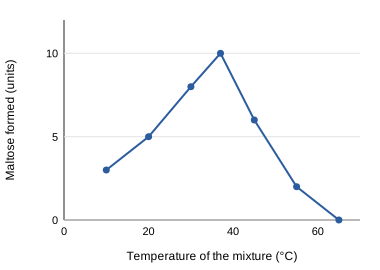
[1 mark]
(a)At what temperature is the most maltose formed?
Show answerHide answer
Tick each point you got.
[1 mark]
(b)State the quantity of maltose formed at 55 °C.
Show answerHide answer
Tick each point you got.
[1 mark]
(c)No maltose is formed at 65 °C. Explain why.
Show answerHide answer
Tick each point you got.
[1 mark]
(d)Name the test that is used to show that maltose is present.
Show answerHide answer
Tick each point you got.
19
Question 19
In Experiment 3.1, a Visking tube containing glucose solution (tube P) and one containing starch suspension (tube Q) were each placed in a beaker of distilled water for 30 minutes. The water was then tested. The water around P gave a brick-red precipitate with Benedict's solution. The water around Q stayed brown with iodine solution.
[1 mark]
(a)What inference can be made from the water around P?
Show answerHide answer
Tick each point you got.
[1 mark]
(b)Why did starch not pass through the Visking tube in Q into the water?
Show answerHide answer
Tick each point you got.
[2 marks]
(c)State two features of a villus that make absorption faster.
Show answerHide answer
Any 2 points
Tick each point you got.
20
Question 20
A vegetarian does not eat meat, fish or chicken but eats vegetables, milk and cheese.
[2 marks]
(a)In your opinion, is this diet healthy? Explain your answer.
Show answerHide answer
Tick each point you got.
[2 marks]
(b)Plan a balanced burger for him. Name one food for each of two food classes, and state the class.
Show answerHide answer
Any 2 points
Tick each point you got.