Science questions, chapter 4
Nama / NameKelas / ClassTarikh / Date
Human health
44 marks. Use Practice to check each answer as you go, or Exam to answer everything against the clock first.
Section A: objective questions
12 marksChoose the best answer for each question.
1
Question 1
Which of the following is a non-infectious disease?
Show answerHide answer
B
Diabetes is caused by genetic factors or lifestyle and cannot be passed from one person to another. Tinea, cholera and dengue fever are caused by pathogens.
2
Question 2
Which disease is spread through the air by droplets?
Show answerHide answer
C
Tuberculosis is an airborne disease. Typhoid is spread by contaminated food and water, malaria by Anopheles mosquitoes and leptospirosis by rats.
3
Question 3
Which pair of vector and pathogen is correct?
Show answerHide answer
A
Rats carry Leptospira bacteria. Dengue and Zika are spread by Aedes mosquitoes, and Plasmodium (malaria) by Anopheles mosquitoes.
4
Question 4
After a flood, many villagers have diarrhoea and vomiting. Which action is the best way to prevent the disease from spreading further?
Show answerHide answer
D
Diarrhoea and vomiting after a flood suggest a waterborne disease such as cholera. Boiling drinking water and washing hands break the spread. Fogging, thick clothes and mosquito nets are against mosquito vectors.
5
Question 5
Which of the following is the second line of defence of the human body?
Show answerHide answer
C
White blood cells that engulf and digest pathogens by phagocytosis are the second line. Skin and mucous membrane are the first line; antibodies are the third.
6
Question 6
What is an antigen?
Show answerHide answer
B
An antigen is a foreign substance, such as a pathogen or a toxin molecule, that stimulates the body to produce antibodies. Option A describes an antibody and option C an antiserum.
7
Question 7
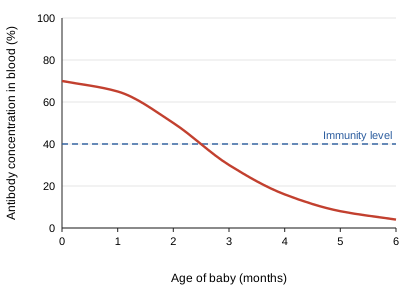
Diagram 1 shows the antibody concentration in the blood of a baby from birth. The baby is breast-fed and has not been given any injection. What type of immunity is shown?
Show answerHide answer
D
The antibodies are already present at birth and no injection was given, so they came from the mother through the placenta and breast milk (natural). The baby's own body did not make them (passive), and they fall below the immunity level within a few months.
8
Question 8
What does a vaccine contain?
Show answerHide answer
A
A vaccine contains antigens from a part or the whole of a weakened or dead virus or bacterium. They stimulate the body to make its own antibodies.
9
Question 9
Which statement about active immunity is correct?
Show answerHide answer
D
In active immunity the body makes its own antibodies and the immunity lasts long. Options A, B and C describe passive immunity.
10
Question 10
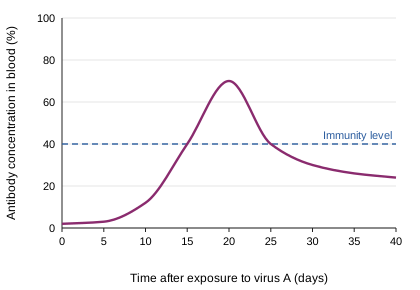
Diagram 2 shows the antibody concentration in the blood of a person after exposure to virus A. On which day did the antibody concentration first reach the immunity level?
Show answerHide answer
B
The curve meets the dashed immunity level (40%) at day 15. Day 20 is the peak (70%), and the curve falls back to the immunity level at day 25.
11
Question 11
Which action belongs to the tertiary stage of preventing the spread of infectious diseases?
Show answerHide answer
A
The tertiary stage controls the vector population (destroying breeding places, fogging) and protects hosts. Immunisation and check-ups are primary; early treatment is secondary.
12
Question 12
Which of the following is NOT part of the first line of defence?
Show answerHide answer
C
Tears, nasal hairs and earwax stop or kill microorganisms at the body's entrances (first line). Antibodies are made inside the body and form the third line.
Section B: structured questions
32 marksAnswer all questions. Write your answers in the spaces provided.
13
Question 13
Classify each disease as infectious or non-infectious.
[1 mark]
(a)Hypertension
Show answerHide answer
Non-infectious
[1 mark]
(b)Leptospirosis
Show answerHide answer
Infectious
[1 mark]
(c)Asthma
Show answerHide answer
Non-infectious
14
Question 14
Typhoid is a disease with fever, intestinal bleeding and red rashes. It is caused by Salmonella typhi bacteria and the bacteria are spread by flies.
[1 mark]
(a)What is the fly called in the spread of typhoid?
Show answerHide answer
Tick each point you got.
[2 marks]
(b)Explain how a fly spreads typhoid to a person.
Show answerHide answer
Tick each point you got.
[1 mark]
(c)State one way to control the fly population.
Show answerHide answer
Any 1 points
Tick each point you got.
15
Question 15
A town has no clean water supply after a flood. Many people suffer from cholera, which is caused by Vibrio cholerae bacteria.
[1 mark]
(a)State the way in which cholera is spread.
Show answerHide answer
Tick each point you got.
[2 marks]
(b)Suggest two ways to prevent the spread of cholera.
Show answerHide answer
Any 2 points
Tick each point you got.
[1 mark]
(c)Cholera patients are kept away from other people. State the stage of prevention for this action.
Show answerHide answer
Tick each point you got.
16
Question 16
Diagram 3 shows the antibody concentration in the blood of a person who was exposed to virus A.
[1 mark]
(a)On which day was the antibody concentration at its highest?
Show answerHide answer
Tick each point you got.
[1 mark]
(b)For how many days was the antibody concentration above the immunity level?
Show answerHide answer
Tick each point you got.
[2 marks]
(c)Is the person protected from virus A on day 10? Explain your answer.
Show answerHide answer
Tick each point you got.
17
Question 17
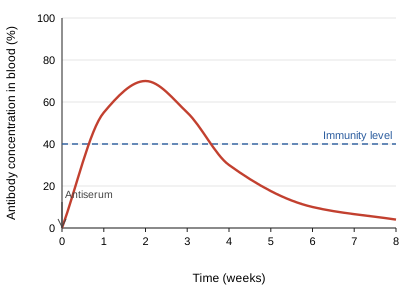
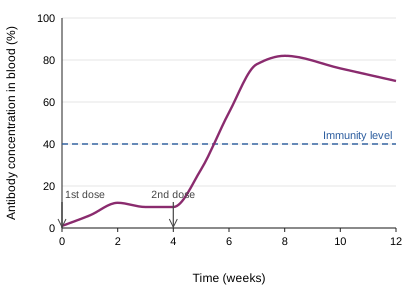
Diagram 4 shows two types of immunity, P and Q. Immunity P follows an injection of antiserum at week 0. Immunity Q follows two vaccine doses, at week 0 and week 4.
[1 mark]
(a)Name immunity P.
Show answerHide answer
Passive artificial immunity
[1 mark]
(b)Name immunity Q.
Show answerHide answer
Active artificial immunity
[2 marks]
(c)State two differences between immunity P and immunity Q.
Show answerHide answer
Any 2 points
Tick each point you got.
[2 marks]
(d)Which immunity gives better long-term protection? Give a reason.
Show answerHide answer
Tick each point you got.
18
Question 18
Name the type of immunity gained in each case.
[1 mark]
(a)Aina had chickenpox when she was six. She has never had it again.
Show answerHide answer
Active natural
[1 mark]
(b)A baby is given the BCG injection.
Show answerHide answer
Active artificial
[1 mark]
(c)A newborn baby receives antibodies from its mother's breast milk.
Show answerHide answer
Passive natural
19
Question 19
The human body defends itself against pathogens in three stages.
[2 marks]
(a)State two parts of the body that form the first line of defence.
Show answerHide answer
Any 2 points
Tick each point you got.
[2 marks]
(b)Explain how antibodies fight pathogens.
Show answerHide answer
Tick each point you got.
20
Question 20
Hafiz's parents did not take him for his scheduled vaccinations. He also sleeps late, is under stress and often stays in a smoky place.
[2 marks]
(a)Explain why babies and children need to be immunised.
Show answerHide answer
Tick each point you got.
[2 marks]
(b)Suggest two changes Hafiz should make to strengthen his immune system.
Show answerHide answer
Any 2 points
Tick each point you got.