Science questions, chapter 5
Nama / NameKelas / ClassTarikh / Date
Water and solution
41 marks. Use Practice to check each answer as you go, or Exam to answer everything against the clock first.
Section A: objective questions
12 marksChoose the best answer for each question.
1
Question 1
A daddy longlegs can stand on the surface of a pond without sinking. Which property of water makes this possible?
Show answerHide answer
B
Cohesive force between the water molecules at the surface gives water a high surface tension, which supports light insects. Capillary action is the movement of water up narrow tubes such as xylem.
2
Question 2
Which of the following describes the gases formed when water is electrolysed?
Show answerHide answer
A
Hydrogen is produced at the cathode and oxygen at the anode. A water molecule has two hydrogen atoms for one oxygen atom, so the volume of hydrogen is twice the volume of oxygen.
3
Question 3
Table salt is added to distilled water and to ice. Which statement is correct?
Show answerHide answer
D
Impurities raise the boiling point of water (above 100 °C) and lower the melting point of ice (below 0 °C).
4
Question 4
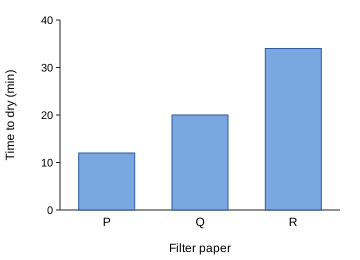
Three identical wet filter papers are hung up to dry. Paper P is left open, Q is folded in two and R is folded in four. Diagram 1 shows the time each takes to dry. What can be concluded from the results?
Show answerHide answer
C
P has the largest exposed area and dries in the shortest time (12 minutes). R, folded in four, has the smallest area and takes the longest (34 minutes). Humidity and air movement were not changed.
5
Question 5
Why does a towel take longer to dry in a humid room than in a dry room?
Show answerHide answer
A
The higher the humidity, the lower the rate of evaporation, because air that is already full of water vapour cannot hold many more escaping molecules.
6
Question 6
Nail varnish does not dissolve in water. Which substance can be used to remove it?
Show answerHide answer
C
Acetone is an organic solvent. Organic solvents dissolve solutes that are insoluble in water, such as nail varnish.
7
Question 7
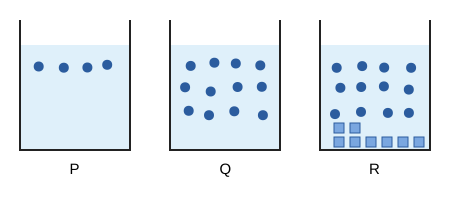
Diagram 2 shows three beakers, each with 50 mL of water, to which copper(II) sulphate crystals were added and stirred. Which statements are correct?
I. P is a dilute solution.
II. Q is more concentrated than P.
III. R is a saturated solution.
I. P is a dilute solution.
II. Q is more concentrated than P.
III. R is a saturated solution.
Show answerHide answer
D
P holds little solute (dilute). Q holds much more solute, so it is more concentrated. R has excess solute that will not dissolve and settles at the bottom, so it is saturated.
8
Question 8
Which mixture is a suspension?
Show answerHide answer
B
Chalk is insoluble in water. The mixture is cloudy, light cannot pass through it, it settles on standing and leaves a residue on filtering. The other three dissolve to form clear solutions.
9
Question 9
Fine sugar dissolves faster in water than a sugar cube of the same mass. What is the reason?
Show answerHide answer
C
The smaller the size of the solute, the larger the total surface area that is exposed to the solvent particles, so it dissolves faster.
10
Question 10
Which of the following is a colloid?
Show answerHide answer
D
Milk is a colloid (an emulsion): the particles are spread evenly and do not settle or form a clear solution. Vinegar and salt water are solutions; muddy water is a suspension.
11
Question 11
A hiker has only cloudy stream water, a clean cloth and a pot with a fire. Which method is best to make the water safe to drink?
Show answerHide answer
B
Filtering removes suspended particles and boiling kills microorganisms. Boiling first and filtering after would let the water pick up new microorganisms from the cloth.
12
Question 12
Which shows the correct order of stages in a water treatment plant?
Show answerHide answer
A
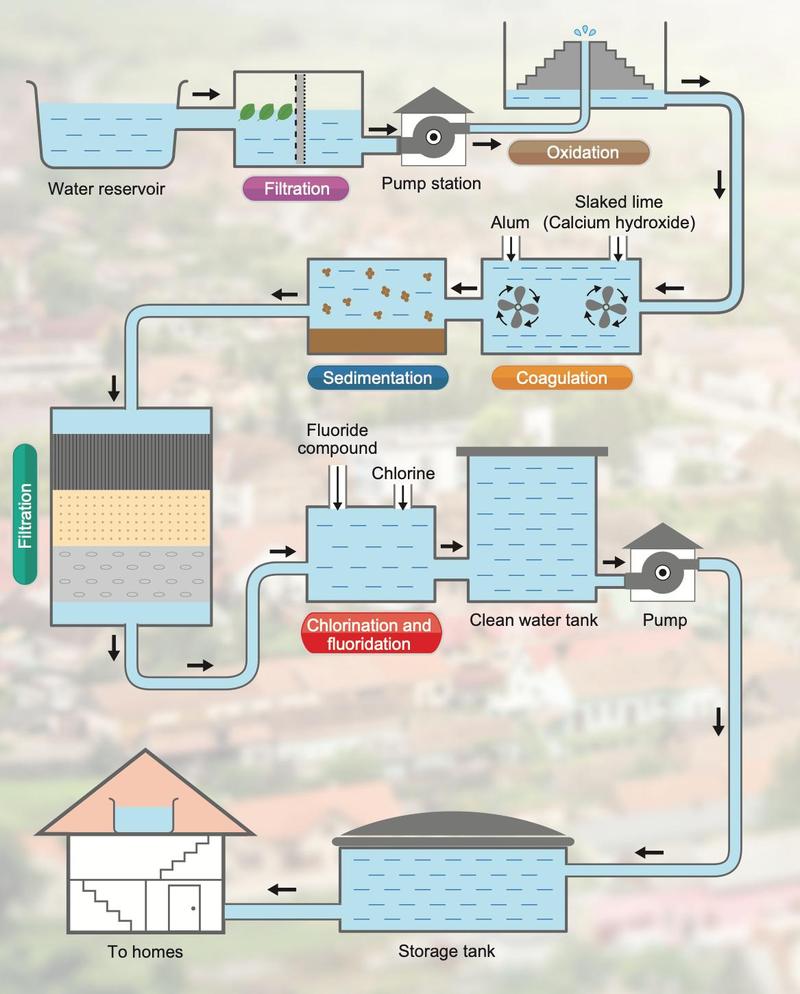
Large objects are screened out first, oxygen is added, alum and slaked lime cause coagulation, particles settle (sedimentation), sand filters remove what is left, and chlorine and fluoride are added last.
Section B: structured questions
29 marksAnswer all questions. Write your answers in the spaces provided.
13
Question 13
Name the process in each change of state of water.
[1 mark]
(a)Ice cubes in a glass change into water.
Show answerHide answer
Melting
[1 mark]
(b)Water vapour in the air changes into droplets on the outside of a cold glass.
Show answerHide answer
Condensation
[1 mark]
(c)Is heat absorbed or released by the water vapour in (b)?
Show answerHide answer
Released
Condensation is a change that releases heat (blue arrow in the textbook figure).
14
Question 14
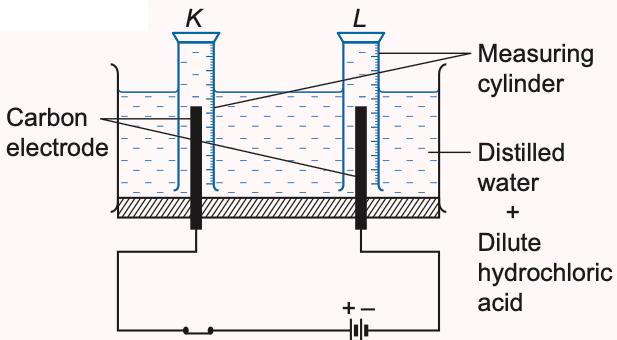
Diagram 3 shows the apparatus used to find the composition of water. After 10 minutes, the gas in cylinder K relights a glowing splinter. The gas in cylinder L burns when tested with a burning splinter, and its volume is 20 mL.
[1 mark]
(a)Name the gas in cylinder K.
Show answerHide answer
Tick each point you got.
[1 mark]
(b)Name the gas in cylinder L.
Show answerHide answer
Tick each point you got.
[1 mark]
(c)What is the volume of the gas in cylinder K?
Show answerHide answer
Hydrogen : oxygen = 2 : 1, so oxygen = 20 ÷ 2 = 10 mL.
Tick each point you got.
[1 mark]
(d)Why is dilute hydrochloric acid added to the distilled water?
Show answerHide answer
Tick each point you got.
[1 mark]
(e)State the number of hydrogen atoms and oxygen atoms in one water molecule.
Show answerHide answer
Tick each point you got.
15
Question 15
Two beakers wrapped in towels each contain the same number of ice cubes. One spatula of table salt is added to beaker P only. The temperature of the ice is recorded every 2 minutes.
| Time (min) | 2 | 4 | 6 |
|---|---|---|---|
| Temperature in P, with salt (°C) | −3 | −6 | −8 |
| Temperature in Q, no salt (°C) | 0 | 0 | 0 |
[1 mark]
(a)What is the melting point of the ice in beaker Q?
Show answerHide answer
Tick each point you got.
[1 mark]
(b)State the effect of salt on the melting point of ice.
Show answerHide answer
Tick each point you got.
[2 marks]
(c)Using the kinetic theory of matter, explain how the ice in beaker Q changes into water.
Show answerHide answer
Tick each point you got.
16
Question 16
Two microscope slides each carry a piece of cobalt chloride paper with a few drops of water on it. Slide M is placed under a moving fan and slide N is placed away from the fan. After 15 minutes the papers are observed.
[1 mark]
(a)What colour is cobalt chloride paper when it is wet?
Show answerHide answer
Tick each point you got.
[1 mark]
(b)State the manipulated variable.
Show answerHide answer
Tick each point you got.
[1 mark]
(c)State the responding variable.
Show answerHide answer
Tick each point you got.
[2 marks]
(d)Which paper turns blue first? Explain your answer.
Show answerHide answer
Tick each point you got.
17
Question 17
A student pours copper(II) sulphate crystals into 100 mL of water in beaker X, and chalk powder into 100 mL of water in beaker Y. Both are stirred and then observed.
| Beaker | Appearance | Light from a torch | After filtering |
|---|---|---|---|
| X | Clear blue | Passes through | No residue |
| Y | Cloudy white | Does not pass through | White residue |
[1 mark]
(a)Which beaker contains a suspension?
Show answerHide answer
Y
[2 marks]
(b)Name the solute and the solvent in beaker X.
Show answerHide answer
Tick each point you got.
[1 mark]
(c)Why does light not pass through the mixture in beaker Y?
Show answerHide answer
Tick each point you got.
18
Question 18
Diagram 4 shows the stages in the water supply system of a town.
[1 mark]
(a)What is added in the coagulation tank to make mud particles stick together?
Show answerHide answer
Tick each point you got.
[1 mark]
(b)State the function of the oxidation stage.
Show answerHide answer
Tick each point you got.
[1 mark]
(c)Why is a fluoride compound added to the water?
Show answerHide answer
Tick each point you got.
[1 mark]
(d)State the function of chlorine.
Show answerHide answer
Tick each point you got.
19
Question 19
A factory beside a river discharges untreated waste water into it. Fish in the river are dying, and villagers downstream who boil river water for drinking still fall ill.
[1 mark]
(a)Name the type of water pollutant from the factory.
Show answerHide answer
Tick each point you got.
[1 mark]
(b)Explain why boiling does not make the river water safe to drink.
Show answerHide answer
Tick each point you got.
[2 marks]
(c)Suggest two actions that can be taken to stop this pollution.
Show answerHide answer
Tick each point you got.