Water and solution
What this chapter covers
- Describe the physical characteristics of water, including surface tension, capillary action and the effect of heat on its state (5.1)
- Show by electrolysis that water is a compound of hydrogen and oxygen, and explain how impurities change its melting and boiling points (5.1)
- Explain evaporation of water and the four factors that affect its rate (5.1)
- Define solute, solvent, solution and solubility; tell dilute, concentrated and saturated solutions, and solutions and suspensions, apart (5.2)
- Explain the factors that affect the rate of solubility, and give examples of colloids, universal solvents and organic solvents (5.2)
- Compare water purification methods, describe the stages of a water supply system and justify water sustainability (5.3)
5.1Physical characteristics of water
Surface tension and capillary action
- Surface tension: the cohesive force between water molecules at the surface makes the surface behave like a thin skin. This is why a daddy longlegs can stand on water, and why a belly flop that lands flat on the water hurts.
- Capillary action: cohesive force (water to water) and adhesive force (water to the cell walls of the xylem) pull water up from the roots to the leaves of a plant.
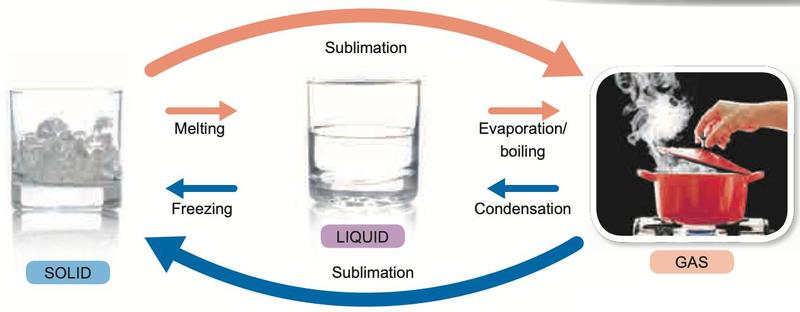
Effect of heat on the state of water
Composition of water
Water is a compound: hydrogen and oxygen that have combined chemically. Its composition is found by electrolysis, passing electricity through distilled water with a little dilute hydrochloric acid.
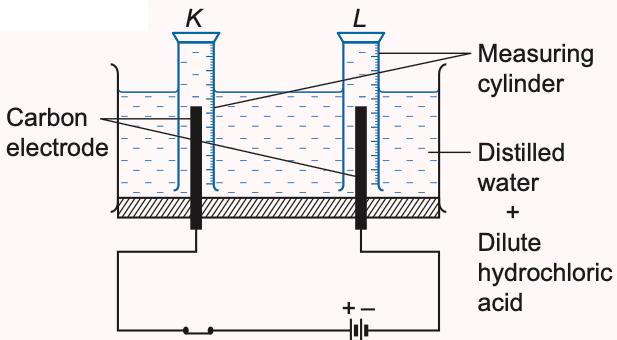
| Electrode | Gas produced | Test | Volume |
|---|---|---|---|
| Anode (+) | Oxygen | Relights a glowing splinter | 1 part |
| Cathode (−) | Hydrogen | Burns with a ‘pop’ sound at a burning splinter | 2 parts |
- The anode is the electrode joined to the positive terminal of the battery and the cathode is joined to the negative terminal.
- A water molecule has two hydrogen atoms and one oxygen atom: H2O.
- The acid is added so that distilled water, a poor conductor, can carry the electric current.
Hydrogen : oxygen = 2 : 1, so oxygen = 18 ÷ 2 = 9 mL, collected at the anode.
Effect of impurities on melting point and boiling point
Impurities such as dissolved salt change the physical characteristics of water.
| Impurity added | Melting point of ice | Boiling point of water |
|---|---|---|
| Table salt | Lowered (below 0 °C) | Raised (above 100 °C) |
Taste, smell and colour also change. Seawater tastes salty because of dissolved salt, and a pot of chicken soup boils at a higher temperature than a pot of pure water.
Show answerHide answer
Evaporation of water
| Factor | Effect on rate of evaporation | Reason |
|---|---|---|
| Humidity | Lower humidity (drier air): rate increases | Dry air holds more of the escaping water molecules |
| Surrounding temperature | Higher temperature: rate increases | Surface molecules gain more energy, move faster and escape easily |
| Exposed surface area | Larger area: rate increases | More molecules can escape at the same time |
| Movement of air | Faster air movement: rate increases | Moving air sweeps away water vapour from the surface |
Based on textbook Experiment 5.1 and Figure 5.12, pp. 101–104.
- Cobalt chloride paper is blue when dry and turns pink when wet, so it is used to show water.
- Everyday uses: clothes dry faster on a clothes line (large exposed area); seafood is dried so that microorganisms cannot survive; sea salt is obtained from evaporating seawater; a hair dryer blows hot air.
- Sweating cools the body because the sweat takes heat from the skin as it evaporates.
Show answerHide answer
5.2Solution and rate of solubility
Solvent — the liquid that dissolves the solute.
Solution — the uniform mixture formed when a solute dissolves in a solvent.
Sugar (solute) + water (solvent) = sugar water (solution).
Dilute, concentrated and saturated solutions
| Dilute solution | Concentrated solution | Saturated solution |
|---|---|---|
| Little solute in the solvent | Much solute in the solvent | Contains the maximum solute: no more can dissolve |
| Can dissolve more solute | Can still dissolve some more solute | Excess solute is left as a precipitate at the bottom |
Textbook Table 5.1, p. 107. Example: copper(II) sulphate crystals in 50 mL of water, textbook Activity 5.5.
Solution and suspension
| Solution | Suspension | |
|---|---|---|
| Appearance | Clear (transparent), uniform colour | Cloudy |
| Light | Passes through | Blocked by large particles |
| On standing | Does not settle | Particles settle |
| Filtering | No residue | Residue on the filter paper |
| Example | Copper(II) sulphate in water | Chalk powder in water; muddy river water |
Solubility and the rate of solubility
| Factor | Rate of solubility | Reason |
|---|---|---|
| Temperature of solvent | Higher temperature, faster | Particles move more rapidly and fill the spaces between each other sooner |
| Rate of stirring | Faster stirring, faster | Solvent particles are brought into contact with the solute more often |
| Size of solute | Smaller particles, faster | Larger total exposed surface area for the solvent particles |
Based on textbook Experiment 5.2 and Photograph 5.7, pp. 109–111.
Colloids
A colloid is a mixture of two or more substances in which tiny particles are spread evenly through another substance. It is neither a clear solution nor does it settle like a suspension, so a colloid is between a solution and a suspension. Examples: milk and mayonnaise (emulsions); shaving cream (foam); blood.
Universal solvent and organic solvents
- Water is a universal solvent because it can dissolve almost all substances, whether solids, liquids or gases. Uses: fertilisers dissolve in water so that roots can absorb them; soft drinks; detergents in cleaning.
- Organic solvents are carbon-based and dissolve solutes that are insoluble in water. They are volatile, so they are used in aerosols such as spray paint, perfumes and pesticides.
| Organic solvent | Used in |
|---|---|
| Alcohol | Perfume, antiseptic |
| Kerosene | Lamp oil |
| Acetone | Nail varnish remover, lacquer |
| Turpentine | Paint remover, paint thinner |
| Ether | Oil extractor |
Show answerHide answer
5.3Water purification and water supply
Natural water contains impurities (suspended particles), microorganisms and dissolved substances. Purification removes odour, taste, colour, microorganisms and dissolved substances so that water is safe to use.
Water purification methods
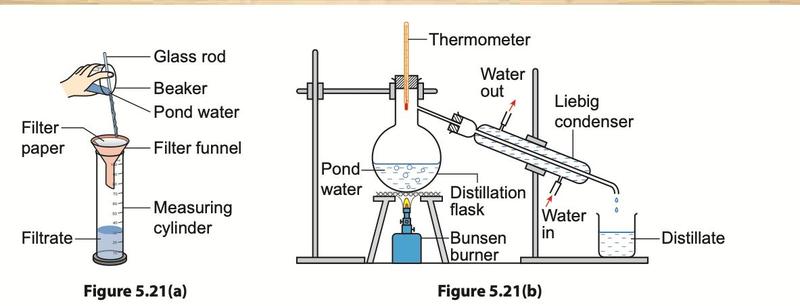
| Method | What it removes | Pure water? |
|---|---|---|
| Filtration | Suspended particles (microorganisms may remain) | No |
| Boiling | Kills microorganisms | No |
| Chlorination | Kills microorganisms | No |
| Distillation | Suspended particles, dissolved substances and microorganisms | Yes |
Water supply system
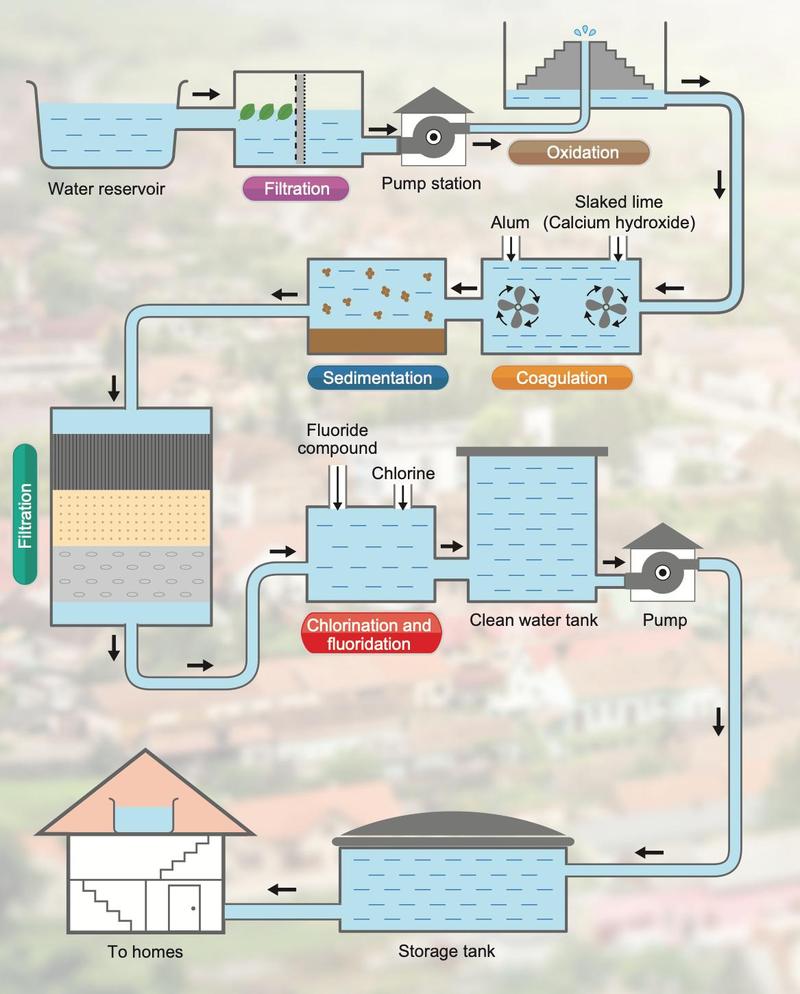
| Stage | Function |
|---|---|
| 1. Filtration | Removes large suspended particles such as branches and leaves |
| 2. Oxidation | Increases the oxygen content to remove unpleasant smell and taste |
| 3. Coagulation | Alum makes mud particles stick together and sink; slaked lime (calcium hydroxide) reduces the acidity of the water |
| 4. Sedimentation | Suspended particles settle at the bottom of the tank |
| 5. Filtration | Sand filters remove the remaining suspended particles |
| 6. Chlorination and fluoridation | Chlorine kills microorganisms; fluoride compound prevents tooth decay |
Countries short of water use other ways to get a supply: recycling water (NEWater in Singapore recycles sewage into drinking water), fog harvesting, and purifying seawater (reverse osmosis).
Water sustainability
Rivers are the main water source in Malaysia, but pollution makes water unsafe to drink and harms the environment.
| Water pollutant | Ways to overcome |
|---|---|
| Domestic waste | Upgrade sewerage systems; educate people to manage rubbish; improve sanitation in rural areas |
| Industrial waste | Enforce laws so that waste is treated before it is discharged into the river |
| Chemicals in agriculture | Educate farmers to use biodegradable fertilisers and pesticides |
| Oil spillage | Surround and contain the oil with an oil spill contingency plan; improve air surveillance |
Based on textbook Figure 5.25, p. 118.