Human health
What this chapter covers
- Differentiate infectious and non-infectious diseases, and name examples of each (4.1.1)
- Explain how infectious diseases are spread through air, water, contact and vectors (4.1.2)
- Separate the cause of a disease (pathogen) from the way it spreads (medium or vector) (4.1.3)
- Suggest the primary, secondary and tertiary stages that prevent the spread of infectious diseases (4.1.4)
- Explain the first, second and third lines of defence and define antigen, antibody and immunity (4.2.1, 4.2.2)
- Justify the importance of immunisation and read the vaccination schedule (4.2.3)
- Differentiate passive and active immunity, natural and artificial, from antibody graphs (4.2.4)
- Justify practices that strengthen the immune system and explain why individual health matters to the nation (4.2.5, 4.2.6)
4.1Infectious and non-infectious diseases
| Infectious disease | Non-infectious disease | |
|---|---|---|
| Cause | Infection by pathogens, directly through a medium or through a vector | Genetic factors or lifestyle |
| Transmission | Can be passed from one person to another | Cannot be passed from one person to another |
| Examples | Tuberculosis, flu, ringworm, tinea, leptospirosis, dengue, malaria, Zika | Cancer, hypertension, diabetes, asthma, cardiovascular diseases |
Pathogens are all viruses and some bacteria, protozoa, fungi and worms. Not all microorganisms are harmful: some bacteria in the large intestine make vitamin K and vitamin B12, which the body absorbs.
How infectious diseases spread
| Medium | How it happens | Examples | Prevention |
|---|---|---|---|
| Air | Droplets from coughs and sneezes, or dust that carries pathogens | Tuberculosis, flu, SARS, H1N1, chicken pox | Cover the mouth and nose when coughing or sneezing; do not spit; avoid crowds; let sunlight (ultraviolet rays) into the house |
| Water | Faecal pathogens pollute drinking water, especially with poor sanitation or after floods | Cholera, typhoid, amoebic dysentery | Chlorinate water supplies and pools; build toilets with good sanitation; boil drinking water; wash hands with soap after using the toilet |
| Contact | Touching infected skin or using an infected person's clothes; body fluids and blood | Ringworm and tinea (fungi); syphilis, gonorrhoea, HIV/AIDS | Do not share personal items; do not share syringes |
| Vector | An animal carries the pathogen to a new host | Dengue, Zika, malaria, typhoid, leptospirosis | Destroy breeding places; fogging; mosquito nets and coils |
Vectors and their pathogens
| Disease | Pathogen | Vector | Way of infection | Symptoms |
|---|---|---|---|---|
| Malaria | Plasmodium malariae | Female Anopheles mosquito | Mosquito bite | Shivering, fever, sweating |
| Dengue | Virus | Aedes mosquito | Mosquito bite | Joint pain, fever, headache, watery eyes |
| Zika | Virus | Aedes mosquito | Mosquito bite | Fever, rashes, joint pain, conjunctivitis |
| Cholera | Vibrio cholerae bacteria | Fly | Contaminated food and water | Diarrhoea, vomiting |
| Typhoid | Salmonella typhi bacteria | Cockroach, fly | Contaminated food and water | Fever, intestinal bleeding, red rashes |
| Leptospirosis | Leptospira sp. bacteria | Rat | Contaminated soil, food and water | Fever, headache, muscle pain |
Tables 4.1 and 4.2: textbook pp. 79–80 (rearranged).
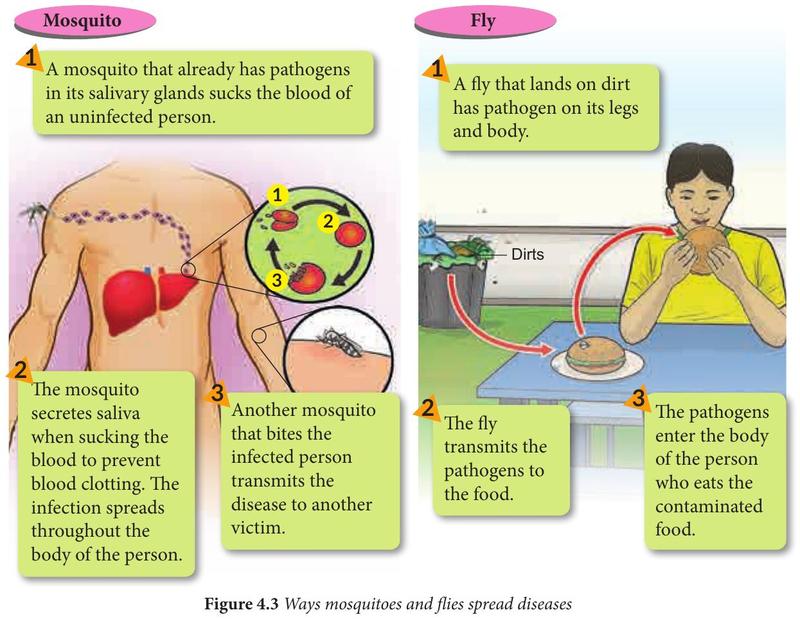
Figure 4.3: Science Form 2 (DLP) textbook, p. 80.
Preventing the spread: three stages
| Stage | What is done |
|---|---|
| Primary | Improve health and hygiene and sanitation; strengthen the body's defence (vaccines and immunisation); health check-ups; a healthy lifestyle (clean air, balanced diet) |
| Secondary | Find cases early (active and passive case detection); treat patients early; separate patients from others |
| Tertiary | Control vector numbers (destroy breeding and hiding places, fogging, fines for dirty food premises); protect hosts (mosquito nets, coils, thick clothes) |
Show answerHide answer
4.2Body defence
Pathogens enter the body through the respiratory system, the digestive system, the excretory system and the skin. The body has three lines of defence.
| Line of defence | Type | What it does |
|---|---|---|
| First | Non-specific | Skin: a tough layer; sweat and sebum contain chemicals that kill microorganisms. Mucous membrane: lines the digestive and respiratory tracts; nasal hairs and mucus trap microorganisms; earwax and tears act as antiseptics. Prevents pathogens from entering. |
| Second | Non-specific | White blood cells in the bloodstream engulf and digest pathogens with enzymes (phagocytosis). |
| Third | Specific | White blood cells make antibodies against the particular pathogen. Antibodies attach to pathogens and make them clump together. |
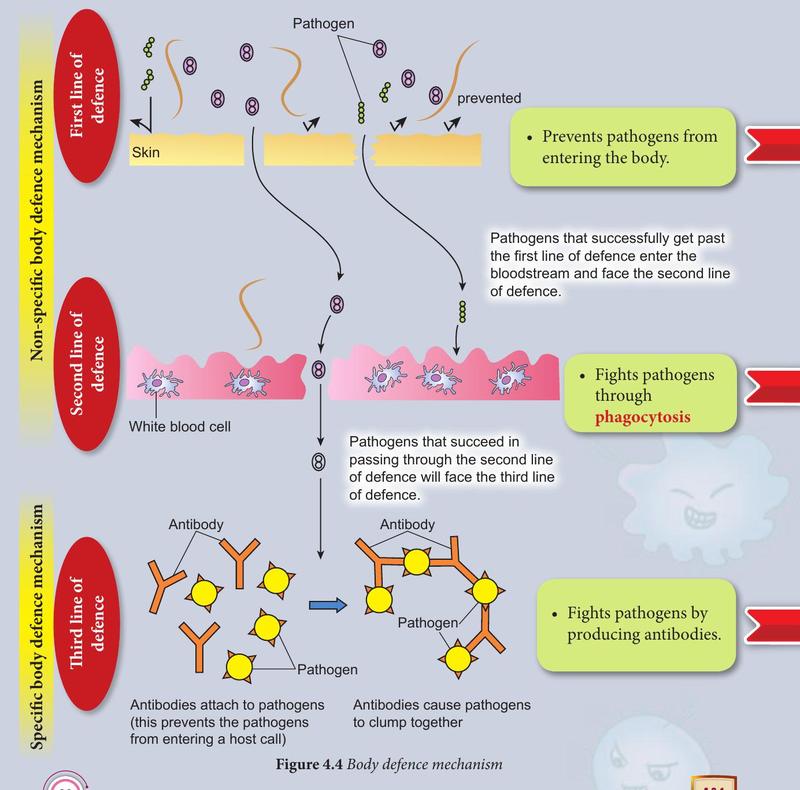
Figure 4.4: textbook p. 82.
Antibody — a protein made by white blood cells into the bloodstream in response to an antigen.
Immunity — the ability of the body to resist pathogens before it is infected.
Show answerHide answer
Immunisation
Immunisation stimulates the body's defence by injecting a vaccine. A vaccine contains antigens from a part of, or the whole of, a weakened or dead virus or bacterium. The antigens stimulate the immune system to make antibodies, so the body is ready if the real pathogen arrives. Babies need several vaccines on a schedule set by the Ministry of Health.
| Vaccine | Protects against |
|---|---|
| BCG | Tuberculosis |
| DTaP | Diphtheria, tetanus and pertussis |
| MMR | Measles, mumps and rubella |
| IPV | Polio |
| HPV | Human papillomavirus (girls aged 13) |
Vaccine notes: textbook Table 4.4, pp. 84–85.
Passive and active immunity
| Passive immunity | Active immunity | |
|---|---|---|
| Antibodies | Come from an external source | The body makes its own after stimulation by antigens |
| Natural | Baby receives antibodies from breast milk or across the placenta; short-lived, a few months | Person recovers from an infection; long-lasting |
| Artificial | Antiserum (a clear liquid with antibodies) is injected; fast but temporary | Vaccine with dead or weakened pathogens is injected; long-lasting |
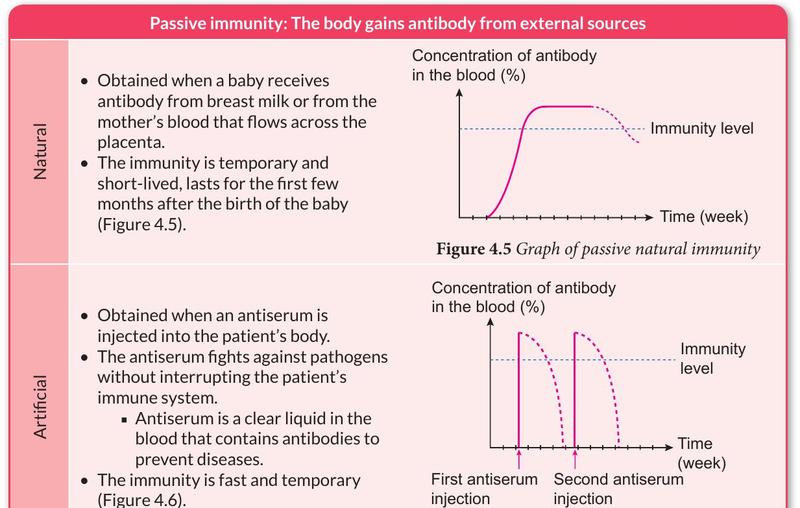
Figures 4.5 and 4.6: textbook p. 86.
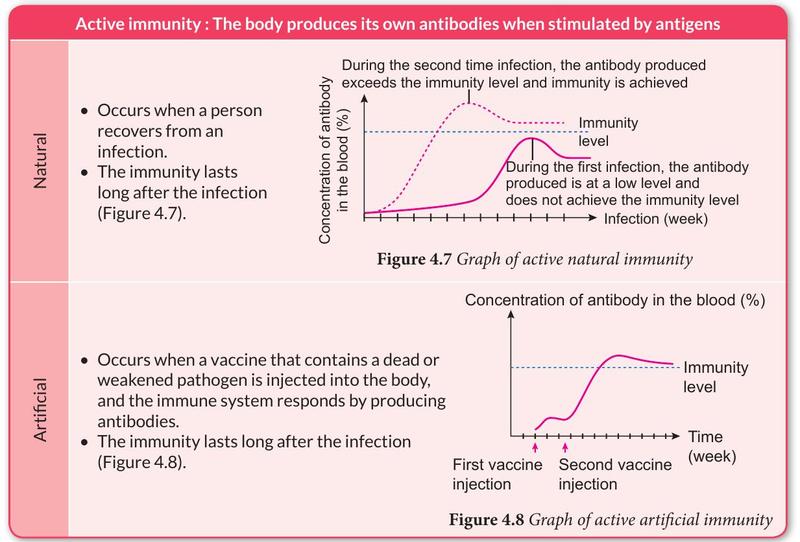
Figures 4.7 and 4.8: textbook p. 86.
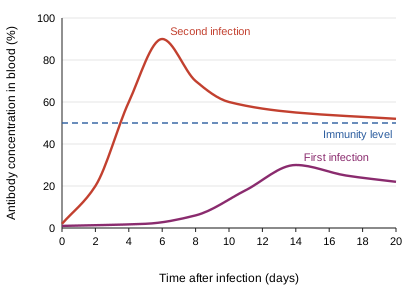
Her body made its own antibodies after recovering, so it is active; it happened without an injection, so it is natural. Answer: active natural immunity.
Show answerHide answer
A strong immune system
| Weakens the immune system | Strengthens the immune system |
|---|---|
| Polluted air; pesticides; stress; too much sugar; cigarette smoke | Enough sleep and rest; exercise and fresh air; not smoking and avoiding smoke; periodic health examinations |
An allergy is a response of the immune system to an allergen that is usually harmless to most people, for example mites, animal hair, dust, pollen, seafood, eggs and milk.
When people are immunised and healthy, fewer people fall ill, the cost of health care falls, work quality and quality of life improve, and diseases such as leprosy, whooping cough and tuberculosis are less likely to return. This benefits the family, society, economy and nation.