Nutrition
What this chapter covers
- Name the seven classes of food, their sources and functions, and the effects of vitamin and mineral deficiency (3.1)
- Test for starch, glucose, protein and fat in food (3.1)
- Explain a balanced diet, the food pyramid and the factors that influence calorific requirement (3.2)
- Estimate the calorific value of a meal and plan a balanced diet (3.2)
- Describe the digestive system, the flow of food and the action of digestive enzymes (3.3)
- Explain absorption in the villi, assimilation and defecation (3.4)
3.1Classes of food
| Class | What it is | Main functions | Sources |
|---|---|---|---|
| Carbohydrate | Contains carbon, hydrogen and oxygen. Starch (stored in plants), glycogen (stored in animals), cellulose (plant cell walls) | Main source of energy; sugar gives energy quickly | Rice, bread, potato, banana, honey, sugar |
| Protein | Contains carbon, hydrogen, oxygen and nitrogen. Digested to amino acids | Growth, repair of damaged tissue, replace dead cells; makes enzymes, hormones and antibodies | Chicken, meat, egg, seafood, milk, nuts |
| Fat | Contains carbon, hydrogen and oxygen. Made from glycerol and fatty acids | High-energy source and store; protects the heart and kidneys; carries vitamins A, D, E, K; heat insulator under the skin | Butter, coconut oil, palm oil, groundnuts |
| Vitamin | Organic compound, needed in small amounts, gives no energy | Keeps the body healthy (see table below) | Fruits, vegetables, milk, meat |
| Mineral | Non-organic substance, needed in small amounts, gives no energy | Regulates body processes (see table below) | Salt, seafood, milk, liver |
| Fibre | Cellulose from plant cell walls; cannot be digested | Stimulates peristalsis, so food moves along the tract and constipation is prevented | Vegetables, fruits, grains |
| Water | Compound of hydrogen and oxygen | Solvent; transports nutrients and oxygen to cells and wastes (urea, salt) out; cools the body by sweat evaporating | Drinks, watermelon, fruit juice |
Based on textbook pp. 46-50, Photographs 3.2-3.8.
Vitamins
Vitamins are of two groups: water-soluble (B and C) and fat-soluble (A, D, E and K).
| Vitamin | Source | Importance | Deficiency |
|---|---|---|---|
| A | Milk, egg yolk, fish oil | Night vision; healthy skin | Night blindness, skin diseases |
| B | Yeast, liver, eggs | Nervous system; forms red blood cells | Beri-beri, anaemia |
| C | Fruits, vegetables | Fights diseases; healthy gums and mouth | Scurvy (bleeding gums) |
| D | Butter, eggs, fish oil, sunlight on skin | Helps absorb calcium; strengthens tooth enamel; healthy skin | Rickets, toothache, skin diseases |
| E | Grains, green vegetables | Reproductive system | Sterility, miscarriage |
| K | Milk, egg yolk, fish oil | Speeds up blood clotting | Prolonged bleeding |
Based on textbook Table 3.1, p. 49.
Minerals
| Mineral | Source | Importance | Deficiency |
|---|---|---|---|
| Calcium | Milk, anchovies, prawns, green vegetables | Blood clotting; strong bones and teeth | Rickets, osteoporosis |
| Sodium | Salt, meat, eggs | Nervous system | Muscle cramps |
| Iron | Liver, meat | Builds haemoglobin in the blood | Anaemia |
| Iodine | Seafood, fruits | Thyroid gland functions | Goitre |
| Phosphorus | Cheese, meat, eggs, vegetables | Strong bones and teeth; forms DNA and RNA | Rickets, brittle teeth |
| Potassium | Plants and animals | Muscle contraction; nervous system | Paralysis, muscle cramps |
Based on textbook Table 3.2, p. 50.
Food tests (Activity 3.1)
| Test | Food class | Method | Positive result |
|---|---|---|---|
| Iodine test | Starch | Add 2 drops of iodine solution to 2 mL of the sample | Brown to dark blue (blue-black) |
| Benedict's test | Reducing sugar, e.g. glucose | Add 2 mL of Benedict's solution and heat in a water bath for 5 minutes | Blue to green, yellow, orange then brick-red precipitate |
| Millon's test | Protein | Add 2-3 drops of Millon's reagent and heat in a water bath for 5 minutes | Red (pink-red) colour or precipitate |
| Alcohol-emulsion test | Fat | Shake the sample with ethanol, then pour a few drops into distilled water | Cloudy white emulsion |
Methods: textbook Activity 3.1, pp. 51-52.
Show answerHide answer
3.2Importance of a balanced diet
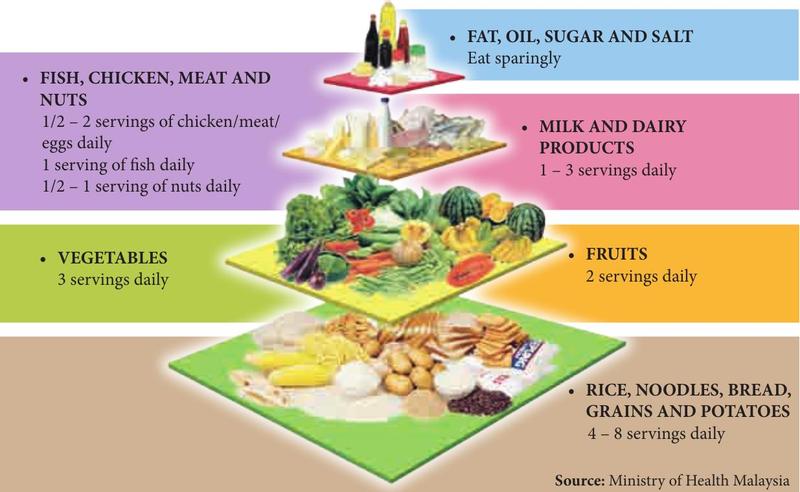
Food pyramid: Ministry of Health Malaysia, as printed in the textbook.
Factors that influence calorific requirement
| Factor | Effect |
|---|---|
| Body size | A bigger body frame needs a bigger portion of food |
| Age | Children and teenagers need more carbohydrate (energy) and protein (growth) because they are growing and active |
| Work | Farmers, labourers and fishermen do heavy work and need more energy than office workers |
| Gender | Men are generally more muscular and do heavier work, so they need bigger portions than women |
| State of health | Sick people need food suited to their condition |
| Climate | People in cold countries lose heat quickly and need more food to keep their body temperature |
Based on textbook Figure 3.8, p. 54.
Calorific value of food
| Food class | kJ per g | kcal per g |
|---|---|---|
| Fat | 37 | 9 |
| Protein | 17 | 4 |
| Carbohydrate | 17 | 4 |
Textbook Table 3.3, p. 55.
Conversion: 1 cal = 4.2 J and 1 kcal = 4.2 kJ.
Total = 640 + 120 + 130 = 890 kcal. In kilojoules: 890 × 4.2 = 3738 kJ.
Protein 10 × 4 = 40 kcal; fat 5 × 9 = 45 kcal; carbohydrate 30 × 4 = 120 kcal.
Total = 40 + 45 + 120 = 205 kcal.
Show answerHide answer
Planning a balanced diet and keeping healthy
A balanced meal plan uses the food pyramid and takes into account the person's size, age, work, gender, health and climate. For example, a construction worker needs more energy than a bank officer, and a pregnant woman needs extra protein and minerals.
Many Malaysians have diet-related problems such as diabetes, high blood pressure, high cholesterol and obesity. To lower the risk, eat food with less sugar, salt, oil and fat, eat enough fruits and vegetables, exercise and do not smoke.
BMI = 60 ÷ (1.5 × 1.5) = 60 ÷ 2.25 = 26.7 (compare with the BMI chart for his or her age and gender).
Show answerHide answer
3.3Human digestive system
| Physical digestion | Chemical digestion | |
|---|---|---|
| What happens | Food is broken into smaller pieces | Food molecules are broken down into simpler molecules |
| Enzymes | Not involved | Involved |
| Where | Mouth (chewing) | Mouth, stomach, duodenum and small intestine |
Based on textbook Figure 3.10, p. 60.
The digestive system
The digestive system is the digestive tract (a long tube from the mouth to the anus) plus the salivary glands, liver, gall bladder and pancreas. Food only passes through the tract; the other organs make juices that pour into it.
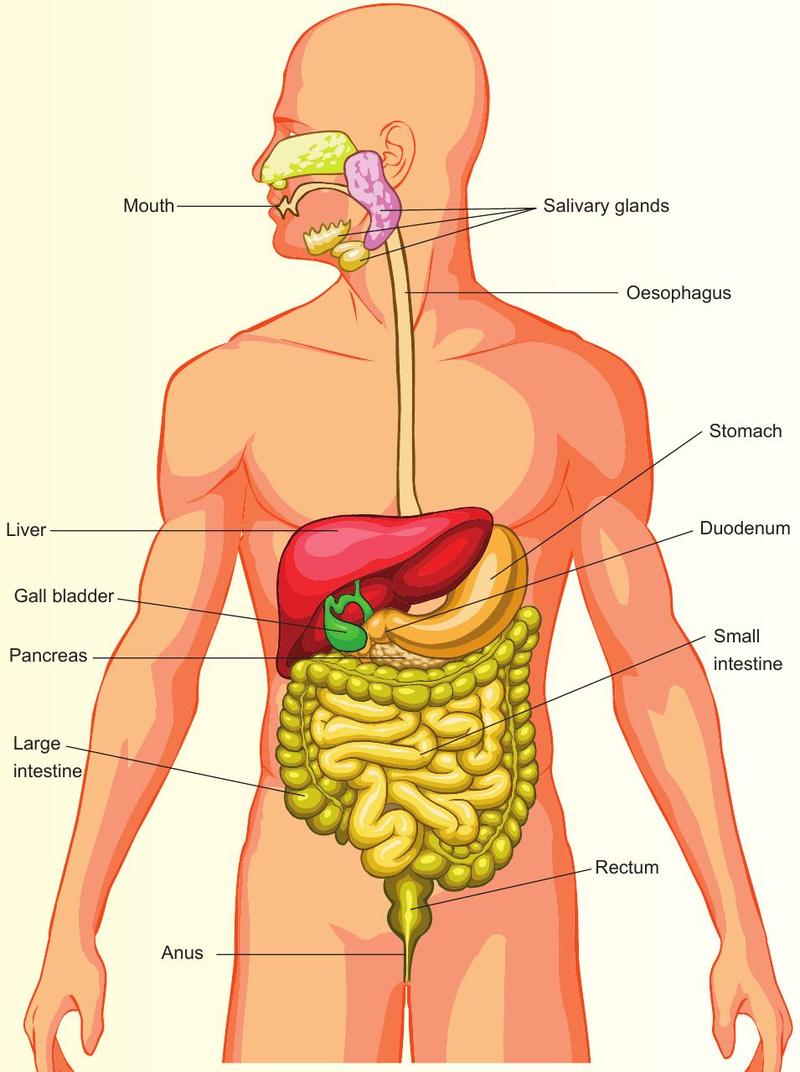
The flow of food
| Organ | What happens |
|---|---|
| Mouth | Teeth chew the food; saliva softens it. Salivary amylase digests starch into maltose |
| Oesophagus | The food, now called a bolus, is pushed to the stomach by peristalsis |
| Stomach | Walls secrete protease and hydrochloric acid (activates protease and kills bacteria). Protein is digested into polypeptides. The semi-liquid food is called chyme |
| Duodenum | First part of the small intestine. Bile (made by the liver, stored in the gall bladder) emulsifies fat into small droplets and neutralises the acid in the chyme. The pancreas adds pancreatic juice with amylase, protease and lipase |
| Small intestine | Secretes maltase and protease to finish digestion. Digested food is absorbed |
| Large intestine | Undigested food enters; water and minerals are reabsorbed |
| Rectum | Faeces are stored |
| Anus | Faeces leave the body |
Based on textbook Figure 3.13, pp. 62-63.
Digestive enzymes
| Enzyme | Made by | Digests | Into |
|---|---|---|---|
| Amylase | Salivary glands, pancreas | Starch | Maltose |
| Maltase | Small intestine | Maltose | Glucose |
| Protease | Stomach, pancreas, small intestine | Protein to polypeptide; polypeptide to dipeptide; dipeptide to amino acid | Amino acids (end product) |
| Lipase | Pancreas | Fat | Fatty acids and glycerol |
Based on textbook Figure 3.14, p. 64.
Result: P still turns dark blue with iodine and gives no brick-red precipitate. In Q, iodine stays brown and Benedict's gives a brick-red precipitate, because the amylase in saliva digested starch to maltose.
37 °C is kept because it is the body temperature, at which enzymes work best.
Show answerHide answer
3.4Absorption, transportation and defecation
Absorption in the small intestine
The wall of the small intestine has millions of finger-like villi (singular: villus). Digested food is small enough to pass through the wall of a villus and enter the blood.
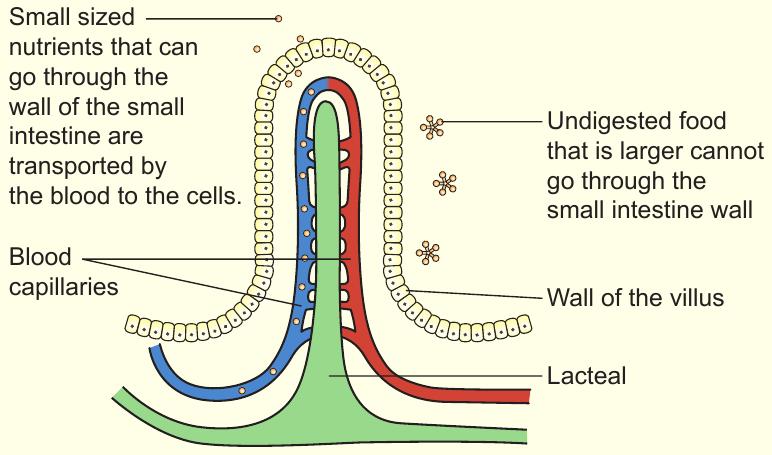
| Feature of the villus | Why it helps absorption |
|---|---|
| Many villi and folds | Large surface area, so absorption is faster |
| Wall one cell thick | Short distance, so digested food passes through quickly |
| Network of blood capillaries | Carries nutrients away to all parts of the body |
| Lacteal | Absorbs digested fat and passes it to the lymphatic system, then the blood |
Result: the water outside the glucose tube gives a brick-red precipitate with Benedict's solution, so glucose has diffused through. The water outside the starch tube does not turn dark blue with iodine, so starch is too big to pass.
Manipulated variable: content in the Visking tube. Responding variable: presence of glucose in the water. Constant: type and size of tube, temperature, time.
Assimilation
| End product | Used for |
|---|---|
| Glucose | Producing energy (respiration) |
| Amino acids | Building cell components (new cells, growth, repair) |
| Fatty acids and glycerol | Recombined into fat, used as heat insulator and to protect organs |
Based on textbook p. 68.
Three systems work together: the digestive system breaks food into small molecules, the blood circulatory system carries them to the cells, and the cells use them for respiration, new cells and body temperature.
Defecation
Fibre, dead cells, digestive secretions and water that are not absorbed move into the large intestine. Water and minerals are reabsorbed into the blood, so the waste becomes solid faeces. Faeces are stored in the rectum and removed through the anus. This is defecation. A diet low in fibre causes constipation.
Show answerHide answer
Summary
| Remember | Key fact |
|---|---|
| Seven classes | Carbohydrate, protein, fat, vitamin, mineral, fibre, water |
| Food tests | Iodine (starch, dark blue); Benedict's (reducing sugar, brick-red, water bath); Millon's (protein, red); alcohol-emulsion (fat, cloudy white) |
| Balanced diet | All food classes in the right quantities; guided by the food pyramid |
| Calorific value | Fat 37 kJ/g (9 kcal/g); protein and carbohydrate 17 kJ/g (4 kcal/g); 1 kcal = 4.2 kJ |
| Energy needs depend on | Body size, age, work, gender, state of health, climate |
| Digestion | Amylase: starch to maltose; maltase: maltose to glucose; protease: protein to amino acids; lipase: fat to fatty acids and glycerol |
| Flow of food | Mouth, oesophagus, stomach, duodenum, small intestine, large intestine, rectum, anus |
| Absorption | Villi in the small intestine; glucose, amino acids, fatty acids and glycerol enter the blood |
| Defecation | Large intestine reabsorbs water; faeces stored in rectum and leave through the anus |