Acids and alkalis
What this chapter covers
- Give the operational definition of an acid and an alkali from their properties (pH, taste, corrosiveness, litmus paper, reaction with metals) and explain the role of water (6.1.1)
- Classify acidic and alkaline substances and choose an indicator (litmus paper, universal indicator, methyl orange, phenolphthalein, pH meter) to test them (6.1.2)
- Use the pH scale to compare the strength of acids and alkalis (6.1.3)
- Describe the uses of acids and alkalis in daily life, agriculture and industry (6.1.4)
- Explain neutralisation, write its word equation and describe titration (6.2.1)
- Give examples of the applications of neutralisation in daily life, agriculture and industry (6.2.2)
6.1Properties of acids and alkalis
Alkali: a substance that has a pH value more than 7, tastes bitter and turns red litmus paper blue. It does not react with metals.
The word acid comes from the Latin acidus (sour). The word alkali comes from the Arabic alqali (ashes of plants). Both words describe what people noticed first: taste and origin.
| Property | Acid | Alkali |
|---|---|---|
| pH value | Less than 7 | More than 7 |
| Taste | Sour | Bitter |
| Corrosiveness | Corrosive | Corrosive |
| Effect on litmus paper | Turns blue litmus paper red | Turns red litmus paper blue |
| Reaction with metals | Produces hydrogen gas | No reaction |
| Examples | Hydrochloric acid, vinegar, lemon juice | Sodium hydroxide solution, soap water, baking soda |
Properties: Science Form 2 (DLP) textbook, Table 6.2, p. 128.
How the properties are tested (Activity 6.1)
- pH value: put the substance on pH paper and compare the colour with a pH chart.
- Reaction with metals: a cleaned magnesium ribbon in dilute hydrochloric acid gives bubbles of gas. A lighted splinter at the mouth of the tube gives a "pop" sound. This is hydrogen. There is no gas with sodium hydroxide solution.
- Corrosiveness: concentrated acid and concentrated alkali both damage filter paper. This test is a teacher's demonstration in a fume chamber, with goggles on.
The role of water
Acids and alkalis show their properties only in the presence of water. Glacial ethanoic acid (no water) does not change the colour of blue litmus paper, but ethanoic acid in water turns it red. Solid sodium hydroxide does not change red litmus paper, but sodium hydroxide in water turns it blue.
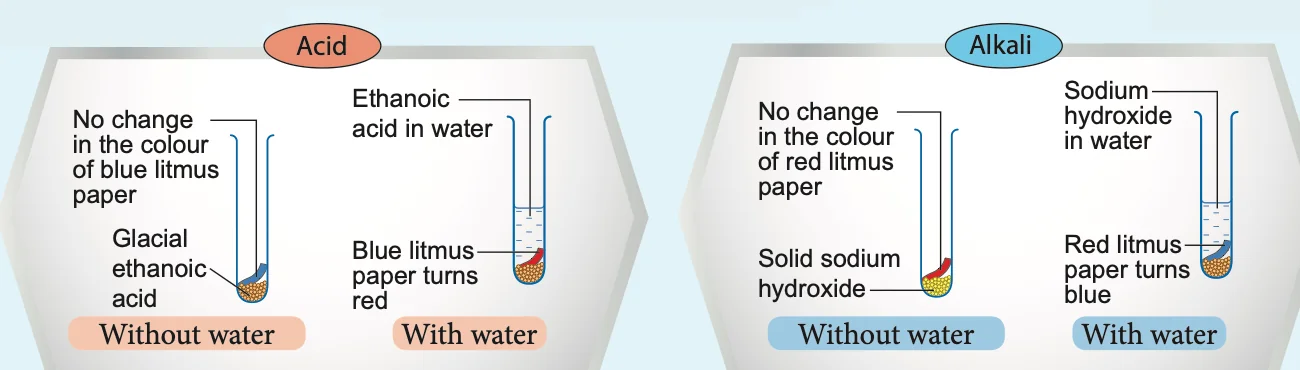
Textbook Figure 6.4, p. 128.
Show answerHide answer
Acidic and alkaline substances, and indicators
Substances that contain an acid are acidic substances. Substances that contain an alkali are alkaline substances. Apples, coffee, vinegar and lemon juice are acidic. Baking soda, soap and toothpaste are alkaline.
| Indicator | Acid | Neutral | Alkali |
|---|---|---|---|
| Blue litmus paper | Red | Blue | Blue |
| Red litmus paper | Red | Red | Blue |
| Universal indicator | Red | Green | Blue |
| Methyl orange | Red | Yellow | Yellow |
| Phenolphthalein | Colourless | Colourless | Pink |
Textbook Table 6.3, p. 129.
Strength of acids and alkalis: the pH scale
The pH scale runs from 0 to 14. pH 7 is neutral (pure water and salt solution). Below 7, the lower the pH, the stronger the acid. Above 7, the higher the pH, the stronger the alkali. The pH of a solution is measured with pH paper (compared with a pH chart), universal indicator or a pH meter.
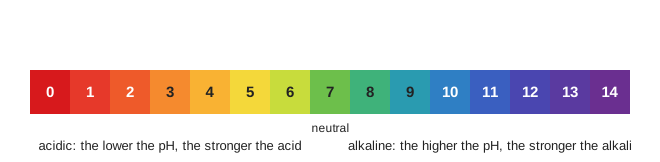
| Substance | Typical pH | Type |
|---|---|---|
| Hydrochloric acid (0.1 M) | 1 | Strong acid |
| Ethanoic acid (0.1 M) | 3 | Weak acid |
| Salt solution, pure water | 7 | Neutral |
| Ammonia solution (0.1 M) | 11 | Weak alkali |
| Sodium hydroxide solution (0.1 M) | 13 | Strong alkali |
The values above are the kind of readings Activity 6.3 gives when all solutions have the same concentration. Always keep the concentration the same, or the comparison is not fair.
Stronger acid = lower pH, so the weakest acid has the highest pH. Order from weakest to strongest: fresh milk (pH 6), pineapple juice (pH 4), vinegar (pH 2).
Show answerHide answer
Uses of acids and alkalis in daily life
| Acid | Where it is found / used | Alkali | Where it is found / used |
|---|---|---|---|
| Tartaric acid | Cola drinks | Potassium hydroxide | Soap |
| Carbonic acid | Fizzy drinks | Ammonia | Fertilisers (made by reacting with acids) |
| Sulphuric acid | Car batteries | Magnesium hydroxide | Antacid pills |
| Ethanoic acid (vinegar) | Cooking, pickles | Sodium hydroxide | Detergent |
Textbook Photograph 6.3, p. 132.
Fertilisers in agriculture are produced from the reaction between acidic and alkaline substances. Industry and medicine also use acids and alkalis. Ants such as fire ants have formic acid in their sting; green apples contain malic acid.
6.2Neutralisation
Hydrochloric acid + sodium hydroxide → sodium chloride + water
Sulphuric acid + potassium hydroxide → potassium sulphate + water
Nitric acid + sodium hydroxide → sodium nitrate + water
Textbook p. 133.
Titration (Activity 6.5)
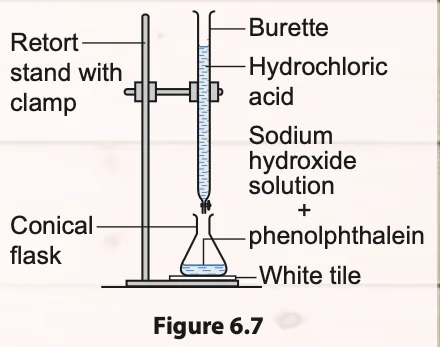
- Fill the burette with 0.5 M hydrochloric acid (use a filter funnel) and note the initial reading.
- Use a pipette to put 25 mL of 0.5 M sodium hydroxide solution into a conical flask. Add three drops of phenolphthalein (the solution turns pink).
- Add acid drop by drop from the burette, shaking the flask gently.
- Stop when the colour changes from pink to colourless. Record the final reading.
Volume of acid used = 27.80 − 2.40 = 25.40 mL.
The pipette is used for the alkali because it delivers a fixed volume exactly; the burette gives the acid slowly and measures the volume accurately.
Applications of neutralisation
| Situation | Problem | Neutralisation |
|---|---|---|
| Dental care | Bacteria in the mouth produce acid that damages teeth (dental caries) | Toothpaste is alkaline and neutralises the acid |
| Hair care | Shampoo makes hair slightly alkaline | Slightly acidic conditioner neutralises shampoo residue and makes hair smooth |
| Skin care | Alkaline face cleanser dries the skin | Acidic toner neutralises it |
| Agriculture | Acidic soil makes plants grow poorly | Slaked lime (alkaline) is added |
| Laundry | Fabric is alkaline after washing with detergent | Acidic fabric softener lowers the pH of the fabric |
| Industry | Acidic factory waste harms rivers | Treated with alkali before it is discharged |
Textbook Figure 6.8 and Photographs 6.4 and 6.5, pp. 134–135.
Show answerHide answer
Slaked lime (an alkali) is added to acidic soil so plants can grow well.