Science questions, chapter 13
Nama / NameKelas / ClassTarikh / Date
Meteoroid, asteroid, comet
39 marks. Use Practice to check each answer as you go, or Exam to answer everything against the clock first.
Section A: objective questions
13 marksChoose the best answer for each question.
1
Question 1
Which statement describes a meteoroid?
Show answerHide answer
B
A meteoroid is a floating piece of stone and metal that moves in space. The ice-and-dust body with a tail is a comet, the small planet is an asteroid, and the streak of light is a meteor.
2
Question 2
The asteroid belt is found between the orbits of which two planets?
Show answerHide answer
C
The asteroid belt lies between the orbits of Mars and Jupiter.
3
Question 3
A comet is made up mostly of
Show answerHide answer
A
A comet comprises gas and water that freeze into ice, with dust and rocky particles. Iron and nickel are found in meteoroids and asteroids.
4
Question 4
A piece of rock from space enters the Earth's atmosphere and burns, leaving a streak of light. What is it called at this stage?
Show answerHide answer
D
A meteoroid that enters the Earth's atmosphere and burns by friction with the air is called a meteor. It is a meteoroid in space and a meteorite only if it lands.
5
Question 5
What is a meteorite?
Show answerHide answer
A
Meteors that do not burn out and reach the Earth's surface are called meteorites. Many meteors at the same time make a meteor shower.
6
Question 6
Why does the tail of a comet always point away from the Sun?
Show answerHide answer
B
The solar wind blowing from the Sun pushes the gas and dust away, so the tail always points away from the Sun.
7
Question 7
An asteroid moves at an average speed of 25 km s⁻¹. How far does it travel in 10 seconds?
Show answerHide answer
C
Distance = speed × time = 25 × 10 = 250 km.
8
Question 8
The fastest meteoroid travels at 42 km s⁻¹. How far does it travel in 5 minutes?
Show answerHide answer
D
5 minutes = 5 × 60 = 300 s. Distance = 42 × 300 = 12 600 km.
9
Question 9
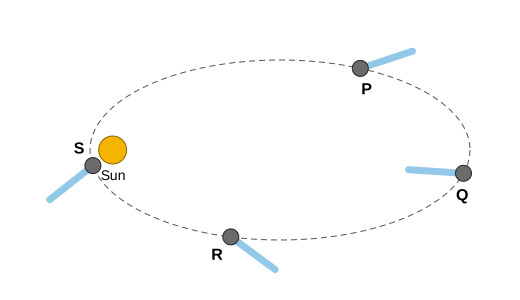
Diagram 1 shows a comet at four positions, P, Q, R and S, in its orbit around the Sun. At which position is the tail drawn wrongly?
Show answerHide answer
B
A comet's tail always points away from the Sun because of the solar wind. At Q the tail points towards the Sun, so it is drawn wrongly.
10
Question 10
Which characteristic is the same for meteoroids and asteroids?
Show answerHide answer
B
Both are made of stones and metals such as iron and nickel. Ice and a tail belong to comets, and the Kuiper belt is where most comets come from.
11
Question 11
The Moon has many more craters than the Earth. Which is the best reason?
Show answerHide answer
A
On the Earth most meteors burn up in the atmosphere. The Moon has no atmosphere to burn them, so many meteoroids reach the surface and make craters.
12
Question 12
Which statement about the collision of an asteroid with the Earth is correct?
Show answerHide answer
C
Some asteroid orbits, such as those of Apollo, Amor and Aten, lie outside the belt and can come near or cross the Earth's orbit, so a collision can happen there.
13
Question 13
What is a meteor shower?
Show answerHide answer
D
A meteor shower happens when many meteors enter the Earth's atmosphere at the same time.
Section B: structured questions
26 marksAnswer all questions. Write your answers in the spaces provided.
14
Question 14
A piece of rock and metal travels from outer space to the ground. Choose the name used for it at each stage.
[1 mark]
(a)Floating in outer space and travelling around the Sun
Show answerHide answer
Meteoroid
Floating in space it is a meteoroid.
[1 mark]
(b)Burning in the Earth's atmosphere with a streak of light
Show answerHide answer
Meteor
Once it enters the atmosphere and burns it is a meteor.
[1 mark]
(c)Landed on the surface of the Earth
Show answerHide answer
Meteorite
A piece that reaches the surface is a meteorite.
[1 mark]
(d)What may be formed on the ground by the impact of a large meteorite?
Show answerHide answer
Tick each point you got.
15
Question 15
An asteroid travels around the Sun at an average speed of 25 km s⁻¹.
[2 marks]
(a)Calculate the distance the asteroid travels in 2 minutes.
Show answerHide answer
Tick each point you got.
[2 marks]
(b)How long, in hours, does it take to travel 90 000 km at this speed?
Show answerHide answer
Tick each point you got.
16
Question 16
A comet moves in an elliptical orbit. It takes many years to come near the Sun. When it gets near the Sun, it grows a long tail.
[1 mark]
(a)From which two regions do most comets come?
Show answerHide answer
Tick each point you got.
[2 marks]
(b)Explain why the comet grows a tail when it gets near the Sun.
Show answerHide answer
Tick each point you got.
[2 marks]
(c)The comet is moving away from the Sun. Where does its tail point? Give a reason.
Show answerHide answer
Tick each point you got.
[1 mark]
(d)State what may happen if a comet is pulled out of its orbit by the gravity of an outer planet.
Show answerHide answer
Tick each point you got.
17
Question 17
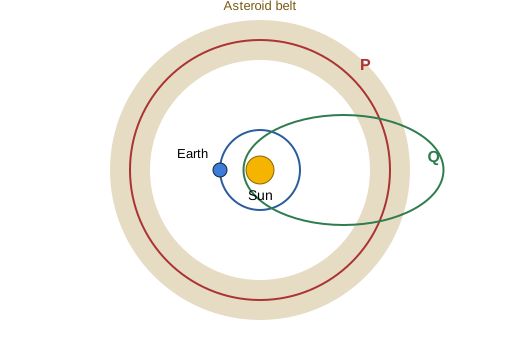
Diagram 2 shows the orbits of the Earth and of two asteroids, P and Q, around the Sun. Asteroid P stays in the asteroid belt.
[1 mark]
(a)Which asteroid has a risk of colliding with the Earth?
Show answerHide answer
Tick each point you got.
[1 mark]
(b)Give a reason for your answer.
Show answerHide answer
Tick each point you got.
[2 marks]
(c)Predict what would happen to living things on the Earth if a very large asteroid hit it.
Show answerHide answer
Tick each point you got.
[2 marks]
(d)Suggest two ways scientists can reduce the chance of an asteroid collision.
Show answerHide answer
Any 2 points
Tick each point you got.
18
Question 18
One theory says the dinosaurs became extinct because a large asteroid hit the Earth about 65 million years ago.
[2 marks]
(a)Suggest one way the asteroid impact may have caused the death of the dinosaurs.
Show answerHide answer
Tick each point you got.
[2 marks]
(b)Some scientists disagree with this theory because some dinosaur species became extinct 20 million years before the impact. Justify their opinion.
Show answerHide answer
Tick each point you got.
[2 marks]
(c)Why are meteors more dangerous to astronauts in space than to people on the Earth?
Show answerHide answer
Tick each point you got.