Science notes, chapter 13
Meteoroid, asteroid, comet
Textbook Science Form 2 (DLP), pages 268–278
What this chapter covers
- Describe the characteristics of meteoroids, asteroids and comets (13.1.1)
- Distinguish between a meteoroid, a meteor and a meteorite (13.1.2)
- Discuss the movement of meteoroids, asteroids and comets and their effects on the Earth (13.1.2)
- Suggest ways to reduce or prevent the possibility of an asteroid colliding with the Earth (13.1.3)
13.1Meteoroids, asteroids and comets
Besides the galaxy, stars and planets, the solar system also holds smaller objects that travel through space. This chapter looks at three of them: meteoroids, asteroids and comets.
Meteoroid — a floating piece of stone and metal that moves in space.
Asteroid — a large metal and rocky body that travels around the Sun in its own orbit.
Comet — a small body of ice, gas and frozen dust that travels around the Sun in its own orbit.
Asteroid — a large metal and rocky body that travels around the Sun in its own orbit.
Comet — a small body of ice, gas and frozen dust that travels around the Sun in its own orbit.
Characteristics
| Feature | Meteoroid | Asteroid | Comet |
|---|---|---|---|
| Size | 10 µm to 1 m | 1 m to 1 000 km | Head up to 250 000 km; tail up to 150 000 000 km |
| Made of | Stone and metals such as iron and nickel | Stone and metals such as iron and nickel | Gas and water frozen into ice, dust and rocky particles |
| Origin | Fragments of asteroids and comets | Found mostly in the asteroid belt between Mars and Jupiter | Most come from the Kuiper belt and the Oort cloud |
| Temperature | About 0 °C in outer space | Cold, about −73 °C | Frozen ice and gas |
| Speed | Varies; the fastest is 42 km s−1 | Average 25 km s−1 around the Sun | 10 to 70 km s−1 |
| Path | Moves freely; pulled by the gravity of planets, the Moon and other objects | Own orbit around the Sun | Own elliptical orbit around the Sun |
- The asteroid belt lies between the orbits of Mars and Jupiter. Large asteroids such as Ceres, Pallas, Juno and Vesta are a few kilometres to 1 000 km across. Asteroids are also called small planets.
- A comet has two main parts, a head and a tail.
A meteoroid and a small asteroid can be the same size (1 m). The difference is the path: an asteroid has its own orbit around the Sun, but a meteoroid moves freely and is easily pulled off course because its mass is small.
Name the object described: it has a head and a tail and is made of ice, gas and dust.
Show answerHide answer
Comet. A meteoroid and an asteroid are stone and metal, with no tail.
Movement of a meteoroid
- A meteoroid floats in outer space and travels around the Sun.
- When it enters the Earth's atmosphere it is called a meteor. Friction between the air and the meteor produces heat until it burns, giving a streak of light (a "shooting star").
- When many meteors enter the atmosphere at the same time, it is a meteor shower.
- Most meteors burn out before they reach the ground. Those that do reach the Earth's surface are called meteorites. Their impact forms craters.
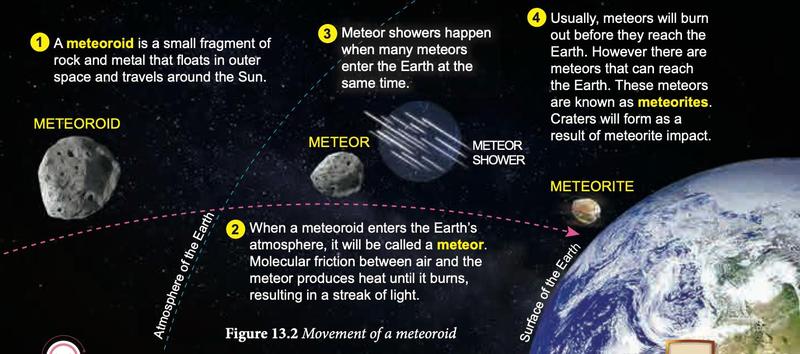
Textbook Figure 13.2, p. 272.
| Name | Where it is | What happens |
|---|---|---|
| Meteoroid | Outer space | Travels around the Sun |
| Meteor | In the Earth's atmosphere | Burns by friction with air, streak of light |
| Meteorite | On the Earth's surface | Survives the fall and may form a crater |
Same piece of rock, three names: meteoroid (before), meteor (burning), meteorite (landed). A meteorite is the only one you can pick up and put in a museum.
Worked example: how far in one minute?
The fastest meteoroid travels at 42 km s−1.Distance = speed × time = 42 × 60 = 2 520 km in one minute.
Example of a crater: the meteorite crater in Arizona, United States, formed about 50 000 years ago and is about 1.2 km across. The Hoba Meteorite in Namibia, the largest known meteorite, made no crater; scientists think its flat shape gave it a low speed at impact.
Why do most meteors never reach the ground?
Show answerHide answer
Friction between the meteor and the air in the atmosphere produces heat, and the meteor burns up before it lands.
Movement of an asteroid
- Asteroids move at an average speed of 25 km s−1. Most are in the asteroid belt.
- Some asteroid orbits lie outside the belt, such as the orbits of Apollo, Amor and Aten. These can pass near, or even cross, the orbit of the Earth.
- A collision can happen where an asteroid's orbit crosses or comes near the Earth's orbit.
- A collision with a large asteroid can destroy living things on the Earth. Paleontologists believe an asteroid about 10 km across helped cause the extinction of the dinosaurs.
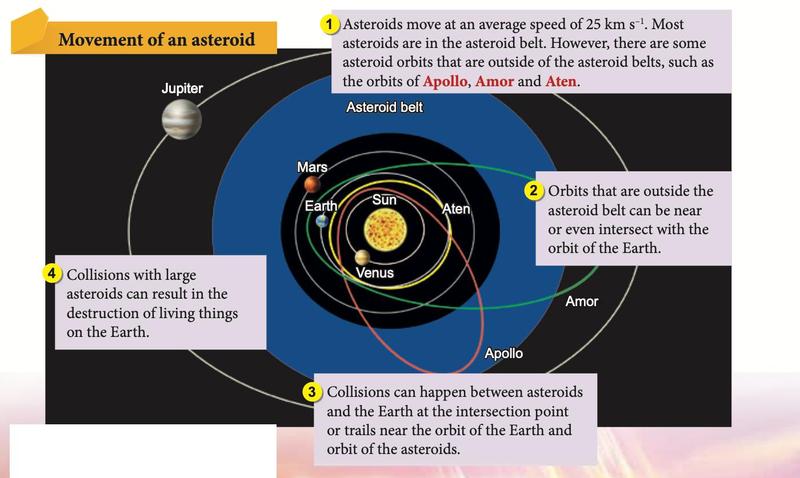
Textbook Figure 13.3, p. 273.
Worked example: how long to cross a distance?
An asteroid moves at 25 km s−1. How long does it take to travel 90 000 km?Time = distance ÷ speed = 90 000 ÷ 25 = 3 600 s = 3 600 ÷ 60 ÷ 60 = 1 hour.
Where is the asteroid belt, and which asteroid orbits can threaten the Earth?
Show answerHide answer
Between the orbits of Mars and Jupiter. Orbits outside the belt (Apollo, Amor, Aten) can come near or cross the Earth's orbit.
Movement of a comet
- A comet moves at 10 to 70 km s−1. Most comets come from the Kuiper belt and the Oort cloud.
- As a comet gets closer to the Sun it speeds up, the ice melts and it appears to have a long tail.
- The tail always points away from the Sun, because of the solar wind blowing from the Sun.
- The strong gravity of the outer planets can pull a comet out of its orbit. A comet out of its orbit may collide with the Earth at high speed.
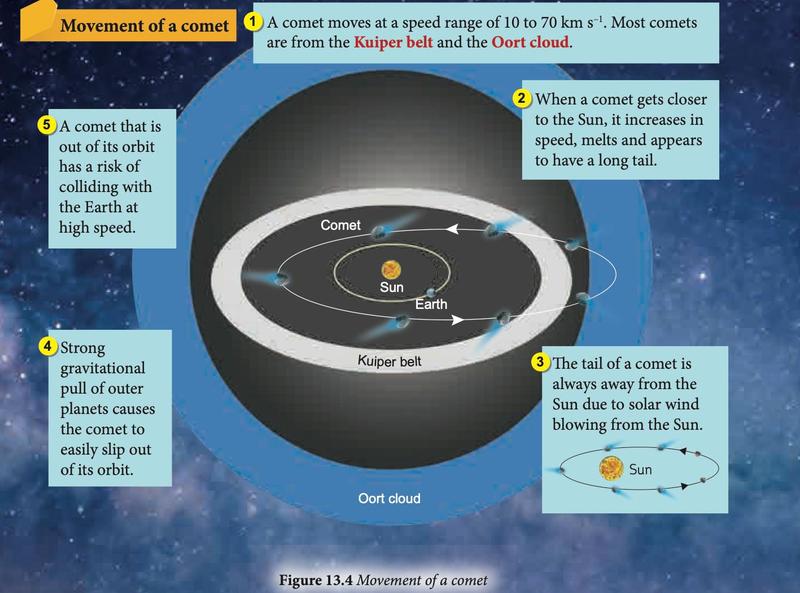
Textbook Figure 13.4, p. 274.
The tail does not trail behind the comet. It points away from the Sun, so when the comet moves away from the Sun the tail goes in front.
Halley's Comet last passed the Earth in 1986 and is expected again in 2061. In 1994 the Shoemaker-Levy 9 comet collided with Jupiter, the first direct collision of a comet with an object in the solar system.
Why does a comet grow a tail only when it is near the Sun?
Show answerHide answer
Near the Sun the heat melts the ice and frees gas and dust, and the solar wind blows this material away from the Sun, forming the tail.
Reducing the risk of an asteroid collision
- Scientists monitor asteroids to check that their orbits stay at a safe distance from the Earth (for example the NASA Near-Earth Object Programme).
- A warning is issued if an asteroid may collide with the Earth.
- An asteroid that approaches the Earth may be destroyed or have its course changed.
- In Malaysia, the National Space Agency (ANGKASA) drives and monitors the development of space science.
Give two things scientists can do about an asteroid heading towards the Earth.
Show answerHide answer
Issue a warning; destroy the asteroid; change its course (any two).
Common exam points
- The Moon has many craters because it has no atmosphere to burn up meteoroids, so they hit its surface. In the same way, meteors are more dangerous to astronauts in space than to people on the Earth.
- Compare using size, material, orbit and speed; do not mix up meteor (burning) and meteorite (landed).