Solar system
What this chapter covers
- Compare the distances between the Sun and the planets using astronomical units (A.U.) and light years (ly) (12.1.1)
- Compare and contrast the planets of the solar system and the Earth using a table of their characteristics (12.1.2)
- Explain relationships between planet characteristics (temperature, gravity, orbit time), including anomalies (12.1.3)
- Reason about hypothetical situations, such as the Earth rotating slower or stopping (12.1.4)
- Justify why the Earth is the most suitable planet for life (12.1.5)
12.1The solar system and distances in space
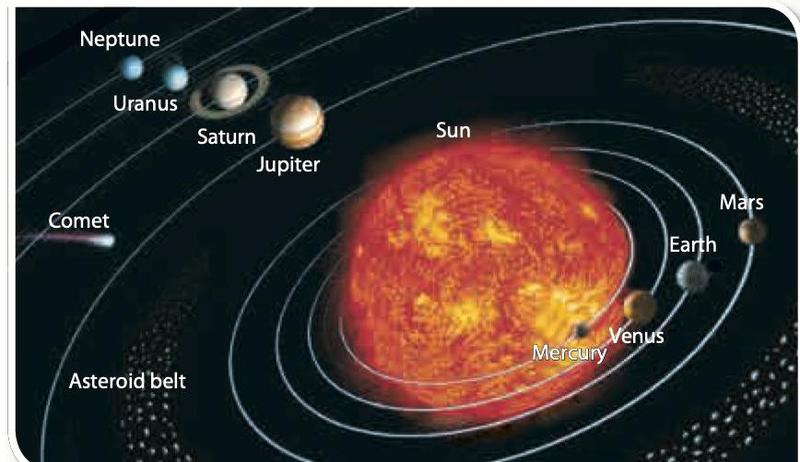
Solar system: textbook Figure 12.1, p. 252.
Two units for huge distances
Distances between the planets and the Sun are so great that kilometres become awkward. Two bigger units are used.
1 A.U. = 1.5 × 10⁸ km
Light year (ly) is the distance travelled by light in one year. Light moves at 300 000 km every second.
1 ly = 9.5 × 10¹² km
| To find | Formula |
|---|---|
| Distance in A.U. | distance in km ÷ (1.5 × 10⁸ km) |
| Distance in ly | distance in km ÷ (9.5 × 10¹² km) |
| Distance in km from ly | distance in ly × 9.5 × 10¹² km |
In A.U.: 2.28 × 10⁸ ÷ 1.5 × 108 = 1.52 A.U.
In ly: 2.28 × 10⁸ ÷ 9.5 × 1012 = 2.4 × 10⁻⁵ ly
In A.U.: 4.15 × 10¹³ ÷ 1.5 × 108 = 2.77 × 10⁵ A.U.
| Planet | Distance (km) | A.U. | ly |
|---|---|---|---|
| Mercury | 5.79 × 10⁷ | 0.39 | 6.1 × 10⁻⁶ |
| Venus | 1.08 × 10⁸ | 0.72 | 1.1 × 10⁻⁵ |
| Earth | 1.50 × 10⁸ | 1.0 | 1.58 × 10⁻⁵ |
| Mars | 2.28 × 10⁸ | 1.52 | 2.4 × 10⁻⁵ |
| Jupiter | 7.78 × 10⁸ | 5.19 | 8.2 × 10⁻⁵ |
| Saturn | 1.43 × 10⁹ | 9.5 | 1.51 × 10⁻⁴ |
| Uranus | 2.87 × 10⁹ | 19.1 | 3.0 × 10⁻⁴ |
| Neptune | 4.5 × 10⁹ | 30 | 4.7 × 10⁻⁴ |
Table values: textbook Activity 12.1, p. 253 (completed and rounded).
Show answerHide answer
12.2Characteristics of the planets
| Planet | Key facts |
|---|---|
| Mercury | Closest to the Sun and the smallest planet. No atmosphere, so the sky looks dark and the surface is covered in craters like the Moon. |
| Venus | The "greenhouse" planet: its atmosphere is rich in carbon dioxide. Rotates east to west, so the Sun rises in the west. About 460 °C. |
| Earth | The only planet with living things. Atmosphere protects it from solar wind, ultraviolet rays and radiation. More than 71% of the surface is water. |
| Mars | The "Red Planet", with two moons (Phobos and Deimos). Polar caps of frozen water and carbon dioxide. |
| Jupiter | The largest planet, mass almost 320 times the Earth's. Its strong gravity can deflect large objects away from the Earth. |
| Saturn | Second largest, a giant gas planet with a ring system of mostly ice. Its moon Titan is bigger than Mercury. |
| Uranus | Giant gas planet with thin, dark rings. Its axis is tilted so much that it rotates on its side. Takes 84 years to orbit the Sun. |
| Neptune | The eighth planet, a giant gas planet. Takes almost 165 years to orbit the Sun. |
Comparing the planets
| Planet | Mass (× Earth) | Density (g cm−3) | Gravity (m s−2) | Surface temperature (°C) | Orbit time | Moons |
|---|---|---|---|---|---|---|
| Mercury | 0.055 | 5.4 | 3.7 | 167 | 88 days | 0 |
| Venus | 0.815 | 5.2 | 8.87 | 457 | 224.7 days | 0 |
| Earth | 1 | 5.5 | 9.8 | 14 | 365 days | 1 |
| Mars | 0.107 | 3.9 | 3.71 | −55 | 687 days | 2 |
| Jupiter | 317.8 | 1.3 | 24.79 | −153 | 11.9 years | 67 |
| Saturn | 95.159 | 0.7 | 10.44 | −185 | 29.5 years | 62 |
| Uranus | 14.536 | 1.27 | 8.69 | −214 | 84 years | 27 |
| Neptune | 17.147 | 1.6 | 11.15 | −225 | 164.8 years | 14 |
Data: textbook Table 12.2, pp. 256–257 (selected rows).
Show answerHide answer
12.3Relationships between planet characteristics
Temperature and distance from the Sun
You might expect the nearest planet to be the hottest. In reality the atmosphere matters too.
| Planet | Why its temperature is what it is |
|---|---|
| Mercury (no atmosphere) | No air to hold heat. The side facing the Sun is above 427 °C and the dark side falls to −173 °C. |
| Venus (thick atmosphere) | Mostly carbon dioxide traps heat (greenhouse effect), reaching 462 °C. It is hotter than Mercury although it is further from the Sun. This is an anomaly. |
| Earth | Clouds reflect some sunlight; the atmosphere traps some heat. The temperature suits life. |
| Mars | Atmosphere is very thin (less than 1/100 of Earth's pressure), so it holds little heat: −143 °C to 35 °C. |
| Jupiter to Neptune | Far from the Sun and receive little sunlight, so they are extremely cold. |
Mass, density and gravity
- The gravity on the surface of a planet depends on its mass and density.
- Mercury and Mars have less mass than the Earth, so their gravity is lower (about 3.7 m s−2).
- Venus has almost the same mass as the Earth, so its gravity is almost the same (8.87 against 9.8 m s−2).
- Jupiter has an enormous mass, so its gravity (24.79 m s−2) is much higher than the Earth's.
- Saturn, Uranus and Neptune have a lot more mass than the Earth, but they are low-density gas planets, so their gravity is only close to the Earth's (and Uranus is lower).
An object released near the Earth's surface falls with an acceleration of 9.8 m s−2.
Distance from the Sun and orbit time
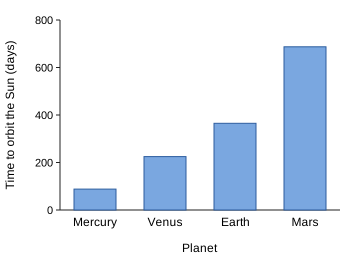
The further a planet is from the Sun, the longer it takes to orbit the Sun. Mercury (nearest) takes 88 days; Neptune (furthest) takes 164.8 years.
Rotation
All planets rotate on their axes at different tilts. Most rotate from west to east; Venus rotates east to west and Uranus rotates on its side (axis tilted 98°).
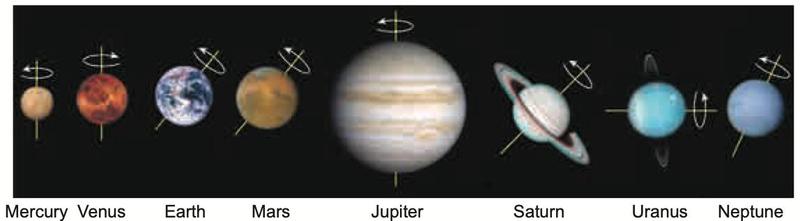
Planet tilts: textbook Figure 12.3, p. 260.
Show answerHide answer
12.4The Earth and its Moon; "what if" situations
- The Moon rotates on its axis and orbits the Earth in about the same time (about 27 days), so the same side of the Moon always faces the Earth.
- The Earth is about four times bigger than the Moon, so the Earth would look much larger in the Moon's sky.
If the Earth rotated slower or stopped
- The length of day and night would be longer in different parts of the Earth.
- The side facing the Sun would become hotter and drier, with more deserts.
- The side facing away from the Sun would get colder because it receives no sunlight.
- The high and low tides would change.
Show answerHide answer
12.5The Earth: the planet for life
The Earth is the only planet known to have life. It has these features.
- Plenty of water for the life processes.
- Enough oxygen in the air for respiration.
- A suitable temperature range, not too hot or too cold.
- Sunlight for plants to carry out photosynthesis.
- An atmosphere that blocks harmful ultraviolet rays.
- Suitable gravity that keeps objects and the atmosphere from floating away.
Ecological footprint
If our footprint is larger than the Earth can renew, resources will run out. We can reduce it by recycling, saving energy and water, and wasting less food.
Show answerHide answer
Summary
| Remember | Key fact |
|---|---|
| 1 A.U. | 1.5 × 10⁸ km, the Earth–Sun distance |
| 1 ly | 9.5 × 10¹² km, the distance light travels in a year |
| Order of planets | Mercury, Venus, Earth, Mars, Jupiter, Saturn, Uranus, Neptune |
| Hottest planet | Venus (greenhouse effect), not Mercury |
| Orbit time | Longer for planets further from the Sun |
| Rotation | West to east, except Venus (east to west) and Uranus (on its side) |
| Gravity | Depends on mass and density; highest on Jupiter |
| Earth for life | Water, oxygen, temperature, sunlight, atmosphere, gravity |