Science questions, chapter 12
Nama / NameKelas / ClassTarikh / Date
Solar system
44 marks. Use Practice to check each answer as you go, or Exam to answer everything against the clock first.
Section A: objective questions
12 marksChoose the best answer for each question.
1
Question 1
Which planet is the closest to the Sun?
Show answerHide answer
A
Mercury is the closest planet to the Sun, about 57.9 million km away (textbook p. 254).
2
Question 2
Which planet is known as the ‘greenhouse’ planet because of the high content of carbon dioxide in its atmosphere?
Show answerHide answer
C
Venus has an atmosphere that is about 96.5% carbon dioxide, which traps heat.
3
Question 3
What is one astronomical unit (1 A.U.)?
Show answerHide answer
B
1 A.U. is the average Earth–Sun distance, 1.5 × 10⁸ km. The distance light travels in one year is a light year.
4
Question 4
Why are astronomical units and light years used to express distances in the solar system?
Show answerHide answer
D
Distances between the planets and the Sun are very great, so larger units give smaller, easier numbers.
5
Question 5
A planet is 7.5 × 10⁸ km from the Sun. What is its distance in A.U.? (1 A.U. = 1.5 × 10⁸ km)
Show answerHide answer
C
7.5 × 10⁸ ÷ 1.5 × 10⁸ = 5.0 A.U.
6
Question 6
A star is 2 light years from the Sun. What is the distance in km? (1 ly = 9.5 × 10¹² km)
Show answerHide answer
A
From ly to km you multiply: 2 × 9.5 × 10¹² = 19 × 10¹² = 1.9 × 10¹³ km.
7
Question 7
Venus rotates from east to west. What would an observer on Venus see?
Show answerHide answer
D
Venus rotates in the opposite direction to the Earth, so the Sun rises in the west and sets in the east.
8
Question 8
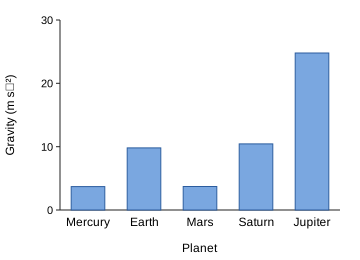
Diagram 1 shows the gravity on the surface of five planets. Which statement is correct?
Show answerHide answer
B
24.79 ÷ 9.8 = 2.5, so Jupiter's gravity is more than twice the Earth's. Mercury (3.7) is slightly lower than Mars (3.71), Saturn (10.44) is higher than the Earth, and Jupiter is the highest.
9
Question 9
The side of Mercury that faces the Sun is above 427 °C, but the dark side falls to −173 °C. Why?
Show answerHide answer
A
Without an atmosphere, the sunlit side heats up strongly and the dark side loses heat, so the temperatures are extreme.
10
Question 10
Venus is further from the Sun than Mercury, but its surface temperature (462 °C) is higher than the average temperature of Mercury. Which factor explains this?
Show answerHide answer
C
Carbon dioxide in the thick atmosphere of Venus causes a greenhouse effect that traps heat. This is an anomaly in the pattern that nearer planets are hotter.
11
Question 11
Why does the same side of the Moon always face the Earth?
Show answerHide answer
B
The Moon rotates once on its axis and orbits the Earth in about 27 days, so we always see the same face.
12
Question 12
Which of the following is NOT a reason why the Earth can support life?
Show answerHide answer
D
The Earth's air is mostly nitrogen (78%) and oxygen (21%). An atmosphere with a very high carbon dioxide content, like that of Venus, does not support life.
Section B: structured questions
32 marksAnswer all questions. Write your answers in the spaces provided.
13
Question 13
Choose the planet that matches each description.
[1 mark]
(a)Known as the ‘Red Planet’.
Show answerHide answer
Mars
Mars has reddish dust and sand on its surface.
[1 mark]
(b)The largest planet in the solar system.
Show answerHide answer
Jupiter
Jupiter's mass is almost 320 times the Earth's.
[1 mark]
(c)Rotates on its side because its axis is tilted at about 98°.
Show answerHide answer
Uranus
14
Question 14
Jupiter is 7.78 × 10⁸ km from the Sun. (1 A.U. = 1.5 × 10⁸ km; 1 ly = 9.5 × 10¹² km)
[2 marks]
(a)Calculate the distance of Jupiter from the Sun in A.U.
Show answerHide answer
Tick each point you got.
[2 marks]
(b)Calculate the distance of Jupiter from the Sun in light years.
Show answerHide answer
Tick each point you got.
[1 mark]
(c)Neptune is 30 A.U. from the Sun. Calculate its distance in km.
Show answerHide answer
Tick each point you got.
15
Question 15
Most planets rotate from west to east.
[2 marks]
(a)Name the two planets that do not rotate in the same way as the others.
Show answerHide answer
Tick each point you got.
[2 marks]
(b)State the direction in which the Sun appears to rise on the Earth, and the direction in which the Earth rotates to cause this.
Show answerHide answer
Tick each point you got.
16
Question 16
Diagram 2 shows the gravity on the surface of five planets. The relative mass of Mars is 0.107, of Saturn 95.159 and of Jupiter 317.8 (Earth = 1).
[1 mark]
(a)Explain why the gravity of Mars is lower than the gravity of the Earth.
Show answerHide answer
Tick each point you got.
[2 marks]
(b)Saturn has a mass about 95 times that of the Earth, but its gravity is only slightly higher than the Earth's. Explain why.
Show answerHide answer
Tick each point you got.
[2 marks]
(c)How many times is the gravity of Jupiter greater than the gravity of the Earth? Give your answer to 1 decimal place.
Show answerHide answer
Tick each point you got.
17
Question 17
The table shows the distance of three planets from the Sun and the time each takes to orbit the Sun.
| Planet | Distance from the Sun (million km) | Time to orbit the Sun |
|---|---|---|
| X | 149.6 | 365 days |
| Y | 227.9 | 687 days |
| Z | 778.3 | 11.9 years |
[1 mark]
(a)State the relationship between the distance of a planet from the Sun and the time it takes to orbit the Sun.
Show answerHide answer
Tick each point you got.
[2 marks]
(b)Planet X is the Earth. Which planet, Y or Z, has the higher temperature? Give a reason.
Show answerHide answer
Tick each point you got.
[1 mark]
(c)Calculate the number of days Planet Z takes to orbit the Sun. (1 year = 365 days)
Show answerHide answer
Tick each point you got.
18
Question 18
Hakim says, “Mercury is the hottest planet in the solar system because it is the closest to the Sun.”
[3 marks]
(a)Is Hakim correct? Give two reasons for your answer.
Show answerHide answer
Tick each point you got.
[1 mark]
(b)Venus is similar to the Earth in size and density, yet it has no living things. Give one reason.
Show answerHide answer
Any 1 points
Tick each point you got.
19
Question 19
Scientists want to know whether another planet could replace the Earth if its resources are used up.
[3 marks]
(a)State three characteristics a planet must have to support life like the Earth.
Show answerHide answer
Any 3 points
Tick each point you got.
[2 marks]
(b)Predict two effects on the Earth if it stopped rotating.
Show answerHide answer
Any 2 points
Tick each point you got.
[2 marks]
(c)Suggest two actions you can take to reduce your ecological footprint.
Show answerHide answer
Any 2 points
Tick each point you got.