Stars and galaxies in the universe
What this chapter covers
- Define a galaxy and name the three types of galaxy with examples (11.1.1)
- State where the solar system is located in the Milky Way (11.1.1)
- Describe the birth of a star from a nebula and the death of stars of different sizes (11.1.1)
- Compare the relative sizes of the Earth, solar system, Milky Way and universe (11.1.1)
- Classify stars by colour, temperature, size, brightness and distance from Earth (11.1.2)
- Relate the colour of a star to its surface temperature, including the Sun (11.1.2)
11.1Stars and galaxies in the universe
Technology helps us to see space more clearly. The Hubble space telescope, launched on 24 April 1990, is so powerful that it could see a coin from 725 km away. Dato' Dr. Sheikh Muszaphar Shukor was the first Malaysian in outer space (10 October 2007).
Galaxies (11.1.1)
There are millions of galaxies in the universe. They have different forms.
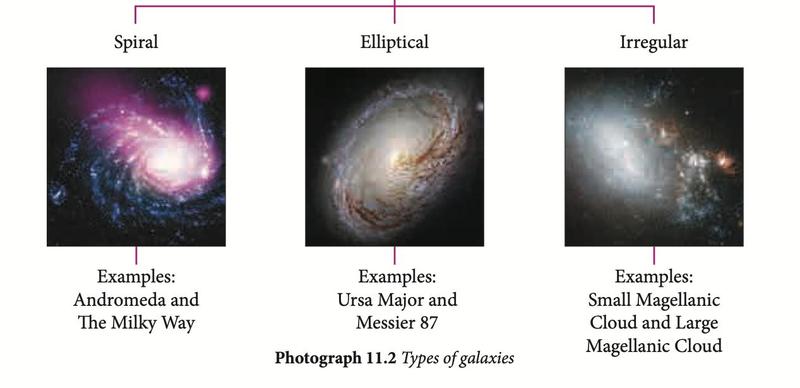
Textbook figure: Science Form 2 (DLP), Photograph 11.2, p. 241.
| Type | Examples |
|---|---|
| Spiral | Andromeda, the Milky Way |
| Elliptical | Ursa Major, Messier 87 |
| Irregular | Small Magellanic Cloud, Large Magellanic Cloud |
The Milky Way
- The Milky Way is a medium-large spiral galaxy.
- It has about 200 billion stars. The Sun is one of them.
- Our solar system is at the edge of one of the spiral arms of the Milky Way.
Relative sizes in the universe
From smallest to largest: Earth, solar system, Milky Way, a group of galaxies, a cluster of galaxies, the universe. Compared with the universe the Earth is smaller than a speck of dust.
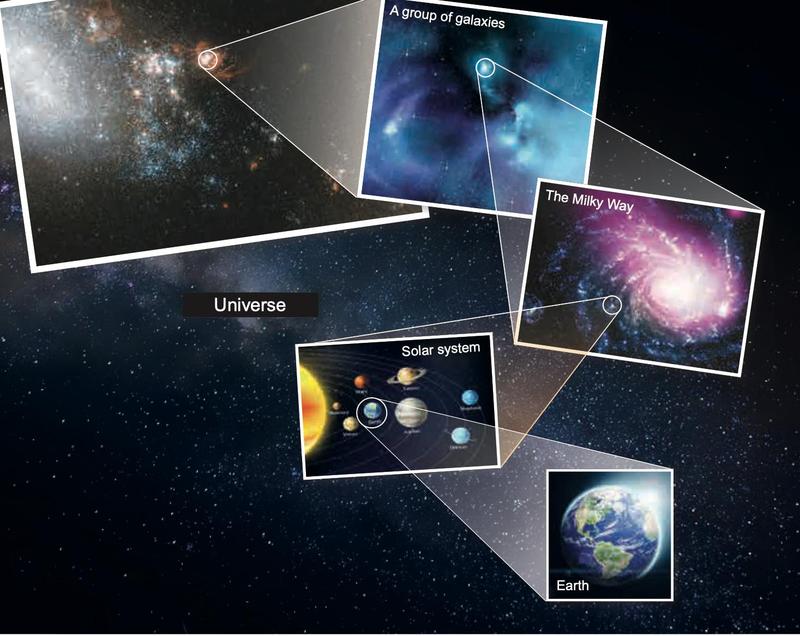
Textbook figure: Science Form 2 (DLP), Figure 11.2, p. 244.
Show answerHide answer
Life cycle of a star (11.1.1)
Birth of a star
- Gravitational force pulls the gas and dust in a nebula together into a globe.
- The globe shrinks and is compressed into a very dense core, because gravity gets stronger as it shrinks.
- The temperature and pressure in the core become very high, so a nuclear reaction starts: hydrogen turns into helium and a huge amount of heat and light is released.
- The core shines. The new star is called a protostar. It becomes an average star like the Sun or a massive star.
Death of a star
Heat from the star heats its outer layer, and hydrogen there begins to burn. The star expands and looks red: it is a red giant. What happens next depends on the size of the original star.
| Original star | Stages | End product |
|---|---|---|
| Medium-sized (e.g. the Sun) | Nebula, star, red giant | White dwarf |
| Large | Nebula, star, red giant, supergiant, supernova | Neutron star |
| Super-large | Nebula, star, red giant, supergiant, supernova | Black hole |
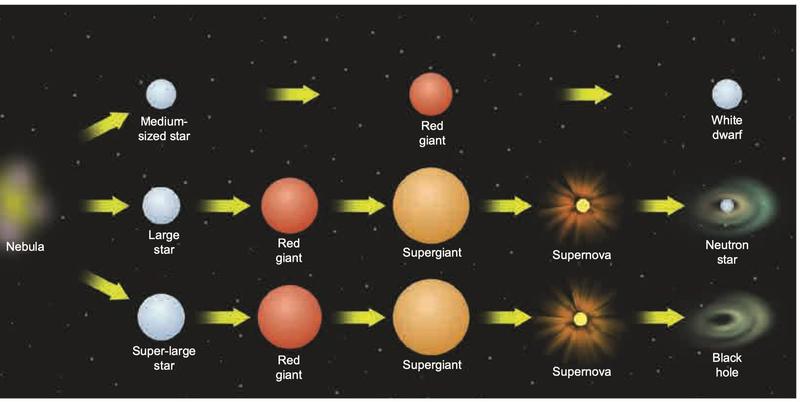
Textbook figure: Science Form 2 (DLP), Figure 11.1, p. 242.
- A supernova is a very big explosion of a red giant that is big enough. It is extremely bright and can be seen in daylight.
- A black hole is so named because light cannot escape from it, and any matter that enters it cannot escape either.
Show answerHide answer
Characteristics of stars (11.1.2)
Stars can be classified by their colour, temperature, size, brightness and distance from Earth.
Colour and surface temperature
The colour of a star shows its surface temperature. Blue stars are the hottest and red stars are the coolest.
| Colour | Surface temperature (K) |
|---|---|
| Red | below 3 500 |
| Orange | 3 500 – 5 000 |
| Yellow | 5 000 – 6 000 |
| Yellowish-white | 6 000 – 7 500 |
| White | 7 500 – 11 000 |
| Bluish-white | 11 000 – 25 000 |
| Blue | above 25 000 |
9 000 K lies between 7 500 K and 11 000 K, so the star is white.
The Sun is a yellow star. Its surface temperature, about 5 500 K, lies in the yellow range.
Size and brightness
- By size, stars are supergiant (the really big ones), giant and dwarf (the really small ones).
- The brightness of a star depends on its size, its distance from Earth and its surface temperature.
- Sirius and Rigel are the brightest stars in the sky.
| Characteristic | What it tells us |
|---|---|
| Colour | Surface temperature of the star |
| Size | Dwarf, giant or supergiant |
| Distance from Earth | Nearer stars look brighter |
| Brightness | Depends on size, distance and temperature |